Categories
Hens Protecting Your Backyard Birds raising happy, healthy chickens Roosters

How Many Hens Should You have per Rooster

Since this blog’s inception, I’ve brought up ratios of hens to roosters many times. But depending on which website you visit, and whether you’re wanting chicks, there are conflicting proportions. So today, I’ll officially answer how many hens should you have per rooster. Further, we’ll also explore chicken mating, and possible problems associated with it.

I’ve seen ratios anywhere from 6 hens per rooster to double digits. Plus, the literature indicates some breeds mate more aggressively than others. However, when I tried to find out which breeds exactly, only aggressive chicken breeds showed up; not aggressive mating chicken breeds.

How Many Hens Should You have per Rooster

mixed flock of ducks and chickens outside
Bakugo is the white duck making a b-line to Megatron. She always finds a way to spend time with him.

The smallest proportion I read of implied that you could safely have one rooster with 2 to 3 hens, if you so choose. Although the quotation specifically highlighted that the birds were adults, not juveniles.

Though I disagree with this quota for a few reasons:

  • First, chickens are considered adolescents until they reach ~ 17 weeks.

It’s at this point that backyard birds become sexually mature, which means they can breed, start to lay eggs if hens, or fertilize them if roosters.

I have had 5 real roosters, since the first 9 didn’t count. And all of them, including the adult males, tread hard on the gals until the boys are around 3 or 4 years old.

For instance, Casanova, our first real roo, just started to be gentle before he died at ~ 3 years old. I imagine he was gentle because he was older and lighter; not because he was an adult. (He was the smallest rooster, and probably chicken, we had.)

And now my current senior rooster, Megatron, has slowed down considerably since I first got him. He is now over 5 years old, and in the past couple of years, he has become a more gentle lover to his girls.

But it’s at this specific age that a rooster’s chances of fertility decreases.

  • And lastly, I have over 30 adult hens, ~ 8 juvenile hens, and 2 adult roosters, one whom I informed you has slowed down.

So Megatron’s son, Tiny Nuts, who is around 1 – 2 years old is the main roo servicing the gals. And he has currently torn up maybe 10 hens’ backs; all in different conditions. Some with a few feathers out, some with a lot of feathers out. And some hens with back and head feathers out. All by himself, while he has mostly 30 hens to himself. And we’re supposed to believe that this adult is considered gentle? Yeah, I’m not buying it either.

Chicken Romance

Before I answer the main question, I’m going to dissect the courtship of chicken romance. It’s certainly different than human romance.

Cockerels first ready to mate are all over the place, running hither and yon from one hen to the next, all because they’re trying to sneak some nookie in behind the boss’s back. And they’re uncoordinated, rough, and generally look like they don’t know what they’re doing. Plus, the girls are all taken by surprise. And some of the hens are older than those boys and don’t want to be ridden by another roo.

However, as the cockerels mature into adults, they pick up some tricks to wooing the hens. They include

This is where the rooster will find a treat and make the look, look, look noise to attract a hen, all in the hopes of garnering her favor.

  • and dancing

Most people are familiar with the rooster dance. And it’s where the rooster drops one wing to the ground as he shuffles around the hen whom he’s interested in. Typically at the end of the dance he’ll try to mate with her.

Although some roosters aren’t interested in performing any tricks to woo the hens. They’re all business and just take charge. Casanova was really good about wooing the hens; I like to think it was because he was so small, and so needed to make a good impression. And Tiny Nuts is good about wooing. But that could be due to him being the bottom roo. On the other hand, Megatron could care less about that kind of stuff. He’s the boss.

Chicken Mating
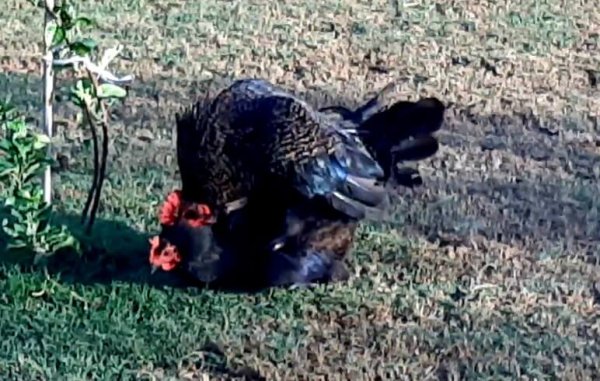
2 chickens mating on grass outside
Baby Nay caught in the act.

Consider this a biology lesson in chicken procreation. But I’m sure it’s nothing you’ve never seen before. And generally chicken sex is fast, lasting no longer than a few seconds.

Typically, in a willing partner, the rooster will go up to the hen, and she will squat for him. Then he will grasp her neck feathers with his beak as he climbs onto her back, balancing himself with his feet. This act is referred to as treading. Roosters have no outward appendages; everything is internal. So both of their cloacas must touch in order for him to transfer his sperm, in what is known as the cloacal kiss. And once they are finished, both shake themselves. Plus, he doesn’t thank her for her time, give her a kiss, or even a backward glance before he’s on toward the next possible hen.

In addition, rooster’s sperm can last about 2 weeks inside of one hen. And if she’s a healthy hen that lays daily, that should equal about 14 fertilized eggs. But it takes about 25 hours for the sperm to fertilize the next egg in the hen’s body. Also, interestingly enough, hens can store sperm from more than one rooster at a time. And a single rooster can mate up to 30x a day, producing as much as 35,000 sperm every second of his life, which is 40x more sperm than a human male.

Potential Problems with Chicken Mating
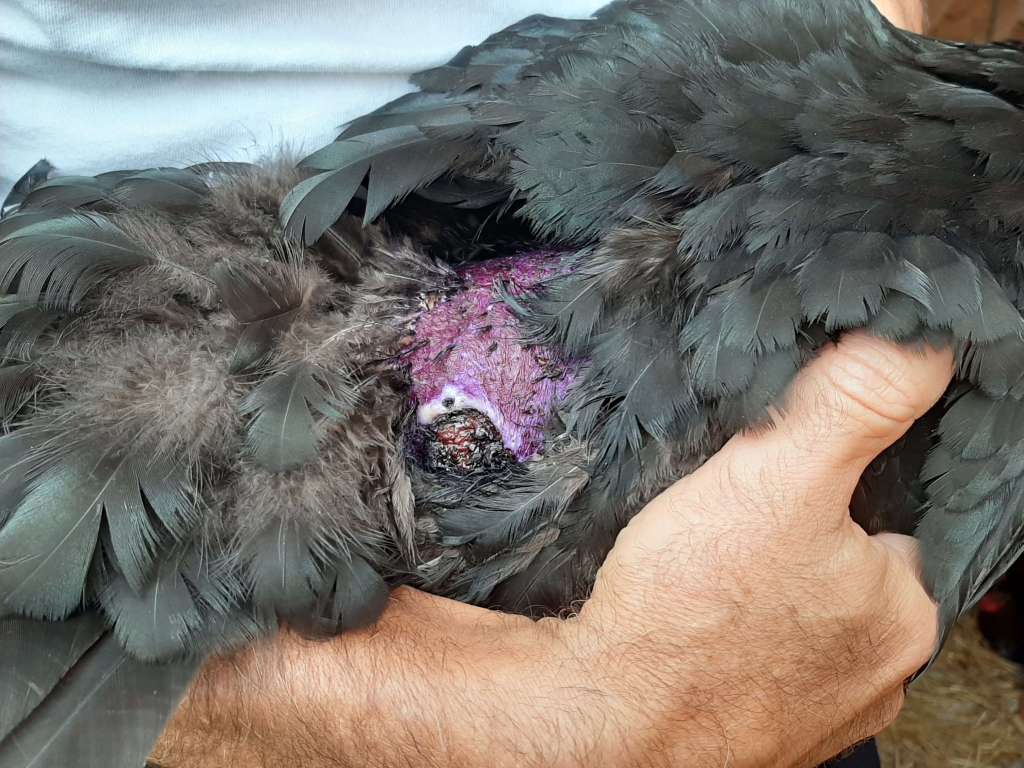
purple stain on laceration on black chicken's back
Baby Nay did this to his favorite hen when we had him. Well, she ended up going broody, and we locked him in rooster jail; so she was able to heal perfectly without any more assault.

I already explained what it looks like with sexually mature cockerels. But if you have several, it will look like chicken gang rape, I kid you not. And the boss rooster won’t be able to control it. He may even join in to show his dominance, however the gals are the ones to suffer. That’s what Casanova did with every one of his 7 sons the first time we incubated eggs. I guess, he decided, if he couldn’t beat them, he’d join them.

Other signs of mating issues include

  • missing back feathers on hens’ backs
  • missing neck feathers from hens’ necks
  • skin lacerations where feathers are missing
  • and fights consistently breaking out between roosters

If you see any of the above, then it’s time to do something about your chicken mating situation.

Ok, So, How Many Hens Should You have per Rooster
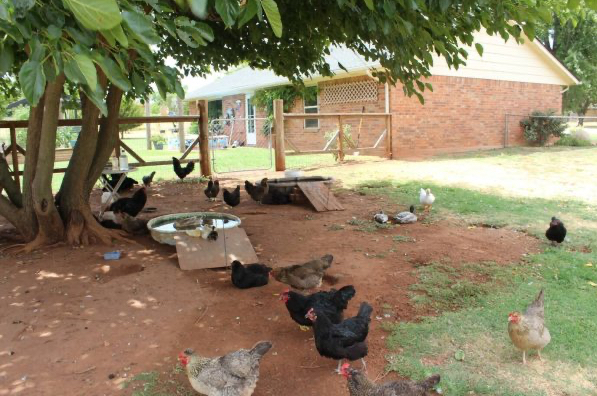
mixed flock of domestic birds under a shade tree with kiddie pools

All right, so having only 2 to 3 hens per rooster is not feasible, because we learned that even though roosters are considered adults after their first molt (~ 1 year old), they don’t settle down until they’re around 2 or 3 years old. That’s when they mellow with the ladies and start treating them right. At least that’s been my observation with all of my roosters: a small Cream Legbar and all of my Ameraucana and Easter Egger roosters, all of whom are considered docile.

Therefore, if you’re seeing any issues with your hens then

  • put a limit on the number of roosters

Roosters are highly virulent until they reach ~ 3 to 5 years of age, which means they may mate aggressively until they start to slow down. They don’t even have to be an aggressive breed: case in point, my roosters. None of mine are considered aggressive breeds. Yet they still tear up my hens, no matter how many I have available for them.

So what’s the magical number? I personally think 6 is too small. Your hens will get damaged with 1 rooster per 6 hens apiece. Therefore, the more the merrier, if you can spare them. However, if you’re wanting to specifically breed your birds, then it’s recommended to have 10 hens per rooster, in order to maintain fertility.

  • separate the injured hens

Any hens with lacerations should be kept out of the breeding pool until they have healed. And apply Vetericyn or Gentian Violet Spray .5% daily. Plus, once they’re better, and feathers have started to grow, place a chicken saddle on their backs to prevent any more issues.

Many sites recommend putting the saddles on before the hens have healed. Though I noticed the feathers on our hens never grew back unless and until the saddles were off. Thus, the separation of the rooster(s) and injured hen(s).

  • isolate the roosters until needed for breeding

If you’re wanting fertilized eggs, or to breed your flock, keep your roosters separate from your hens in a distinct enclosure. In this way your hens won’t be misused.

To Summarize
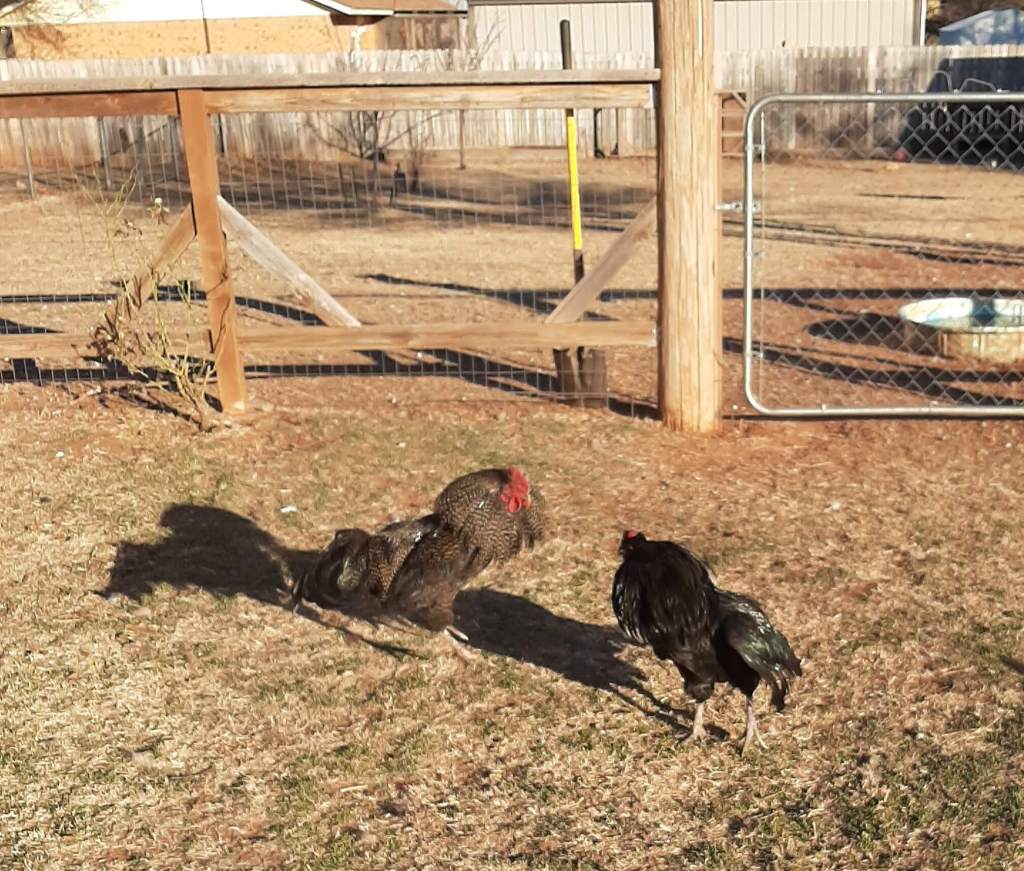
one spotted olive egger rooster and one black Ameraucana rooster fighting outside

We learned that roosters are highly virulent, and therefore, mate aggressively until they’re about 3 years old. And because of that, it’s best to have at least 10 hens per rooster if you’re breeding them. Less than that, the roosters will definitely injure your hens with feathers torn out and back lacerations. Furthermore, we learned all about chicken romance and mating. And also that if there aren’t enough hens per rooster, not only will the hens be at risk for injury, but the roosters will constantly fight.

How many hens do you have for your roosters? And how do they get along? Your comments are appreciated.

If you enjoyed this post, please like, share, and please don’t forget to follow!
Categories
Chicks Hens Protecting Your Backyard Birds raising happy, healthy chickens Roosters

Chicken First Aid Kit Contents

I’ve been an animal lover for 4 decades. But it wasn’t until 2015, or since chickens, that we started collecting what would be considered animal first aid items. If you have backyard birds long enough, sooner later, something will pop up, requiring you to have a few essentials. Thus, I thought it would be helpful to share some basic chicken first aid kit contents.

From the moment we’ve had dogs and cats, we’ve never had to perform any type of first aid on them. On the other hand, our fur babies have a veterinarian, whereas our feather babies do not. And unfortunately a lot of the advice online can be contradictory. Plus, some issues necessitate quick action. Therefore, we’ve had to learn how to take care of our birds ourselves. In addition, when we started out, we had a small flock. So, little by little, we began adding items to what became our chicken first aid kit.

Chicken First Aid Kit: The Container

chicken first aid kit with assortment of bandaids, scissors, electrolytes, etc, in a blue and clear plastic box

When we first started making our kit, little did we know that’s what we were doing. Hence, ours was in our medicine cabinet, until one day it was gigantic and no longer fit. Now we have everything in a tackle box that’s easy to locate and move. So get a caboodle, makeup box, or a tackle box. But make sure it’s

  • Portable
  • Within easy reach
  • And easy to carry

Chicken First Aid Kit: Chicken Hospital

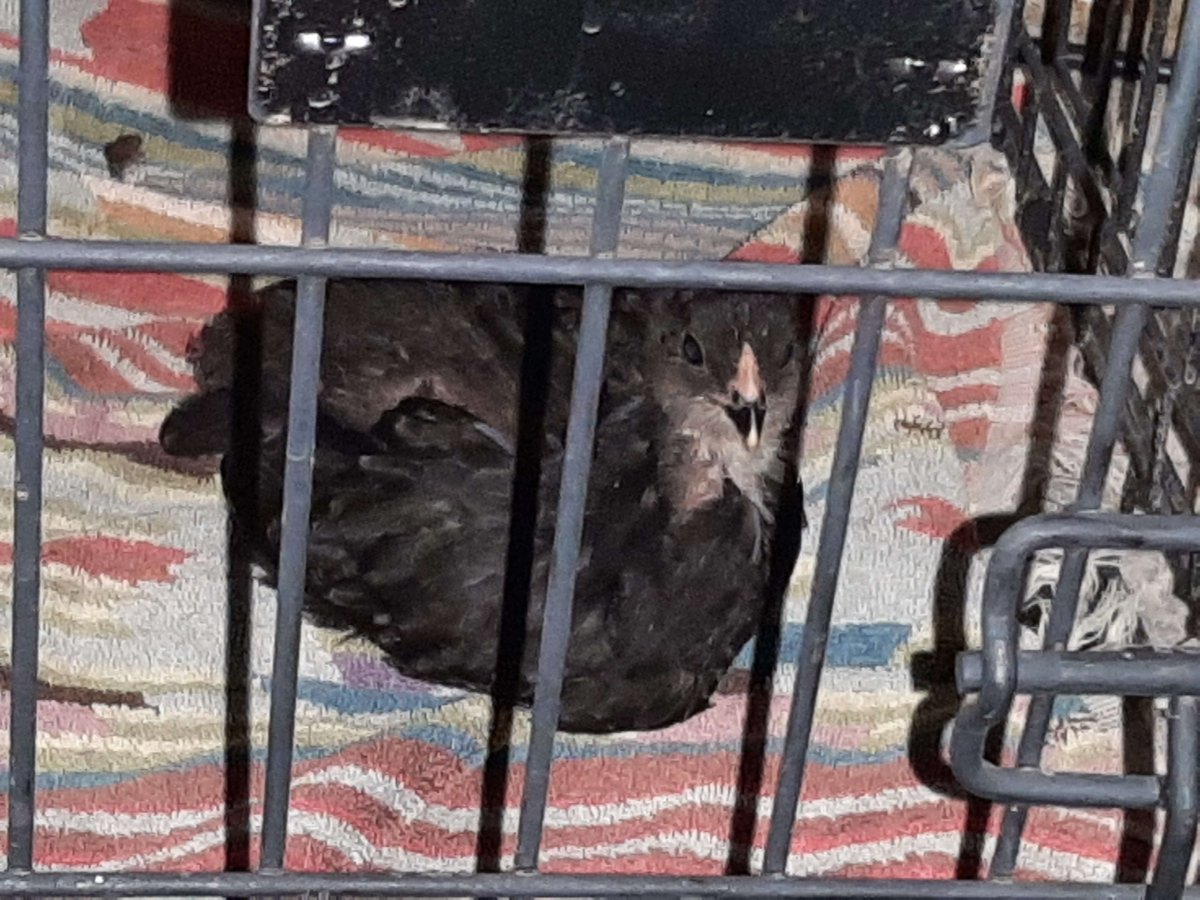
black metal pet crate with old towel on top of it

Since most injuries and illnesses require separating the chicken from the flock, this is where you will house them until they are well enough to mingle back with the flock. Ideally you need

  • A pet crate or carrier

If possible, make sure the chicken hospital is big enough for the patient to be comfortable during their stay.

  • And old towels

Towels you no longer use are to help make the patient comfortable.

Some injuries aren’t serious enough to warrant total isolation from the flock. For example, if you have a hen with sores on her back from an overeager rooster, then she can stay in the the safety of the crate while still in the coop. That way she won’t worry about pecking order issues.

But more concerning problems of contagious illnesses demand the chicken be separated to prevent spreading the illness. Further, urgent medical issues require the bird to be isolated to help calm them down.

Online discrepancies abound, regarding whether to leave the chicken patient in the coop or isolate them. And both have valid reasons for their points. Personally, I’ve done both, depending on the nature and/or seriousness of the issue. But all the times I’ve kept my chicken patients away from the flock, they’ve been calm, and they didn’t seem lonely. In addition, my reasons were justified for keeping them isolated.

Chicken First Aid Kit: Disposables

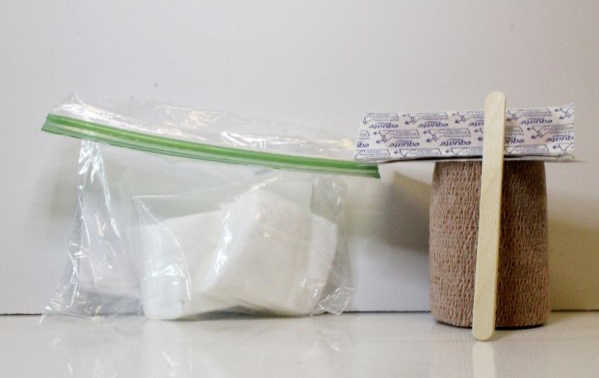
cotton 2x2s, Coban, bandaids, and popsicle stick

When I made this list, I really wasn’t sure how to itemize it. As you’ll notice, some of these things can go in multiple categories. Plus, you potentially have some materials in your house now, which can also be taken from your own first aid kit; just be sure to replace anything you swipe from your personal kit. However, for the disposables, you need

  • Q-tips
  • Non-stick gauze
  • Disposable gloves
  • Coban or vet-wrap
  • Bandaids
  • And popsicle sticks for splints

Chicken First Aid Kit: Dealing with beaks, nails, and spurs

battery-powered nail file and superglue

Rather than putting these few items in their prospective categories, I just made their own section. Further, they all use the same supplies, such as

  • Dremel tool or other battery-powered tool
  • Superglue
  • And styptic powder or alum

Chicken First Aid Kit: Tools or Instruments

box of assorted sutures, hemostats, scissors, and surgical forceps

Once again, some of these you should have in your medicine cabinet. Although, with the rest of these items, we collected from various trips to the emergency room for sutures. And since hospitals just throw suture kits away after using them, we asked if we could keep ours. The rest I ordered. Therefore, in your kit you should have

  • Tweezers
  • Scissors or surgical grade scissors
  • LED headlamp
  • Surgical forceps
  • Hemostats and resorbable sutures
  • And disposable scalpels

Chicken First Aid Kit: Antiseptics

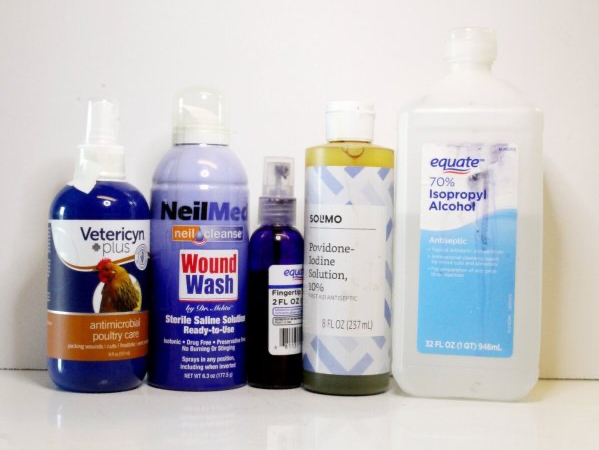
assortment of antiseptics and poultry first aid care

With the exception of rubbing alcohol, I had to order all of the items in this section, at one time or another. So make sure you have

  • Rubbing alcohol (to sanitize instruments)
  • Gentian violet .5%
  • Iodine
  • Sterile saline (for washing wounds)
  • and Vetericyn

Chicken First Aid Kit: Anti-inflammatories and Salves

big bag of epson salt, almost empty bottle of astroglide, and tube of hydrocortisone

From having a hen who’s egg-bound to having one with sour crop to having another one with vent prolapse, the following is what you’ll need in your chicken first aid kit.

  • Salve or Vaseline (for mites or frostbite in the winter)
  • Epson salt (has many uses)
  • 1% hydrocortisone (for vent prolapse)
  • and a Water-based lubricant

Chicken First Aid Kit: Medicine, Vitamins, Electrolytes, and Pain Relief

assortment of poultry medicine and vitamins for illness and injury
  • Neosporin
  • Enfamil poly-vi-sol infant multi-vits (without iron)
  • Medicine dropper
  • Electrolytes
  • Probiotics
  • Vet-Rx (for respiratory issues)
  • Fishbiotics (which is amoxil 500mg, for surgical procedures like impacted crop)
  • **And topical anesthetic spray, like hospital formula benzocaine (also for the above mentioned surgery)

**There is some mis-information, and thus confusion on multiple sites as to whether you can give any anesthetic to chickens. For example, multiple sites claim you can’t give anything to chickens if it has caine on or in it. And that’s not true. In fact, I watched a Dr perform a surgery on a chicken, after he injected it with anesthetic. And as far as I know, all anesthetics contain caines. Further, the chicken did not die; she survived the surgery and the anesthetic.

However, the real issue is epinephrine, which is added to local anesthetics to prolong local anesthesia and prevent additional blood loss. Thus, in someone who might have heart issues, or a small animal, it could present problems. But because benzocaine is only a topical, it is clearly the better option for backyard chickens. You can read more about it here.

Chicken First Aid Kit: Advice

advice lettering text on black background
Photo by Anna Tarazevich on Pexels.com

The items you see in bold are some of the first, and only, items we used while first involved with chickens. Though now it has definitely grown and evolved. You too may also already have some things you use on and for your birds. So the materials in bold are a suggestion only, to have on-hand what you will eventually need.

My last bit of advice is when Googling your bird problems, read at least 3 other suggestions, and not necessarily the top 3. They might not be right. And after you’ve received 3 suggestions from Google, cross reference them. For instance, if I read that something won’t work or is harmful, I Google why that something won’t work, like what will happen, especially if there isn’t a link to the original article. You’ll be surprised by how many answers you get that will contradict what you were just advised.

Lastly, taking care of injured or sick chickens is just like anything else: it isn’t cookie cutter perfect. Nobody knows your birds better than you. You will have to adjust and use your intuition based on your understanding of your flock. These are all suggestions according to my experience with my flock. And it has worked for us. But I Google several sources, and not the most popular ones either, and adjust the care instructions to gear them toward my flock.

Have you made a chicken first aid kit? Or have you had to use first aid on a chicken? Your comments are appreciated.

If you enjoyed this post, please like, share, and please don’t forget to follow!

Categories
Extras recipes

Doctored Up Carrot Cake Mix

We celebrated Hannah’s birthday recently. Plus, she moved out, since she’ll be attending college in the Fall. So I wanted to try a doctored up carrot cake mix. And it was the best cake mix with add-ins so far.

I used carrots, of course. And I added in flaked coconut, raisins, chopped nuts, crushed pineapple and spices. Please enjoy.

Doctored Up Carrot Cake Mix Ingredients:

  • 2 boxes Carrot Cake mix (I used Duncan Hines)
  • 1 1/2 c buttermilk
  • 1/2 c flour
  • 6 large eggs
  • 2 egg yolks
  • 2/3 c melted butter
  • 2 tsp cinnamon
  • 1 tsp ginger
  • 1/2 tsp salt
  • 1 c grated carrots
  • 1 1/2 c shredded coconut
  • 8 oz crushed pineapple, drained
  • 3/4 c raisins
  • 1 1/2 c chopped nuts (I used almonds)
  • and 1 pkg of vanilla pudding
white frosted two layer cake on a cake stand

Carrot Cake Mix Instructions:

Preheat oven to 350°, and spray your pans with nonstick cooking spray. Alternatively you could grease and flour them.

  • First, combine your dry ingredients (cake mixes, flour, salt, and spices) in a mixing bowl.
  • Next, add eggs, buttermilk, melted butter. And mix on medium speed for ~ 1 minute, scraping the sides of the bowl.
  • Then fold in shredded carrots, coconut, nuts, and drained pineapple.
  • This makes ~ 8 cups of batter, which you’ll then pour into your prepared pans. And bake at 350° for 45-55 minutes. Check at 50 minutes, and a toothpick inserted in the center of the cake should come out clean.
  • Let the cakes cool completely before turning out and frosting with either cream cheese frosting, cream cheese whipping cream frosting, or even a buttercream frosting.
  • And finally, serve and enjoy.

This is a great cake to have really any time. But with all of the extra ingredients to the cake mix, it’s almost like homemade. If you made this, what did you think? Your comments are appreciated.

If you enjoyed this post, please like, share, and please don’t forget to follow!

Categories
Chicks ducks Hens other fowl Protecting Your Backyard Birds raising happy, healthy chickens Roosters

Can You Mix Ducks with Chickens

Chickens are often the first bird homesteaders will tackle before raising other livestock. They cite practical reasons: food, composting, and pest control. Since ducks are some of the smartest and hardiest, they debut on the farm after chickens. But before getting any birds, I’ll answer the question Can you mix ducks with chickens.

You can, in fact, raise chickens and ducks together. However, there are some slight differences with both kinds of birds. And, with careful consideration, you should have no problem mixing both. So, whether or not you’ve purchased any ducks, just continue reading.

Brooding Facts for Both Ducklings and Chicks

chick feed in a shallow dish with chicks in a brooder

Recently I wrote an in-depth article explaining how to raise ducklings and chicks together. So I’m only going to list the main points.

  • Provide the same feed for both

Contrary to popular belief, you can give medicated feed to ducklings, as I explained a short while ago. But no matter what, by the 3rd week, make sure the protein is no more than 18%, or your ducklings will be at risk for something called Angel’s Wing. And provide niacin in the form of brewer’s yeast, so the ducklings can thrive. (This needs to be provided lifelong in the duck’s diet.)

Also, regular chick fountains and nipple waterers work well with ducklings. However, shallow pans for feed are ideal due to their bills.

  • Similar brooder temperature for both

There is only a 5° difference between both birds when starting the brooding process. Therefore, just observe them to see whether they are cold or hot. If they huddle together, they’re cold. And if they move as far away as they can from the heat, then they are hot. And adjust accordingly.

  • Clean brooder daily

Both ducklings (and ducks) drink as they eat to prevent choking. And this causes a big mess in the brooder that needs to be cleaned on a daily, sometimes several times a day, basis.

  • Harassment

Depending on the number and breed of chicks and ducklings you have, could determine who does the bullying and who gets bullied. In my experience, our chicks have always done the bullying until they were juveniles. But by then, the ducks were much larger, thus the roles were reversed.

It’s definitely simpler to raise chickens and ducks on their own. However, it’s not unrealistic to raise them together either.

Teenager Ducks and Chickens

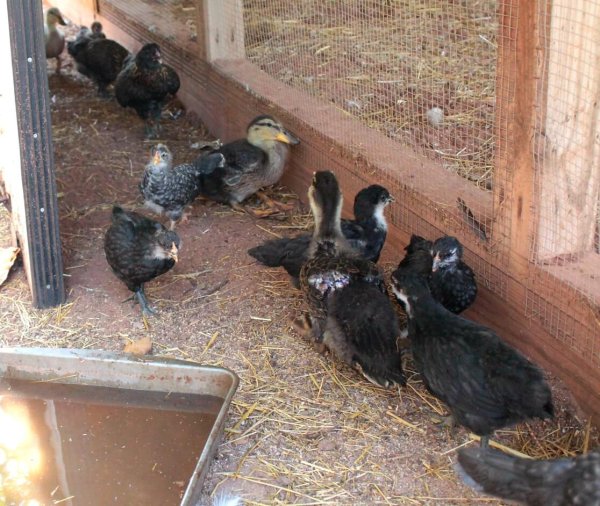
mixed flock of birds outside on dirt ground with blue triangle of feed

At this stage of development, your ducks and chickens are going through puberty. You know, their voices crack and they look fugly. In addition, you might notice your ducks bullying the chickens they once hung out with. But by the time they’re all adults, this behavior generally stops.

The 3 ducks we recently raised with our juvenile chickens bullied their brooder buddies. And they even tried to bully one of our cats. But that only lasted until the 2 juvie drakes were sold to someone in need of them, so the lone female no longer feels the need to bully. Thus, it’s the other way around again. Plus, when we raised Squirt, the boss drake, he was raised alone by me. Therefore, he really didn’t bully anyone, and no one bullied him. I’m still constantly learning about ducks. And I know I don’t know all there is to know about them.

Advice for Smooth Desegregation

kiddie pool with ice in the shade
This picture shows ice in the pool; and that’s due to the triple digit heat lately.

Depending on the time of year and temperature will determine when you move your newbies outside. For instance, if it’s spring and still chilly out, then wait till the chicks are ~ 5-6 weeks old. However, if it’s summer and hot in the evenings, like it’s been lately, you don’t necessarily need a heat lamp. But still wait for the chicks to get to 5-6 weeks old for size. Then you need to

  • Check your coop space

Ducks need twice as much space as chickens do. And if your chickens use a ramp to get in the coop, you might need to come up with something so the ducks can get in too.

Also, ducks don’t use nesting boxes. Therefore, just put some straw on the floor of the coop, and they’re fine.

  • Circulate the air in the coop

You likely already have your coop well ventilated with your existing flock. However, since ducks emit ~ 90% moisture, there needs to be adequate circulation in the form of predator-proof windows and air exhaust vents on the roof.

  • Gradually mix your new ducks and chickens with the established flock

Put your juvenile mixed birds in a pen where they and your primary flock can see each other without aggression for a few days to a week.

  • Provide water

This source of water is different from the drinking water. Though you will see both the chickens and ducks drinking from it. But if you don’t provide this water source for the ducks to bathe and preen their feathers, they can develop wet feather.

Mixing Adult Ducks and Chickens

a couple of chickens and ducks mixed in with kiddie pools outside under a big shade tree

Up to this point I’ve covered the basics from brooding ducklings and chicks together to integrating the juveniles with the adults. From the time the ducks are adults, they no longer hang out with the chickens they were raised with. Unless they happen to be eating, sharing snacks, or drinking together. Or unless you have a species-confused duck, like me.

Now it’s time to go over some final important details.

  • Continue to supply the same type of feed for ALL backyard birds

Once the ducks and chickens you raised are adults, they can eat layer feed like everyone else. And continue adding 1 TBSP brewer’s yeast to 1 cup of feed.

  • Carry on with same feeders and waterers

Since your duck-raised chickens are used to eating out of a shallow pan, continue that with the newbies. However, with your established flock, you can try keeping the technique you’ve been using. Though, if they start eating the newbies’ food, you may need to just switch everyone to the new method. And the same goes for their waterers.

  • Provide a watering hole

This is one of the most important points, because ducks not only love water, they need it. And not just drinking water either. They need access to a source of water to swim and bathe in. But again, it doesn’t need to be custom. You can just purchase a kiddie pool, and they will be content.

Also, when ducks swim, they poo; and they drink from this water source as well. And the chickens might too. So it needs to be changed at least twice daily.

At about this point, you might be wondering if chickens will drown in the kiddie pool. And the answer is debatable. Sure, chickens can’t swim like ducks. Plus, their feathers aren’t waterproof, and they lack webbed feet. But since they don’t like water the way ducks do, they usually only approach the watering hole to drink. From the time we’ve had our ducks and kiddie pool, no chickens have drowned. Though chicks should definitely be monitored.

Can You Mix Roosters and Drakes

black rooster stops by mixed mallard drake outside by a tree
In this picture, it looks like the 2 males are sharing a moment.

Given both roosters and drakes can be territorial, it’s only natural to wonder if you can have both at the same time. I usually only keep 2 adult roosters at any time. And they’ve never had a problem with the drake, whichever one I had, even when it was the sex-crazed Kirishima.

But it’s true that drakes might try to mate with hens. And this is usually the case when there aren’t enough females for the drakes. Just as there is a proper ratio for hens to roosters, there’s a proper ratio for ducks to drakes. Proper in this sense maintains harmony in the flock.

Therefore, to prevent abuse to your hens and ducks, and any fighting between roosters and drakes, provide enough females for both. You will find various recommendations on this subject. But I advise you to err on the side of caution, especially regarding mating season and drakes. Each rooster needs ~ 10-12 hens, while drakes require ~ 3-6 ducks each. You know what they say? The more the merrier.

What About Flock Dynamics

mixed flock of ducks and chickens outside near 2 kiddie pools under shade tree

Now that you’ve hypothetically (or realistically) integrated ducks into your flock, has the pecking order changed? Did you notice whether the ducklings, then juvenile ducks had a hierarchy remotely similar to the chickens?

Most duck lovers agree, me included, that ducks have a pecking order. Though it’s way laid back compared to chickens: they may chase, peck at (in their own way), or quack at someone. But usually the group doesn’t gang up on that someone, like chickens do.

In addition, the boss in each group is the male. But if there are 2 roosters, it is generally the senior rooster, unless he is weaker or has been challenged and fallen from grace. Drakes are different. The senior drake is more concerned with mating, from what I’ve observed, and so that influences most things. We had 2 juvenile drakes recently and Squirt ignored them; he’s only interested in the females. However, I’m happy to report, he hasn’t killed any ducks, unlike his predecessor. And the juvenile drakes, from what I observed, were just living life, being kids.

Also, my roosters stay away from Squirt, although I’m not sure why. But then, they stay away from the ducks altogether; almost pretend like they’re not there. On the other hand, Squirt will get in Megatron’s face and yell at him only when Bakugo is flirting with him. Thankfully they haven’t come to blows yet.

So, Can You Mix Ducks with Chickens

6 different types of ducks under a tree near a fence

While raising chicks and ducklings together can be difficult, it’s not theoretical. Plus, they form a unit until they become adults. And at that time they tend to stay with their own kind. Once adults, they might ignore one another, but they don’t squabble or fight each other. Furthermore, males of both groups are boss of the yard. However, if there was ever any contest, the drake would be the clear winner. Though it’s the duck’s callous disregard of the pecking order that makes one think they don’t even have one. But they do, in their own duck-ish way.

I sincerely hope I’ve answered any questions you might have had about mixing ducks with chickens. Do you currently have any ducks? Or are you thinking about adding any? Your comments are appreciated.

If you enjoyed this post, please like, share, and please don’t forget to follow!
Categories
Extras recipes

Egg Burritos

Egg burritos can be very diverse. You can make them with beans, pork, or chicken. And you can top them with a variety of choices. However this recipe is really quite simple. Although, you can spruce it up if you want to. But it tastes quite good on its own.

Ingredients for Egg Burritos

  • 8 eggs
  • ~ 1/4 cup whipping cream
  • 6 La Tortilla Factory light flour tortillas
  • 1/4 tsp salt
  • 1/8 tsp pepper
  • 2-3 tbsp salted butter
  • ~ 3-5 oz queso fresco cheese
  • 2-3 oz of guacamole
scrambled eggs and white cheese in a frying pan on stove

Instructions for Burritos

  • First, beat eggs in bowl; add whipping cream and beat some more. Then beat in salt and pepper.
  • Next, melt 1-2 tbsp of butter over medium heat. Add 1 tbsp more of butter just before pouring egg mixture.
  • Then scramble eggs till light and fluffy. Add cheese before eggs are completely done.
  • Remove pan from heat. And microwave the tortillas, and then assemble burritos; top with guacamole.

Thank you for reading this post. If you made this recipe, please let me know what you thought.

If you like this post, please like, share, and please don’t forget to follow!

Categories
Chicks Hens raising happy, healthy chickens

What Does Hybrid Chicken Mean

If you have a rooster and a mixed flock of chickens, then it’s possible you might someday get a hybrid. Not long ago I wrote a post mentioning that hybrid chickens were some of the best egg layers. However, they’re also great for beginners. But just what does hybrid chicken mean?

Since a breed is something that produces offspring with similar characteristics, there are no hybrid chicken breeds. That’s because hybrids don’t breed true, meaning the traits they were bred for won’t be passed down. Also, hybrids have been around for quite some time. Although, before they were given their current appellation, they were called crossbreed, or worse, mongrel.

Originally poultry farmers would cross 2 or more purebred chickens, resulting in a crossbreed. And those same farmers discovered that some of those mongrels laid more eggs. Or they were better suited for meat production. Then, in 1936, Henry Wallace created Hy-Line poultry genetics in Iowa.

The breeds usually used in crossbreeding are Rhode Island Red, Light Sussex, and Leghorns. While some of today’s hybrids can be composed of 3 or 4 breeds, sometimes the parents are also crossbred, going back generations. Thus a hybrid chicken may look slightly different from how it first began. Now it’s a well-oiled machine.

Punnett squares of parent's genes in purple and pink writing
Digital Art of Chicken Punnett square, Courtesy of Sarah Smith.

Typical Traits of a Hybrid Chicken

The following list is characteristic when buying hybrids from hatcheries or farm stores. Most hybrids

  • mature fast
  • can be sex-linked, so you know you’re getting hens
  • lay ~ 260 to 320 eggs annually
  • are easy going and docile
  • have a short lifespan compared to pure breeds
  • don’t go broody
  • also can be dual purpose, for meat
  • and egg quality and quantity of most hybrids deteriorates after ~ 3 to 4 years

Examples of Hybrids

  • Meat hybrids
little girl holding one white adolescent chicken while another one is on the grass and sheltie is watching

The companies that developed these birds initially used strains from birds like Cornish Game, Light Sussex, and White Plymouth Rocks.

  • Red Sex Link

As the name implies, these birds can be sexed at hatch. Which means, feather color determines the sex. Therefore, generally, males at hatch will have pale or white feathers. And females will have buff or red tinted feathers.

Furthermore, Red Sex Links are the result of crossing Rhode Island Red or New Hampshire Red roosters with White Plymouth Rock, Rhode Island White, Silver Laced Wyandotte, or Delaware hens.

  • Golden Comet

When crossing a RIR or New Hampshire Red rooster with a White Leghorn hen, the result is the Golden Comet, one example of a Red Sex Link.

  • Cinnamon Queen

Breeding a RIR rooster with a Rhode Island White hen produces the Cinnamon Queen. And this hybrid resembles the one above, another Red Sex Link.

  • Black Sex Link

Similar to the Red Sex Link is the Black Sex Link, because it is also sexed by the color of feathers at hatch. Male chicks at hatch will have a white spot on their heads, otherwise they’ll be black. And females will be all black.

Also, this chicken is the product of a Barred Rock hen crossed with a RIR or New Hampshire Red rooster.

Exceptions to Crossbreeding Mantra

However, there have been instances of crossbreeding at least 3 purebred chickens before and not getting a hybrid. Cream Legbar and Australorp are 2 examples that come to mind.

black rooster on brown sand
Photo by Raghav Modi on Pexels.com

Around 1900, with the intent for better layers, Australorps were created by mixing Orpingtons with Minorcas, White Leghorns, and Langshans. Though Cream Legbars were developed after WWII. And the scientists involved with Cream Legbars wanted good egg layers that could also be auto-sexed. Thus, by crossing Brown Leghorns, Barred Rocks, and Araucanas, the result was the Cream Legbar.

But these two examples are considered breeds, not hybrids. And that’s because they produce offspring that share their traits. Therefore, it’s possible for you to dabble in chicken breeding, creating something unique as well. Although you would first need some breeds or pure breeds. Not hybrids, because that wouldn’t be something new.

Our Experiences with Hybrids

white broiler meat chicken

Some of you are familiar with how I got into chicken-keeping, so I’ll try to be quick. We were given our first chickens by someone who claimed they were Leghorns. But they were really broilers.

And once all of the broilers, except Natalie, were gone, it was apparently time for more chickens. My 2 youngest went to East Texas to visit their grandparents. However, while they were there, they picked up some chicks. For those wondering why I didn’t get any around me,

  • I looked into it briefly, however my youngest got attacked by a different neighbor’s dog when I went to discuss chickens and where they got theirs.
  • And my mother-in-law has been involved with chickens for over 15 years, maybe more. So I trust her judgment and where she’s gotten her birds.

So when my daughters returned from East Texas, they brought home 2 Silver-Laced Wyandotte chicks, 3 brown red Ameraucana chicks, and 2 Black Sex links.

Then, as we learned more about backyard chickens, we thought we would sell eggs. Hence, we purchased 6 more black sex link chicks, but this time, locally.

Since I don’t have a ton of experience with meat chickens, I won’t get into those. However, sex links don’t tend to lay beyond 3 years, from what I’ve seen. While some can have health issues, it’s not across the board. We still have Sunshine, who is 6 years old.

My Other Crossbreeding Examples: Cream Legbar Mix

mixed flock of chickens pecking the ground
Our original little flock of chickens.

During the time we had our Cream Legbar rooster and the remaining preliminary members of our little flock, we incubated some eggs only once. And the eggs which hatched with the best results were the Ameraucana chicken eggs. Since Ameraucana and Araucana chickens are related, it makes sense.

We have one hen that looks like a purebred Cream Legbar hen, though she isn’t. And we have another one that comes close, but she has a rose comb. Plus, we have one that’s shaped like a Cream Legbar, with the head tuft, and yet, she’s all black. She hatched last year, and is a cross of Megatron and one of the Cream Legbar crossbreeds. While the one with the rose comb lays brown eggs, the other two lay baby blue eggs. But I’m not claiming we created a new breed. Though it would be fascinating to find out if Sunday (the black one) has offspring similar to herself.

Traits from our Cream Legbar Crossbreeds:

person holding black chicken with head tuft
This is Sunday, our Black Ameraucana/ Cream Legbar crossbreed.
  • They matured fast

The boys were crowing at 1 month old. And they were chasing the adult hens, trying to get a free ride. Not to mention, the girls were laying eggs no later than 4 months old.

  • Life expectancy similar to purebred chickens

We still have 3 of the first crossbred Cream Legbar hens we hatched. And they are ~6 years old.

  • Healthy

They have been healthy and still lay eggs today. Although I wouldn’t say that they lay an inordinate amount of eggs like typical hybrids.

  • Go broody

The first chicken we ever had go broody was Cody, one of our Cream Legbar/Ameraucana mixes. And Plo has been a repeat co-parent on a number of occasions. Additionally, Sunday has also gone broody.

  • Friendly and docile

Perhaps it’s since we’ve had these birds for so long that they’re friendly. I don’t know. But they’re calm and trusting around us.

Even though our original Cream Legbar crossbreeds resembled chipmunks, I couldn’t say whether they could be auto-sexed or not at the time. That’s because I was still a novice and wasn’t aware our rooster was even a Cream Legbar, or what auto-sexing meant. I thought the pattern on our chicks was a result of their mixed heritage.

Easter Eggers

multi-colored eggs in a flat carton
Ameraucana, Maran, Hybrid, and Mallard eggs.

My initial reason for raising chickens changed from that of eggs to eggs. Instead of having chickens to sell or eat eggs, I now want chickens for esthetics: Of the birds and eggs. Therefore, that’s how I’m trying to manage my flock. Thus, I prefer Ameraucana and Maran chickens, since they complement each other. And if the birds crossbreed, they still make pretty birds. And they can be sexed, depending on the eggshells they hatch from.

But everything is a learning experience. And sometimes my husband likes to get involved and doesn’t pay attention to which eggs he takes to incubate. Hence there are more hybrids than before. And a lot more brown layers than before.

Traits of my Easter Eggers:

black broody hen with gray chick in a pen
  • Sex linked

Since the barring gene is dominant, and we have a Black Ameraucana rooster, I can sex link the chicks that hatch from the Cuckoo Maran eggs.

  • Matured at a normal rate

Our Easter Eggers have all developed around 4-6 months. And sometimes that depends on whether we use a heat lamp the whole time. Because, if it’s warm enough, we don’t utilize one.

  • Broody

Similar to our Cream Legbar crossbreeds, we’ve had a few of our Easter Eggers go broody as well.

  • Flighty

Not only are they jumpy, but they fly over the fence for greener pastures, often endangering themselves. However, with a little time, food, and consistency, I’ve won them over.

  • And healthy

So far they have been healthy.

Summary

Hybrid chickens were initially created by chicken enthusiasts, like you and me. And the results were more eggs and better meat. But there is often conflicting information about hybrids. However they make wonderful backyard additions.

Have you had hybrid chickens? If so, which ones? Do you still have any?

Thank you for taking the time to read this. If you enjoyed it, please like, share, and please don’t forget to follow!

Categories
Extras recipes

Instant Pot Hot Beef Sandwich Recipe

I don’t remember it being this hot for this long. And it’s times like these that my family and I get creative in the kitchen, so we don’t make the whole house oppressive. This instant pot hot beef sandwich recipe is great for days when you don’t want to use the oven or stove.

But originally, when I found the recipe at the library in OkC, it was supposed to be cooked in the oven. However I changed some things. Although, if you’re interested in the original, you can check it out here.

Hot Beef Sandwich Ingredients:

  • 1 1/2 c water
  • 3/4 c each water and brown sugar
  • 2 tbsp lemon juice
  • 1 sliced onion
  • 3 tbsp minced garlic
  • 1 1/2 tsp ginger
  • 1 (4lb) boneless chuck roast
  • 2 tbsp extra virgin olive oil
  • and 2 pkgs of ciabatta rolls
top down view of beef browning in a pot

Instructions for Instant Pot Hot Beef Sandwiches:

  • First, combine first 7 ingredients in a resealable gallon size plastic bag. Then seal it, turning to coat, and refrigerate overnight.
  • Next, add the olive oil to your Instant Pot; and turn on the sauté function and press the beef or medium option. Further, add the chuck roast; sauté till browned on both sides. After, remove the beef and set aside.
  • Then add the marinade to deglaze the pot before continuing. It only takes a few minutes; maybe less.
  • Next, place the roast back in the Instant Pot; lock the lid and turn the steam release vent to ‘sealing’. In addition, using the manual setting, adjust it to cook ~ 1 hour on high pressure.
  • When the cook time is ended, let it to reduce pressure on its own for ~ 12 minutes. Then open the steam release vent, and remove the lid. But if it isn’t tender, put the lid back on, and pressure cook a little longer. ***
  • Finally, transfer meat to a large plate to shred or slice; and serve beef on ciabatta rolls with juice from the Instant Pot. And enjoy!

***Here’s a little note about Instant Pots and other electric pressure cookers: they’re all basically the same. However variations in quart model size, inner pot liner diameter, and also wattage affect cook times. Furthermore, elevation and personal preference influences cooking times as well. Since I have the bigger model Instant Pot, I had to cook mine on medium for an extra 30 minutes, and it was fine.

Please let me know if you made this in an Instant Pot; and if you did, what did you think? Did you make any changes or adjustments? Your comments are appreciated.

As always, if you enjoyed this post, please like, share, and please don’t forget to follow!

Categories
Chicks ducks other fowl raising happy, healthy chickens

Raising Chicks and Ducklings Together

After having chickens for any length of time, it’s only natural to progress to another domestic bird. Moreover, it’s also reasonable to have questions about raising chicks and ducklings together. Unfortunately most websites discourage you from attempting it, saying there are too many differences. However raising both together isn’t impossible. And the two have more in common than not.

Most sites even claim you cannot incubate, hatch, and brood chicks and ducklings together. Although that is simply not true. It can be done, as others have done so. What’s more, I’ve also incubated, hatched and raised ducklings and chicks together a few times.

But it is a lot of work. Likewise you don’t have to raise them together. Unless you find yourself incubating some chicken eggs and end up getting some ducklings. In that case, you might want to read this.

Brooder Basics Between Ducklings and Chicks

digital art of brown chick makes fun of yellow duckling on black background
Digital Art, Courtesy of Sarah Smith

Below you’ll find some key points when raising both ducklings and chicks together.

  • Feed is the same for both

First, you can feed either medicated or non-medicated chick starter to both birds, EXCEPT only give ducklings chick starter for 2-3 weeks. After that, switch to grower, unless your chick starter is only ~ 18% protein.

Yes, there used to be a time, long ago, when ducklings couldn’t have medicated feed. However that is no longer true. Read this article by the National Library of Medicine regarding the lack of adverse effects of medicated feed and ducks. Plus, it’s what I feed my ducklings, and they’ve never had a problem.

In addition to chick starter, you need to add niacin, because ducklings require 10mg of it to thrive and grow. And you can find it in brewer’s yeast. Just sprinkle ~ 1 TBSP per cup of feed. Further, it’s perfectly safe for chicks and chickens.

  • Feeders and fountains

Given the duck’s bill, provide chick starter in a shallow dish. Having water in a regular chick fountain works just fine. And Cornell University College of Veterinary Medicine even found that nipple waterers worked ok.

  • Brooder temperature is similar for both

Managing the brooder temperature till both kinds of poultry are feathered out is comparable. Even though the beginning temperature for each is a 5° difference, it’s important to not lose sight of monitoring how the birds react to the temperature. If they huddle, they’re cold. But if they’re moving as far away from the heat source as possible, then they’re hot. It’s really quite simple to just watch them.

  • Clean brooder & change bedding daily

In order to prevent choking, ducklings (and ducks) drink water as they eat. And it’s this combo that creates a daily mess in the brooder. A big, wet, stinky mess, sometimes several times a day, that, unless cleaned up on a regular basis, could compromise the health of the chicks. And it’s this that I consider the biggest hurdle to raising ducklings and chicks together.

  • Bullying

Harassment by ducklings is another often mentioned reason not to raise chicks and ducklings together. Though, in my experience, chicks are just as likely to bully ducklings.

We have successfully brooded and thus, raised a few generations of chicks and ducklings together. And this is what seems to work for us. First, understand that the type of bird you raise more of usually has the advantage. So if you raise more chicks, they might dominate the ducklings, for a time. But if you raise more ducklings, then they might be the antagonizers.

Tips for Brooding Chicks and Ducklings Together

duckling on screen of brooder
This is a picture of one of the ducklings we’ve raised with our chicks this year; they’re all juveniles now.

When we got our first ducklings, we started small: we only got 3. And since ducks are naturally bigger, we’ve kept our duckling and duck numbers small. Plus, we’ve incubated and hatched most of our own ducklings with our chicks. Also, given that ducklings take an extra week to incubate, the chicks have a week to get bigger and sturdier.

However, before jumping into raising babies together, decide first if you can commit the course. Especially due to the fourth item on the list: cleaning up the mess.

Then, if you are, resolve to

  • check your brooder

Ducklings need almost 179% more space than chicks. Though both their space requirements will double in a month. So make sure the brooder box will house them both comfortably, along with their feed and water.

  • either incubate or purchase chicks before any ducklings

Considering that ducklings are bigger than chicks, plan on having the chicks for ~ 5-7 days before the ducklings. This will help them gain a little weight and not be so wobbly before the newbies arrive.

  • have at least three times as many chicks as ducklings

By having more chicks than ducklings, this could make the chicks the aggressors. Although the ducklings will be able to handle it, because they’re bigger. Also, depending on the breed you pick out, will likely determine if the chicks will be aggressive. But this is true for ducklings as well. We have mostly Ameraucana chickens, while we have Pekin and Mallard ducks. And they’re all pretty laid back. Plus, once both hit the juvenile or teenage years, the roles reverse.

Additionally, never get a lone chick, chicken, duck, duckling, or any type of backyard bird. It will get bullied and most likely have a miserable life. Therefore, at least get 2 ducklings and 8 chicks, if you want to start small.

It certainly is easier to raise them separately. But it’s not impossible to do both together, especially if you follow these tips. And don’t forget to clean the brooder and change the bedding daily.

Juvenile Ducks and Chickens

mixed flock of juvenile ducks and chickens hiding in bushes outside
You can’t see them all, but you should be able to see some chickens and ducks in this photo.

When raising ducklings with chicks, once they’re teenagers, they become a flock. They stay together, and feed and water together. I wouldn’t say that they’re buddies. But they consider themselves a unit of some sort.

At this stage, you continue to keep their grower feed the same, whatever you get. And continue supplying brewer’s yeast, as well as how you supply the feed and water.

Tips for Peaceful Integration

person holding 2 ducklings

Before moving your juvenile ducks and chickens in with your existing flock, there are some things you’ll need to take care of, such as

  • make sure you have space

Despite the fact ducks can be housed in the same coop as chickens, they need twice as much space as the latter. So just be certain you have enough of it, but you don’t need to make or get anything extra for them. However, if your chickens use a ramp to get in at night, make sure it’s not too steep for the ducks.

In addition, ducks can’t roost. And they prefer sleeping out in the open. Therefore, it might be ideal for the ducks to nest in the run, away from roosting chickens.

  • have coop well ventilated

According to Cornell University College of Veterinary Medicine, ducks ingest and eliminate more h2o than chickens. And their poo is over 90% moisture. For that reason, the coop needs adequate ventilation. Again, nothing fancy: a couple of predator-proof windows and air exhaust vents on the roof.

  • slowly integrate ducks and chickens with the flock
Juvenile ducks and chickens outside interacting

Either when the juvenile birds are feathered out, or the ducks are 3-4 weeks old, it’s time to introduce the newbies to your existing flock. The ducks will nearly be adult size by then, but the juvenile chickens will still be small-ish. Though that’s ok, once again, depending on your breed(s) of chickens. Mine don’t bother the young ones until they look like adults. **If you live somewhere cold, just make sure the temperature is ~ 75°, since the ducks won’t be fully feathered at 3 weeks.

So put the newbies in a pen where the existing birds can observe them, as they please, for a few days. Then watch for any aggressive behavior as they mingle with limit. Usually there are some curious chickens or some looking for food. Otherwise they’re not too interested after the initial inspection.

  • Supply extra water

While the newbies are being gawked at by the establishment, have a source of water available for the ducks. But it can be as simple as a pan of water, depending on the number of ducks you have. However the important thing is that they can get in to clean and maintain their feathers. When everyone is finally incorporated together, you can get a kiddie pool.

In Summary

If you really want to raise chicks and ducklings together, it’s totally doable, since they can eat the same food, and eat and drink out of the same containers. You just have to add brewer’s yeast to their diet. Plus, they can be brooded similarly.

But the mess is real, and you have to be diligent to clean it daily. And there are definitely some breeds of ducks that are bullies. Therefore, if you’re still unsure, I recommend doing some more research, by clicking on any of the links highlighted in this post.

Do you have ducks, or do you want ducks? If you have them, what’s the easiest part of raising them? Your comments are appreciated.

If you enjoyed this post, please like, share, and please don’t forget to follow!

Categories
Chicks Hens Protecting Your Backyard Birds raising happy, healthy chickens Roosters

How Many Chickens Should I Have

Possibly you’ve seen the memes related to backyard chicken owners, with laughable signs of poultry addiction. They’re pretty funny and can be spot on. We were like that in the beginning too: Buying chicks, adolescent hens and roos, and always keeping our eyes open for more. But how do you know when you have enough? Or is it something you should figure out in advance? Well, I’m going to help answer the question, how many chickens should I have?

Assuming you’re not a commercial chicken breeder, and you already have birds, you likely know the legal situation of owning them where you live, whether in the city or suburbs. I live in the country on only an acre. And there are no limits like they have in the cities.

But if you’re interested in getting into chicken-keeping and you live in the city, a lot of cities are now embracing raising chickens. However most don’t allow roosters due to crowing. Plus, there are limits to how many birds you can keep. So, if you live in an area with restrictions, that answers the question about the number of birds you can have.

Although, if you live on acreage, you have more freedom in the amount of birds you can own. In addition, it will affect whether or not you’ll keep roosters, because then it’s solely your decision. And since space won’t be an issue, collecting too many birds will be a temptation. Trust me.

How to Decide Chicken Numbers

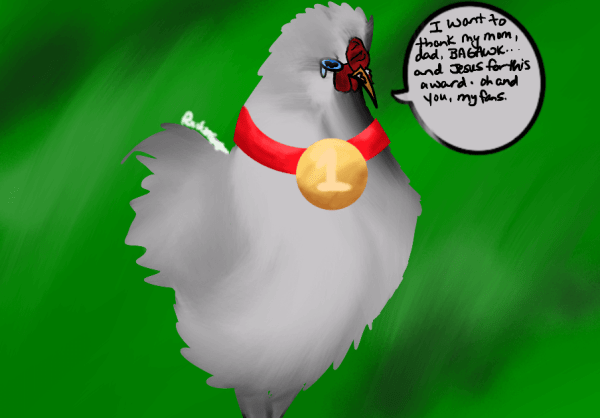
digital art of white Silkie receiving an award
Digital Art, Courtesy of Sarah Smith

Before answering our question, I’m going to present some facts that influence chicken-keeping. And, in effect, they will help determine how many birds you should have.

Decide the Amount of Birds Based on Purpose:

  • Layers
  • Or show chickens

So the first way to come up with how many chickens you should have, is knowing your reason for having them. Are you getting chickens to sell eggs? Or do you want show birds for competitions?

Solution to Choosing Birds Based on Purpose:

If you’re getting layers, settle on how many eggs you want a week. Also, do you have a family? And are you going to try to sell eggs? Some breeds produce more eggs, and some less.

However, if you’re only getting chickens for personal use, then starting out with 3 to 4 hens will yield ~ dozen eggs weekly.

Similarly, for show birds, think about how many birds you need to enter competitions. But if you’re new to showing chickens, starting out with 3 birds is fine, as long as they’re all hens.

Decide on Number of Chickens by Your Space:

chickens on grassy field
Photo by Styves Exantus on Pexels.com
  • Calculate how much space you have for any and all chickens
  • And if you already have a coop with run, then measure its dimensions to determine how many chickens you can fit in it

Most experts agree that each chicken needs ~ 3 to 4 square feet in the coop. That’s where the hens lay eggs and the birds shelter at night. And if there are predators, your birds will go there to hide.

In addition, figure another 5-10 square feet per bird in the run. The purpose of the run is managed safety for the birds to get exercise and daylight. But it’s not ideal for chickens to stay in confined space. They do best when they can forage and have free access to the whole yard. However, if you decide to keep your birds confined all the time, then calculate at least 10 square feet per bird.

  • And for pasture-raised or free-range chickens, plan on at least 108 square feet per bird

If you choose to have pasture-raised chickens, account for predators. So you’ll need a fence with hardware cloth to keep your chickens in and predators out. Living where we do, on only 1 acre, we don’t have that many. But we have neighbors with 5 acres who suffer coyote attacks, as well as other predator depredations to their flocks.

Determine Amount of Birds by Cost:

  • Financial commitment

Initial expenses are higher the more birds you have: if you don’t have a coop, you either need to build one yourself. Or you’ll have to buy one, or hire someone to build one. Plus, your monthly expenses on feed and bedding will be more. We spend ~ $200 a month on feed. And you’ll have added vet bills with more chickens. Not to mention, if you have electricity to your coop, that’s another expense that’s increased the more birds you have.

  • Can be labor intensive

Regardless of who makes the coop, they need one. Besides that and as a result of them eating, chickens poop a lot. So the more you have, the more poop you’ll have to clean out of their coop and run. Even if you clean in the recommended way, if you have 30 birds, it’s still a lot of work. Although, if you have a tractor coop and run, cleaning it won’t be as much of an issue, as I bring up here.

My 20-year-old daughter thinks we have too many birds. But I’m not there yet. Yes, we have over 30 chickens and several chicks. But some of our birds are close to retirement age with signs of a decrease in egg production, which is why I have chicks now. I’m preparing for the future.

So, How Many Chickens Should I Have

3 brown red Ameraucana hens by a wooden fence outside
From center going clockwise, Davis, Bumblecade, and Smiley.

To recap, if you live in the city or suburbs, check with your municipalities to find out their regulations. And that will give you the information you need. Though, if you live in the country, determining numbers really comes down to how many you can manage, financial and otherwise.

However, 3-5 hens is a great start to chicken-keeping no matter where you live. It’s kinda like just getting your feet wet. But the one hard and fast rule is that there has to be a ratio of no less than 10 hens to every rooster. Or else your hens will get abused by too much attention. I’ve seen it, and it isn’t pretty. Therefore, just make sure you get all girls.

If you have chickens already, how many do you have? And are you happy with that amount? Also, how did you decide on your chicken numbers? Your comments are appreciated.


Thank you for taking the time to read this. If you enjoyed it, please like, share, and please don’t forget to follow!

Categories
Extras recipes

Fourth of July Mini Cheesecakes

Last year we had a neighborhood party to celebrate our nation’s independence. But things are different this year. For one, it’s really hot. So I don’t want to be outside more than I have to. And for another, we have someone staying with us. However I still want to contribute. And one of my favorite ways to do so is with food. Therefore, please enjoy this recipe of Fourth of July mini cheesecakes.

Mini Cheesecakes Ingredients

  • 1 1/2 c of graham graham crumbs
  • 1/8 c Truvia
  • 1/4 c melted butter
  • 24 oz softened cream cheese
  • 14 oz sweetened condensed milk
  • 3 eggs
  • and 2 tsps vanilla extract

Mini Cheesecakes Instructions

mini cheesecake topped with blueberries on a white plate
  • First, heat oven to 300°.
  • Next, combine the first 3 ingredients in a bowl; press equal amounts onto bottoms of 12 lightly greased muffin cups.
  • Then, in a large mixing bowl, beat cheese until fluffy.
  • Next, slowly mix in sweetened condensed milk until smooth.
  • After that, add eggs and vanilla, mixing well.
  • Then spoon equal amounts of mixture (~4 TBSP) into prepared cups.
  • And bake ~ 20 to 22 mins or until cakes spring back when lightly touched.
  • Cool for ~ 10 minutes on the counter; then chill in the refrigerator.
  • Before serving, garnish with fruit preserves or fresh berries. And enjoy!

This is another recipe I got from the Great American Favorite Brand Name Cookbook. Although I made the cheesecakes a little bigger. Instead of making 24 mini cheesecakes, I made 12. Further, you’ll have some extra cheesecake mix. So just refrigerate the rest. Plus, the original recipe indicated there would be extra anyway. And keep any cheesecakes refrigerated until ready to eat.

Did you make this? Or do you have a favorite cheesecake recipe that you’d love to share? Your comments are appreciated.

If you enjoyed this post, please like, share, and please don’t forget to follow! Have a safe and happy 4th of July!