
Categories
All animals non-fowl

What Animals Can Get Covid

We’re into our second year, continuing to deal with the ever-changing Covid, and all that entails.  Not to mention all of the confusion that still seems to surround this strange virus, including what animals can get Covid.

I recall learning about the first animal in the U.S. that contracted this disease.  It was a tiger at the Bronx Zoo in March 2020.  And since then, many more animals have gotten infected.  Moreover, recently in December 2021, two hippos tested positive for the virus at a Belgian Zoo.  Even though their symptoms were reportedly mild, they are thought to be the first of their species to get Covid.

What are Coronaviruses

coronavirus
Photo by CDC on Pexels.com

Infectious coronaviruses transmit diseases to many species of birds and mammals, which include us.  And there are hundreds of them that are spread around, mainly by animals like camels, bats, cats, and pigs.  However, human coronaviruses were first observed in the 1960s and are divided into four main sections.  Additionally, since 2019 and Covid, seven coronaviruses can now infect people.  Thus, coronaviruses are just a big family of viruses that cause sickness and illness.  And the symptoms can range from mild, like a cold, to more severe.

photo of people holding siamese cat and chihuahua
Photo by Sharon McCutcheon on Pexels.com

The most common coronavirus(es) that your pet dog or cat could get is CCoV for dogs, and FCoV for cats.  And the symptoms primarily involve GI problems.  Though, these CV aren’t the same as Covid.  But again, they are in the same family.  Remember, SARS-CoV-2 was a brand new coronavirus at the end of 2019 and early 2020.  It’s still new.

Furthermore, poultry have their own coronaviruses, generally from group 3.  Also, the most common CV in fowl is IBV or infectious bronchitis.  So, you see that, in just these 3 examples, there are many CV with varying symptoms, some affect the GI, while others affect the respiratory system.

So What Other Animals Can Get Covid

German Shepherd headshot
Photo by Pixabay on Pexels.com

Now that I’ve covered some basics, let’s discuss the novel coronavirus, that infects both people and animals. To date, the species that have been infected with Covid-19 are:

  • cats
  • dogs
  • tigers
  • lions
  • snow leopards
  • gorillas
  • otters
  • a cougar

The one thing the majority of these animals have in common is they are carnivoran, which isn’t the same as being a carnivore. Carnivoran mammals are placental, mostly consume meat, but are quite diverse. However, this point regarding Covid isn’t conclusive, and it doesn’t necessarily mean anything. It’s just one fact of many, which keeps evolving.

Also, most of these animals don’t get very sick, with some exceptions. Buddy, the first U.S. dog confirmed to have Covid, died in July 2021. And an unnamed cat in Pennsylvania was put down in October 2020 after suffering respiratory distress. Buddy reportedly had lymphoma, and the cat in Pennsylvania was 16 years old.

Can You Transmit Covid to Your Pet

a woman kissing her cat
Photo by Meruyert Gonullu on Pexels.com

In case you don’t know, yes, if you or someone in your home has Covid, and gets cuddly with your pet, your pet can get infected. However, it’s not guaranteed. I think the risk of transmission, and definitely illness, is possibly similar to our own risk.

For example, my 19 year old had Covid around the holidays. But we didn’t make her isolate away from us. Although she did have to wear a mask and practice routine hygiene, like hand washing, or use a hand sanitizer if she couldn’t wash her hands. Also, neither our animals nor any of the other humans in my house got sick or infected. And we got tested. However, there’s definitely still a lot we don’t know.

Can Your Pet Transmit Covid to You

close up of microscope
Photo by Pixabay on Pexels.com

As of this publishing, there have been no pet zoonotic transmissions of Covid. But, with that being said, in 2020, the virus did break out on 2 mink farms in the Netherlands. It ended up spreading to 70 farms, leading to the culling of millions of mink. The mink developed respiratory symptoms and the virus mutated, infecting the workers on the farms.

Further, it’s noteworthy to mention that white-tailed deer have been testing positive for Covid, yet not dying. And still the virus is spreading among deer, leading many to wonder if they are an animal reservoir for the illness. Besides, it is believed that Covid-19 originated in bats. However, as of yet, no one knows the intermediate animal that spread the virus from bats to people.

Thankfully, so far there have been no reports of Covid-19 in poultry. Birds have enough to worry about as it is. Avian flu probably being the biggest.

What to do if You Think Your Pet is Infected with Covid

flat lay photography of red anti radiation handset telephone beside iphone
Photo by NEOSiAM 2021 on Pexels.com

Once again, most animals that get infected with the virus don’t get seriously ill. And some might not have any symptoms at all. However, since it’s possible for animals to contract the virus, symptoms they could exhibit are:

  • fever
  • coughing
  • trouble breathing
  • lack of energy
  • sneezing
  • runny nose
  • eye discharge
  • vomiting
  • and/or diarrhea

So, if your pet is ill, and you’re concerned it might be Covid, the CDC advises you to call your veterinarian. And, if you’re infected with the virus, and your pet gets sick, the CDC cautions NOT TO TAKE YOUR PET TO THE VET YOURSELF. However, call your vet to let them know you have the virus; they might offer Telehealth for your pet or other options. Read here for some more guidelines from the CDC regarding Covid and your pet.

Important Reminders Concerning Wildlife

person washing their hands
Photo by Burst on Pexels.com

Even considering the mutation and spread of the virus from mink populations back to humans, the risk remains low for animal to human transmission. Therefore, there’s no need to abandon or mistreat wild animals. But we should be cautious around them all the same. Some other reminders are:

  • Don’t feed wild animals or touch their droppings.
  • Maintain a safe distance from wild animals; and keep your pets at a safe distance from them too.
  • Wash your hands after playing or working outside.
  • Don’t directly interact with abandoned animals, because parents typically return.
  • DON’T touch or get close to sick or dead animals.
  • And if eating game meat, read your state’s wildlife agency guidelines.

If you enjoyed this post, please like, comment, share, and please, don’t forget to follow!
Categories
Extras recipes

Recipe for King Ranch Chicken Casserole

To me, good casseroles taste good, are easy to assemble, and don’t require dirtying more than 2 pots. And that’s if you’re not paying attention. That said, sometimes you don’t know if you’re about to make a good dish, especially if it’s new. But then there are the classics. The ones that have been around for generations, like this recipe for King Ranch chicken casserole.

Many people believe that King Ranch chicken casserole has been around for at least 80 years. Since it’s prepared with both condensed chicken and condensed mushroom soups, this seems a likely time frame. That’s because Campbell’s introduced condensed mushroom soup in 1934, while condensed chicken soup came out in 1947. And both types of condensed soups feature in King Ranch chicken casserole.

Others believe the recipe originated at King Ranch, the largest ranch in the world. Although the owners deny this allegation, because they’ve focused on beef, not poultry. Therefore, nobody really knows the exact beginning of this timeless southern casserole.

King Ranch Chicken Casserole Ingredients:

layer of shredded chicken on a casserole dish
  • 1 1/2 chicken breasts, cooked and shredded
  • **22 corn tortillas
  • 10.5 oz can each of cream of mushroom and cream of chicken soup
  • 1 c each of diced onions and diced bell pepper
  • 10 oz of Rotel
  • 1 tbsp chili powder
  • 1 tbsp butter
  • 2-3 c shredded Mexican blend cheese

King Ranch Chicken Casserole Instructions:

  • Spray 9×13 baking dish with non-stick cooking spray.
  • Next, line the dish with a layer of corn tortillas.
  • Then saute´ onions and green peppers in butter over medium heat. When soft, add soups and chili powder. Stir till well combined.
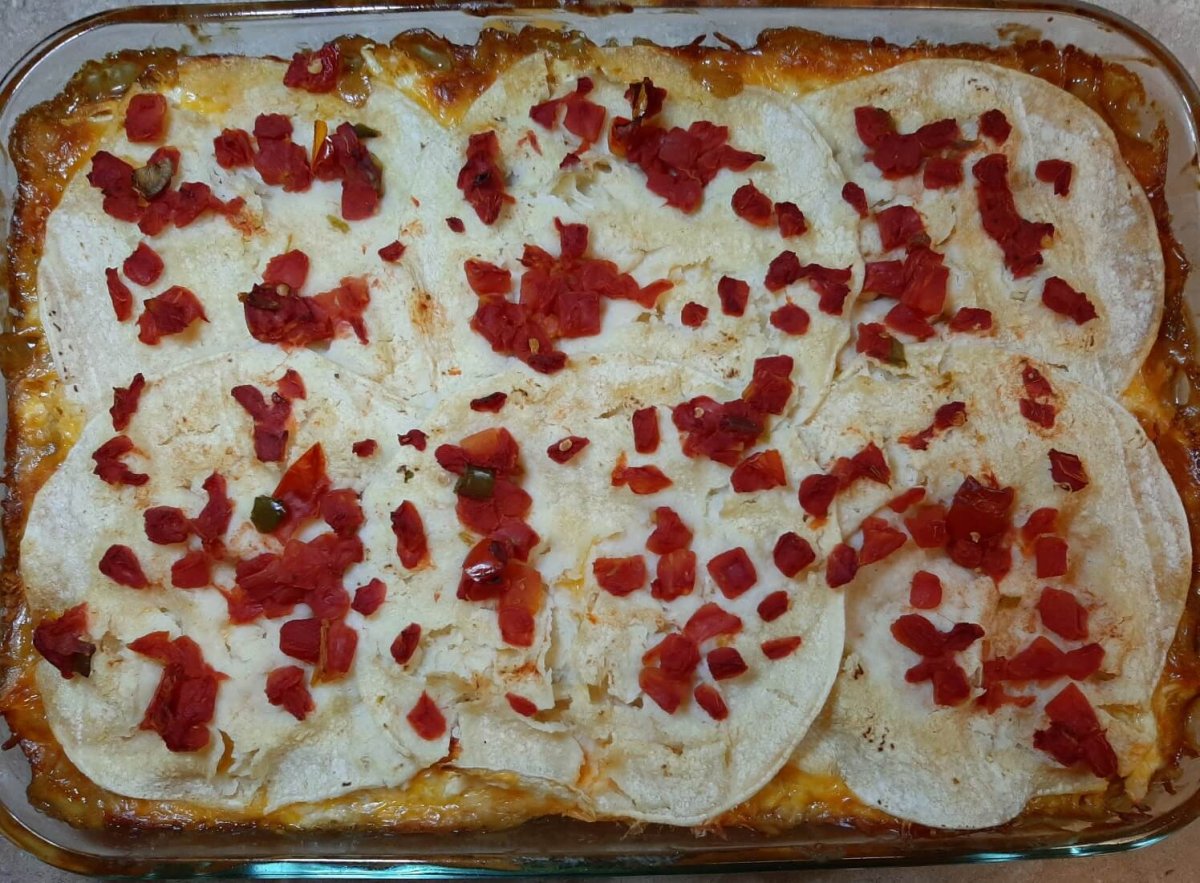
  • Pour layer of soup mixture over tortillas, then layer with shredded chicken, and then layer with shredded cheese. Repeat layers. When done, pour over all the Rotel.
  • Then bake one hour in 350° oven.

**I got this recipe from my mother-in-law, who’s been making King Ranch chicken casserole for at least 40 years. And her recipe calls for a 2-3 lb fryer chicken, but I don’t like having to deal with that mess. I find it’s much easier working with chicken breasts. In addition, most of the classic recipes call for only a dozen corn tortillas, which makes me think I distribute my layers sparingly.

Also, I boil my chicken, which makes shredding so much simpler. However you can buy a roasted chicken and shred that instead. It’s really up to you and what’s easier. Furthermore, you can add more heat to spice things up. And then there are newer varieties of the recipe which call for chips instead of tortillas. But the idea is still the same: a comfort food that’s easy to make.

Thanks for stopping by! If you enjoyed this post, please like, post a comment, share, and please don’t forget to follow!
Categories
All animals Hens non-fowl raising happy, healthy chickens recipes

What are Pasture Raised Eggs

It used to be you only had brown and white eggs to choose from. But now grocery stores offer cage-free, free-range, and even pasture raised eggs. Maybe you think they’re all the same? I mean, they all come from the same place, right? Well, I’m going to explain the differences, in particular, of pasture raised eggs and the others.

What are Caged Eggs

white chicken in cage
Photo by cottonbro on Pexels.com

Caged eggs come from hens that are basically housed in battery cages. This is the most common method for industrial egg production. So ~85% of US eggs are from caged hens. And that means the birds are stuck in cages for their egg-laying lives in roughly 67 square inches. Also, they’re fed a corn or soy diet.

In my own opinion, I understand why the industrial egg producer keeps their hens in this situation. Since they’re dual-purpose birds, when the hens are no longer laying eggs, (at the industrial level ~ 2-3 years old), they’ll slaughter them, package the meat, and sell to a specialty grocery store. Because a 3 year old hen, that’s gotten plenty of exercise, is a tough old bird in terms of food. So, the less space they have to move in, the better they’ll taste when those farmers cash in on those hens for the last time. Thus, it’s more economical for the farmer to keep their egg-producing hens confined this way.

However, some industrial egg producing farmers send the hens to a landfill or make them into pet food. I wouldn’t do any of those options, because my birds are like my pets. But I’m also not a commercial egg producer.

What are Cage-Free Eggs

As of March 2021, about 29% of eggs sold in US grocery stores were from cage-free hens. In addition, these hens have a little more space, than caged hens, with a little less than one-square foot each. Furthermore, they’re living in barns, and like their counterparts, they don’t have access to the outdoors. And they also have a diet consisting of corn or soy.

What are Free-Range Eggs

hen chickens through chain link fence
Photo by Will Kirk on Pexels.com

According to the National Chicken Council, (yes, apparently there’s a chicken council), less than 1% of chickens are considered free-range in the US. Additionally, these hens have more room than either caged and cage-free hens with 2 square feet each. And they have access to the outdoors. Although there’s not really a consistent standard on how long the birds get to be outdoors or what the space is like. Also, they too are fed a diet of corn or soy.

What are Pasture Raised Eggs

pasture raised chickens outside

Pasture raised eggs first got their start in 2007 by Matt O’Hayer from Texas. However they didn’t get any steam until cage-free and free-range had already gotten attention. With that being said, there’s not a standard for pasture raised eggs either. But, according to the USDA, pasture raised eggs are laid by hens with more access to the outdoors, and their diet is supplemented with bugs and wild plants.

Although, the best method to determine if the eggs you’re buying are pasture-raised is other labels, such as: Certified Humane Raised and Handled + Pasture Raised, or American Humane Certified and Pasture Raised. If your eggs have either of these labels, then the hens who laid the eggs have access to the outdoors, with 108 square feet per hen. And each hen eats a combination of a balanced feed and whatever they get from foraging: grass, worms, and insects. In addition, they can roam all day and return when it’s time for bed.

Which is More Expensive

dollar sign
Digital Art of a Dollar Sign, courtesy of Sarah Smith

As you can well imagine, the most expensive option is going to be the one that is the most humane for the birds. I already mentioned that the most economical way for the farmer was the battery caged method; and that’s because the farmers are sucking every last penny out of those chickens that they can get.

Which is the Healthiest

2 different chicken egg yolks in a white bowl

According to The Egg Nutrition Center, there’s little nutritional difference between all 4 types of eggs. Although, there have been studies showing differences in mineral content based on the type of housing a particular egg was laid in. And Mother Earth News has verified the superiority of true pasture raised eggs to traditional eggs sold in grocery stores several times.

Furthermore, I covered a post on egg facts not too long ago, confirming that hens with access to pastures, grass, and bugs lay richer eggs. And richer eggs just taste better.

What’s Better for the Birds

red and black rooster on green grass
Photo by Erik Karits on Pexels.com

Obviously allowing chickens all day access to the outdoors is the best policy for the chickens. It’s what they do in nature; it’s what they did before we captured and tamed them for our own use. They can communicate with each other, stretch, roost, forage, and just be birds when they’re truly in a pasture setting. But in the other 3 settings they don’t really get to be the way nature intended; they’re the way we intended, which isn’t the same thing at all.

What’s Better for the Environment

green grass field and river
Photo by Barnabas Davoti on Pexels.com

Since we’re considering every option, people and birds, I wanted to include the environment. Because any type of industrial food production has an impact on the environment, which then trickles down to us. However, the only thing I could find on that was based on feed. And that really applies to all of the egg-producing systems. Apparently any type of egg production leaves behind a pretty steep carbon footprint due to the embedded emissions in concentrate feed.

Therefore, if industrial chicken or egg farmers could find an alternative feed for their birds, that doesn’t produce as many greenhouse gases, then it would be better for the environment. Of course the feed should also consist of a balanced diet for the birds.

In Conclusion

There are 4 types of eggs to choose from at the grocery store. Since labels can be confusing, you need to know how to read them. Caged eggs make up the vast majority on grocery store shelves. While cage-free hens are in somewhat better living conditions, they still represent a small percentage. Even though free-range and pasture raised have access to the outdoors, there still isn’t a standard for commercial egg producers.

green leaves and organic word
Photo by Fuzzy Rescue on Pexels.com

However, if you’re interested in animal welfare, then look for those kinds of labels. But if you see labels for organic, that has nothing to do with the bird’s welfare; it just means the bird was fed a vegetarian diet, free from antibiotics and pesticides.

If you have neighbors with backyard birds, know they treat their birds well, and you have the means, buy some eggs from them. That way you’ll be supporting your very local community and get to enjoy the benefits of farm fresh eggs, which are true pasture raised eggs.

Thanks for stopping by! If you enjoyed this post, please like, post a comment, share, and please don’t forget to follow!

Categories
Extras recipes

How to Decorate Chocolate Covered Strawberries

Since Valentine’s Day is coming up, it’s typical to see chocolate covered strawberries in grocery and on online stores. However ordering, or buying pre-made, doesn’t make much economic sense when you only get 6-12 strawberries for a whopping $30-40. In addition, 2 lbs of fresh strawberries costs less than $8, and the other ingredients are simple to get. Thus, it’s just as easy to make your own. So I’m going to show you how to decorate chocolate covered strawberries instead.

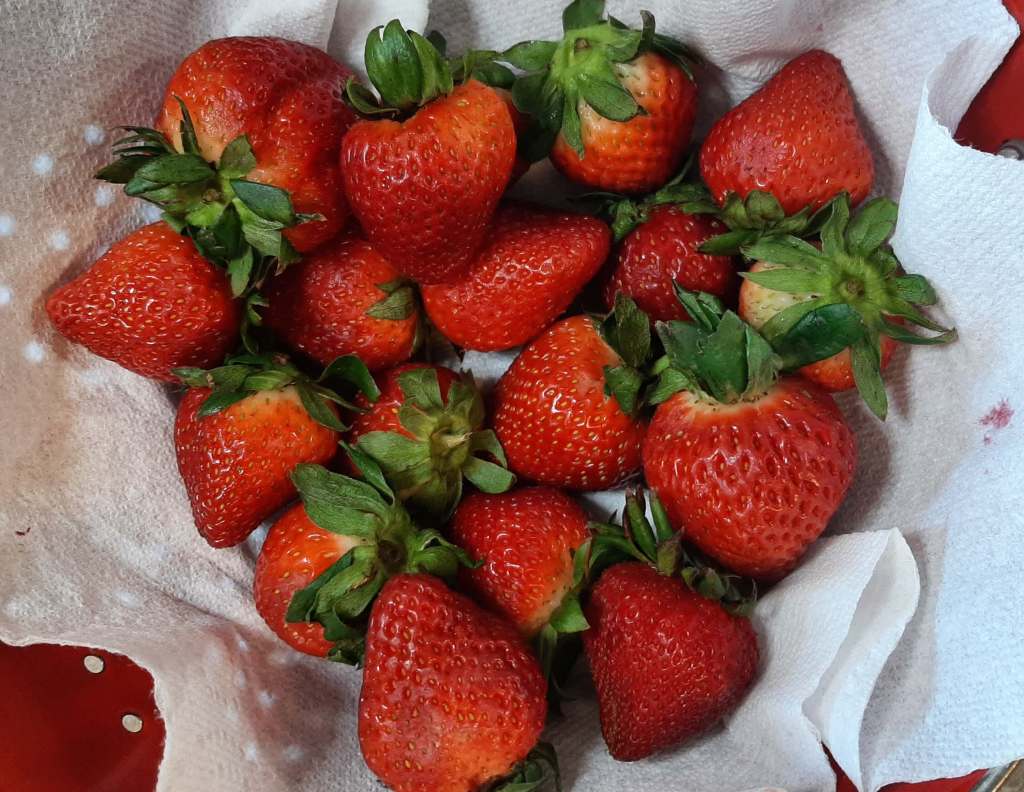
fresh strawberries

Chocolate covered strawberries are great to eat any season. And there are a lot of benefits to eating them, such as their fiber content. Also, eating strawberries can lower the bad cholesterol in our bodies. Additionally, eating them could even prevent cancer cell growth.

Then there’s the chocolate combined with the strawberries. And there are different textures involved too. Sometimes it doesn’t work. But sometimes it does. And chocolate and strawberries are definitely meant to be together.

Ingredients for Decorating Chocolate Covered Strawberries

metal muffin tin filled with a variety of toppings
  • 1 lb strawberries; Driscoll’s have the best
  • 10 oz semi-sweet chocolate chips
  • 6 oz white or vanilla melting wafers
  • 1/4 c each of toppings, such as: sprinkles, decorating sugar, coconut, chopped nuts, and/or chocolate curls

Instructions for Chocolate Covered Strawberries

  • First, line a jellyroll pan with wax paper
  • Next, wash the strawberries; and carefully pat each one dry with a paper towel
  • Put each topping in a separate shallow bowl

Melting Chocolate Chips and Wafers

melted chocolate and melted vanilla in 2 white bowls
  • Place the vanilla wafers in a microwave-safe bowl
  • And microwave on medium power for 30 seconds to a minute, depending on how cold it is in your house; the colder it is, the more cooking time you’ll need
  • Stir the melting wafers
  • Continue this until the wafers start to melt; then drop the cooking time to 30 secs
  • Stir in 1 tsp of olive oil to thin out the vanilla, if it’s a thick mixture
  • Next, melt the chocolate chips in a similar manner to the wafers: on medium power for 30 seconds to a minute; however, do not add any olive oil when you’re done

We’re almost done! My main concern during the last part was the chocolate and vanilla hardening before covering all of the strawberries. So my youngest helped me out, and it made it much easier. Also, I laid everything out like an assembly line. Therefore, if you have pre-teens, have them help. You both will enjoy it. Likewise, set everything up as an assembly line: strawberries, chocolate, toppings, and finally, the jellyroll pan.

How to Decorate Chocolate Covered Strawberries

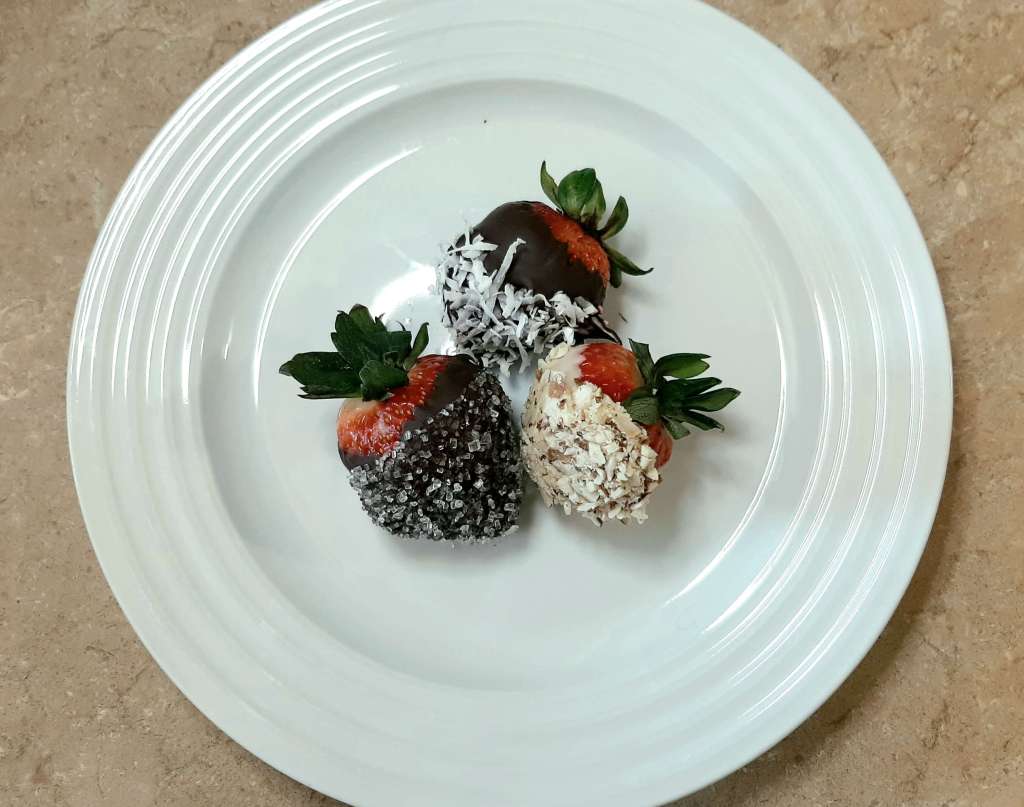
3 decorated chocolate covered strawberries on a white plate
  • Take one strawberry by the leaves and dip it into the melted chocolate or vanilla.
  • Swirl until evenly coated.
  • Then dip chocolate coated strawberry into the topping of your choice.
  • Next, place decorated, chocolate covered strawberry onto jellyroll pan.
  • And repeat until all of the strawberries are decorated.
  • Chill in the refrigerator for 15-30 minutes or until chocolate is set.
  • Ideally, these are best served the day you make them and at room temperature. They can be made a day ahead, however condensation will form, which isn’t good. Read this for tips on how to store chocolate covered strawberries in the refrigerator.

I hope you guys have a great Valentine’s Day! And thanks for stopping by! If you enjoyed this post, please like, post a comment, share, and don’t forget to follow!

Categories
All animals non-fowl

Do Pets Get Jealous of Other Pets

Basic emotions come from the limbic system. And we share that with many animals: reptiles and other mammals. Also, birds, like chickens, have something similar to a limbic system that’s said to have evolved from a common ancestor. So, with that information, do pets experience emotions? Or, for that matter, do pets get jealous of other pets?

Do Pets Get Jealous of Other Pets

Sketch of a Brain
Sketch of a Brain, courtesy of Paul Smith

Well, the answer should be obvious that, yes, pets can and do get jealous of other pets. And they can also get jealous of other people, particularly babies, boyfriends, or girlfriends. Or really anyone or thing that’s taking attention away from them. That’s because the limbic system, which I already mentioned, is linked to emotions.

Signs of Pet Jealousy

Australian Shepherd dog and calico cat leaning on an indoor gate

According to the emotion wheel, jealousy or envy is a combination of anger and sadness. But what are some other signs your pet is jealous?

  • Aggression

If your pet is jealous, they might be aggressive. For instance, they might bite or nibble the person, or pet, getting the attention they’re in competition with.

  • Acting out

Since our pets can’t talk the way we do, sometimes they’ll act out. For example, when we first got Meow Meow, she was the only indoor pet we had, other than our dog, Moses. However, as time went on, we collected 2 more cats, 2 bunnies, and another dog. The bunnies are no longer with us, and Moses died of old age. Now these changes happened over a period of years. But Meow Meow didn’t care. She metaphorically put her paw down and started acting out. By peeing on the kitchen counters. Therefore, Meow Meow moved out to the garage with Cake, so she wouldn’t be alone.

**Because using the bathroom outside of the litter box, or having accidents in the house, can be a sign of a health issue, always check with your veterinarian.

  • Clinginess

If your pet is clingy, which you might interpret as cuddly, they want your attention. Imagine your pet is in your face, extra close, and licking your face and hands. That’s clinginess.

  • Dominating

This type of behavior reminds me of our dog, Sophie, when my husband and I hug or kiss each other. Sophie will come right in between us, demanding attention.

  • Fighting

Listen to the sounds your pets make when they interact. Do they hiss and growl at each other? Watch their body language, and you’ll know if they’re fighting.

  • Scaring Visitors

Some pets may fiercely bark, hiss, or growl when visitors come over. In addition, other pets might be just as aggressive if there’s a knock on the door or the doorbell rings.

  • Smother you

Cats are notorious for getting on their owner’s level when they want attention. For instance, when my calico cat, Poppy, is ready for me to play fuzzball with her, she’ll walk on the kitchen table where I’m working. And a lot of times she’ll just walk across my computer keyboard.

  • Fawning

This is another behavior typical in cats, where they will rub against their owners, purr, and meow prodigiously. And these are all in the attempt to get their owner’s attention.

  • Leaving

Pets can get mad just like people. And if you don’t pay attention to your pet, they might just walk out of the room and withdraw. Poppy did this last night. She pulled away from me while I was busy with something else. But the next time I spotted her, she was playing with one of her fuzzballs. So I made it up to her and started playing with her.

  • Competition

Finally, the last sign of pet jealousy is competition. Pets who are jealous of other pets might compete with each other for attention. However the competition doesn’t necessarily have to be aggressive.

Both Poppy and Sophie are jealous of each other. When one of them is getting attention, the other is watching and waiting. If Sophie gets to go outside, Poppy will meow, yowl, and cry to go out too. And Sophie’s playtime with her ball prompted Poppy to learn how to play fetch. Additionally, Poppy doesn’t like to play fuzzball with me when Sophie is in the room with us. She wants me all to herself.

Warning. Graphic image of animal injury below.

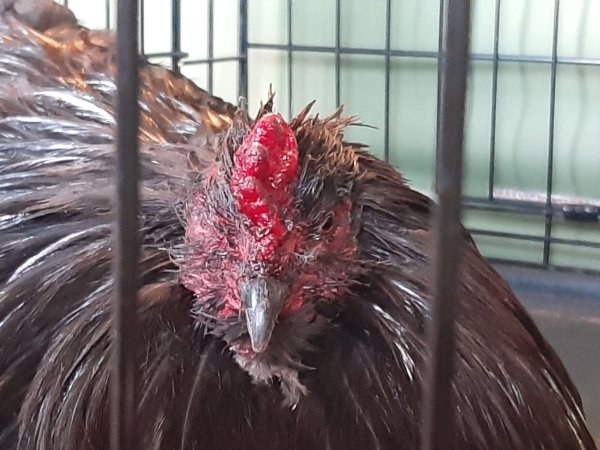
headshot of injured Black Ameraucana rooster
This is our boss rooster, Megatron, after his son attacked him for leadership. He had feathers ripped out, and his right eye was swollen shut. But we nursed him back to health.

What about birds? Do they get jealous? If you follow my blog, it’s possible you’ve read my article on the chicken pecking order. Which is all basically based on the leader of the flock running a tight ship. However birds that aren’t on the top will display jealous behavior.

Take, for example, my 2 roosters, father and son. Baby Nay is jealous of his dad, because Megatron bosses him around, essentially telling him when he can mate, who he can mate with, when he can eat, and etc. And so he attacked his dad to change his position in the hierarchy.

Possible Reasons for Jealousy

ethnic hipster man taming west siberian laika in park
Photo by Zen Chung on Pexels.com

There are several reasons why pets will get jealous of other pets, including boredom, lack of space and exercise, and stress or conflict. Furthermore, genetic disposition, upbringing and level of socialization, insecurity, and interaction with a pet parent all contribute to pet jealousy.

Interaction with a pet parent can also be interpreted as lack of enough bonding time. If your pet feels like it’s not getting enough quality time with you, it can act out aggressively toward another pet.

Insecurity can come from abandonment issues, like our dog, Sophie, has. Animals have memories of both good and bad events. Thus, their jealousy could stem from being abandoned by previous owners. Or possibly even from past abuse.

Pets without enough social interaction with people or animals can easily experience jealousy. So when they’re confronted with a social encounter, that pet might act out due to a lack of instruction and experience. Because, essentially, they’ve never been taught better.

Tips to Stop Jealousy in Pets

a young woman walking a group of dogs in a park
Photo by Blue Bird on Pexels.com
  • Observe and note the times and conditions that cause the jealousy and/or aggression. This way you can discuss the issues with your veterinarian to help manage them.
  • Give your pets equal time and attention.
  • Make sure your pets each have their own safe space, like a crate for a dog, and a room for a cat.
  • Feed your pets separately during meals. And give them an equal amount of treats.
  • When you get home, don’t pay more attention to one pet over another.
  • Leash dogs when walking two at a time.
  • When petting your pets, make sure to include all of them.
  • Make sure each pet has its own bed and toys.
  • And don’t forget to reward your pets when they’re good and don’t act jealous!

To Summarize

2 roosters fight outside

Jealousy is a complex emotion. And it’s obvious that, since all animals have some sort of limbic system, your pets have emotions like you, including the ability to get jealous of other pets. In addition, just like with people, jealousy in pets can present in similar ways.

But there are things you can do to mitigate issues with your pets. And they primarily involve giving each pet the same amount of attention, food, supplies, and toys. However, this doesn’t always work with chickens, like with my 2 roosters.

They each have their own harem of hens. And they have plenty of space, healthy food, and clean, fresh water. But after letting Megatron back with his flock, both father and son wanted to annihilate each other, to the exclusion of all else. Therefore, if you still have issues with your pets, definitely reach out to your veterinarian for suggestions.

Thanks for stopping by! If you enjoyed this post, please like, post a comment, share, and please don’t forget to follow!

Categories
Extras recipes

Easy White Chicken Chili

My parents were both realtors when I was growing up in Dallas. And each year the Collin County Association of Realtors had a chili cook-off in the spring, which my parents participated in. But most of the entries, if not all of them, were classic chili. However, now that I cook, I know there are so many more choices out there. Although, the first time I made this easy white chicken chili was just a couple of years ago.

I think the main difference with this and classic chili is obviously one is white, while the other is red. But the other main difference is in this recipe, the meat, or chicken, has to be pre-cooked. And you can cook it pretty much any way you want to; including buying a roasted chicken and shredding the meat.

Ingredients for Easy White Chicken Chili:

  • 1 tbsp extra virgin olive oil
  • 1 tbsp minced garlic
  • 6 cups chicken broth
  • 1 chopped onion
  • 1 tbsp dried cilantro
  • 2 tbsp lime juice
  • 1 tsp ground cumin
  • 1/2 tsp dried oregano
  • 1/4 tsp each red pepper sauce and salt
  • 11 oz white shoepeg or whole kernel corn, drained
  • 1 can each (15 or 16oz) great northern beans and butter or lima beans, drained
  • 2 cups shredded cooked chicken breasts
  • crushed tortilla chips
  • 1 fresh diced tomato
  • chopped green onion
  • shredded Mexican blend cheese
  • sour cream or Greek non-fat plain yogurt
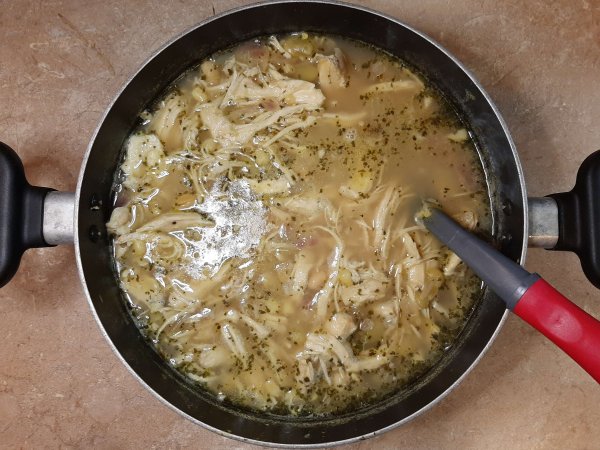
pot of white chicken chili

Instructions for White Chili:

  • First, heat olive oil in 4 quart Dutch oven over medium heat. Then cook onion and garlic in oil. And stir intermittently, until onions are cooked through.
  • Next, add the rest of the ingredients, aside from the chicken. Stir and heat to boiling.
  • Then reduce heat, and simmer uncovered ~ 20 minutes.
  • After that, stir in the chicken, still simmering until hot.

At this point the white chicken chili is finished. However, no chili is complete without toppings. Thus, add some shredded cheese, crushed tortilla chips, chopped green onions, fresh diced tomatoes, and sour cream.

Similarly with my Cincinnati-style chili, I found this originally in Betty Crocker’s Cookbook, 9th edition, which was printed in 2000. And again there isn’t a link online, but if you’re interested, you could probably find it at Etsy, Ebay, or something similar.

Thanks for stopping by! If you enjoyed this post, please like, comment, share, and please don’t forget to follow!
Categories
Extras recipes

Cincinnati-Style Chili

It’s been cold and windy the past few days. Perfect weather for Cincinnati-style chili. Although, chili is great to eat in summer too, due to the availability of garden fresh vegetables.

And there are so many ways to make it. White, crockpot, BBQ, and classic are just a few of the options. But there are even Paleo and vegetarian versions. Furthermore, each recipe varies in the length of time to cook, from 30 minutes to several hours.

Which brings me to the different methods of cooking chili: Instant Pot, pressure cooker, stove-top, and slow cooker. Though, there are possibly even ways to cook it in the oven.

Although, most of my cooking history, I’ve made chili on the stove. Until recently. You see, our neighbors gifted us with an electric pressure cooker. But my husband was the only one to try it out, and he loved it immensely. So, after watching and tasting his results, I made this Cincinnati-style chili in the electric pressure cooker to save time.

Ingredients for Cincinnati-Style Chili:

  • 1 lb ground beef
  • 1 onion, chopped
  • 2 (14.5 oz) cans whole tomatoes, pulsed
  • 1 (14.5 oz) cans tomato sauce
  • 2 tbsp chili powder
  • 1 tbsp fresh garlic minced
  • 2 (15 or 16 oz) cans of kidney beans, rinsed and drained
  • 1 1/2 tsp ground cumin
  • 1/4 tsp each of salt and pepper
  • 1 tbsp extra virgin olive oil
  • ~ 10 oz angel hair pasta
  • 1 (15.25 oz) can of whole kernel corn, drained
  • 2 fresh tomatoes, diced and seeded
  • 1 cup sour cream or plain Greek yogurt
  • shredded Mexican blend cheese
Chili with various ingredients in electric pressure cooker

Putting it All Together:

  • Put the olive oil in the pressure cooker; then add the garlic, onion, and beef, and turn the pressure cooker on saute and beef, cooking until beef is brown; stirring occasionally.
  • Next, stir in the rest of the ingredients, except the pasta. And cover and lock the pressure cooker, pushing button for pressure, still on beef; and it will cook for ~30 mins.
  • When the chili is finished, cook the angel hair pasta according to the package instructions; drain when cooked to al dente.
  • And spoon ~ 3/4 cup chili over ~ 1 cup noodles. Top with shredded Mexican blend cheese, chopped onion, sour cream, fresh chopped tomatoes, etc.

Cooking this in the electric pressure cooker cut my cooking time in half. So, if you’re short on time, that’s a definite plus. Also, originally I got this recipe from Betty Crocker’s Cookbook the 9th edition, printed in 2000. But I couldn’t find a link to it online.

Thanks for stopping by! If you enjoyed this post, please like, comment, share, and please don’t forget to follow!

Categories
Extras

Chicken Casserole

This chicken casserole recipe originally was tuna casserole.  But since my family isn’t too big on the idea of canned tuna with noodles, I changed it one day when I didn’t have any tuna.  And the tuna casserole recipe I have came from my Great Aunt Jo on my mom’s side of the family. 

I remember eating the original casserole for the first time in Scottsdale, Arizona.  This was when I was a kid, and we were swimming in summer-time.  Furthermore, I think my mom told us we were going to have tuna casserole.  And we all thought, ‘Uugh, yuck.’  However, we were in for a delicious surprise.

Though you guys know I love to change recipes.  The original calls for 10 oz can of albacore tuna; and to cook the noodles until they’re tender only, not fully cooked.  Although, if you don’t cook them fully, then when the casserole comes out of the oven, a lot of the noodles, if not most of them, will be rock hard.  Unless you know the trick to cooking them.  Trust me, I’ve made this enough times to know.  This is why I’ve added the water, so that the noodles have some way to cook prior to going in the oven.

Ingredients for Chicken Casserole:

  • 1 lb ziti or penne pasta
  • 1 small onion, chopped
  • 2 tbsp extra virgin olive oil
  • 14 1/2 oz can tomatoes, pulsed in food processor with the juices
  • 1 c shredded mozzarella cheese
  • 4 oz can of mushrooms or 8 oz fresh sliced mushrooms
  • 12.5 oz can of chicken
  • 1 tsp basil
  • 1/2 tsp salt
  • 1/4 tsp cayenne pepper
  • 14-35 oz of water
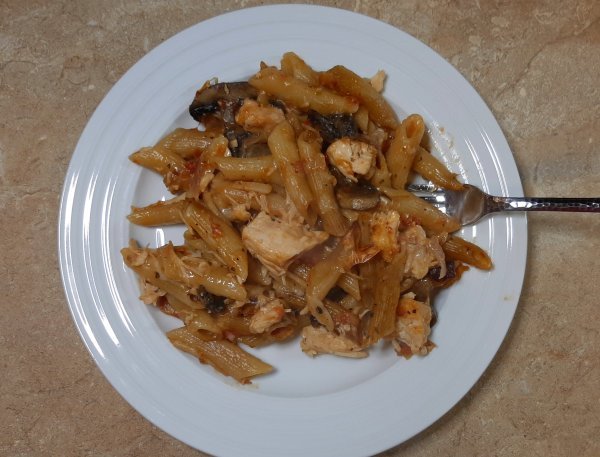
penne pasta, chicken, tomatoes on white plate

Instructions for Chicken Casserole:

  • First, preheat oven to 375 degrees; and spray a 9X12 inch casserole dish with non-stick cooking spray.
  • Next, cook the pasta with chopped onion in olive oil until pasta is golden.  Then add the remaining ingredients, except chicken and cheese.  And bring to a boil.  When adding the water, do so 14 oz or less at a time, and stir frequently to prevent burning.
  • Cook until noodles are al dente.  Remove pot from heat and add canned chicken; stir into the noodles.  Then transfer to a casserole dish.  And top with the shredded cheese.  Stir and bake in 375 degree oven for 20-25 minutes.

I could only find one recipe that appeared similar to the one from my aunt, with the spices and tomatoes.  Though there are others with tomatoes.  But mostly when you look up tuna casserole, you’ll find recipes with mushroom soup, condensed mushroom soup, etc.  So people associate tuna casserole more with a white sauce rather than a red tomato sauce.

And there are probably about as many chicken casserole recipes around as there are people.  Chicken is extremely diverse, as are casseroles.

Thanks for stopping by!  And if you enjoyed this post, please like, comment, share, and don’t forget to follow!

Categories
ducks Hens other fowl raising happy, healthy chickens

Difference Between Chicken Eggs and Duck Eggs

Eggs are one of the healthiest foods on the planet. They’re fairly easy to obtain and inexpensive. And there are other eggs besides the common chicken egg. Quail, turkey, duck, and goose eggs can also be eaten. Cooking with duck eggs has been around for a while, especially in Asian markets. Perhaps you’ve seen them at specialty markets or on a restaurant menu. The following is the difference between chicken eggs and duck eggs.

Most Apparent Difference Between Chicken Eggs and Duck Eggs: Appearance

  • Size of the egg
4 different colored and sized eggs
The 2 eggs on the left side are duck eggs, while the 2 on the right are chicken eggs. Pekin ducks lay large creamy white eggs, and Mallards lay smaller greenish blue eggs. At least ours do.

The size of duck eggs can be 50-100% larger than the average chicken egg. However it also depends on the duck. Some ducks, like our Mallard, are smaller than your typical chicken. And so their eggs will tend to be smaller than the average chicken egg.

  • Color of the eggshell

Just like with chickens, the color of a duck eggshell depends on the breed, diet, environment, and genes. And eggshells can be pale gray, creamy white, green, black, or blue.

  • Size and color of egg yolk
3 egg yolks in 3 separate bowls
The dark orange on the bottom right is from a chicken. The egg in top center is from the Mallard, and the bottom left is from a Pekin. Notice how the chicken egg has more white than the duck eggs.

Duck egg yolks are also different in size and color. Chicken egg yolks can be yellow, yellow orange if the chicken is pasture-raised, while duck egg yolk can be a deeper shade of golden orange. In addition, the yolk tends to be bigger than chicken egg yolk.

Second Difference Between Chicken Eggs and Duck Eggs: Taste

  • Creamy taste

For the most part, chicken and duck eggs taste similar, but duck eggs are creamier.

  • Intense flavor

In addition to the creamy taste, people who eat duck eggs think their flavor is richer than chicken eggs.

Third Difference Between Chicken and Duck Eggs: Nutrition

  • More nutrients
letters spelling out nutrition on flowery background
Photo by Bluehouseskis on Pexels.com

Duck eggs have more fat, protein, and cholesterol than chicken eggs. Furthermore, they also contain more vitamins, particularly vitamin B12, which is important for red blood cell formation, DNA, and cell metabolism.

And according to Livestrong and Mayo Clinic, the cholesterol in eggs isn’t the same as bad cholesterol in our bodies. However, people with diabetes could be at risk for heart disease. (Though experts don’t know yet the connection between diabetes, eggs, and heart disease.)

Fourth Difference Between Chicken Eggs and Duck Eggs: Extra info

  • Availability
food display in the market
Photo by Meruyert Gonullu on Pexels.com

Chicken eggs are generally easier to obtain: at the grocery store, farmer’s markets, or from your neighbor, whereas duck eggs aren’t mainstream. Although they are gaining popularity with backyard bird enthusiasts.

  • Cost

Due to the fact that duck eggs can be difficult to find, that tends to drive up the price. However, chicken eggs, where I live, are about $2-3 a dozen at the store.

  • Allergies

Some people can be allergic to chicken eggs, but not to duck eggs. Or vice versa. And that’s because the proteins in both are similar but not exact. Therefore, if you have a known allergy to chicken eggs, it’s recommended to talk to your healthcare professional before trying duck eggs.

So, the next time you’re out grocery shopping, and assuming you don’t have an egg allergy, why not give duck eggs a try?

Thanks for stopping by! If you enjoyed this post, please like, share the post, comment, and don’t forget to follow!

Categories
Extras recipes

Homemade Gyros Recipe

I was living in Dallas when I first tasted gyros; this was a long time ago, so I don’t remember where. Likely the place is no longer there anyway. But when my daughter, Hannah, worked for a pizza place a few years ago, that also served gyros, I tried my hand at them. Scroll down to find the homemade gyros recipe that I continue to use today.

Some people mispronounce the word, making the hard ‘g’ sound. Rather the g is silent, more like a ‘yu’. ‘Yeeroh’ is really how it’s pronounced. And gyros originate in Greece. Gyro in Thessaloniki means to turn. While in Athens the generic word is ‘souvlaki’, and ‘souvla’ is a skewer. So both terms are correct, because a gyro is shaved meat on a rotating skewer, served in a pita.

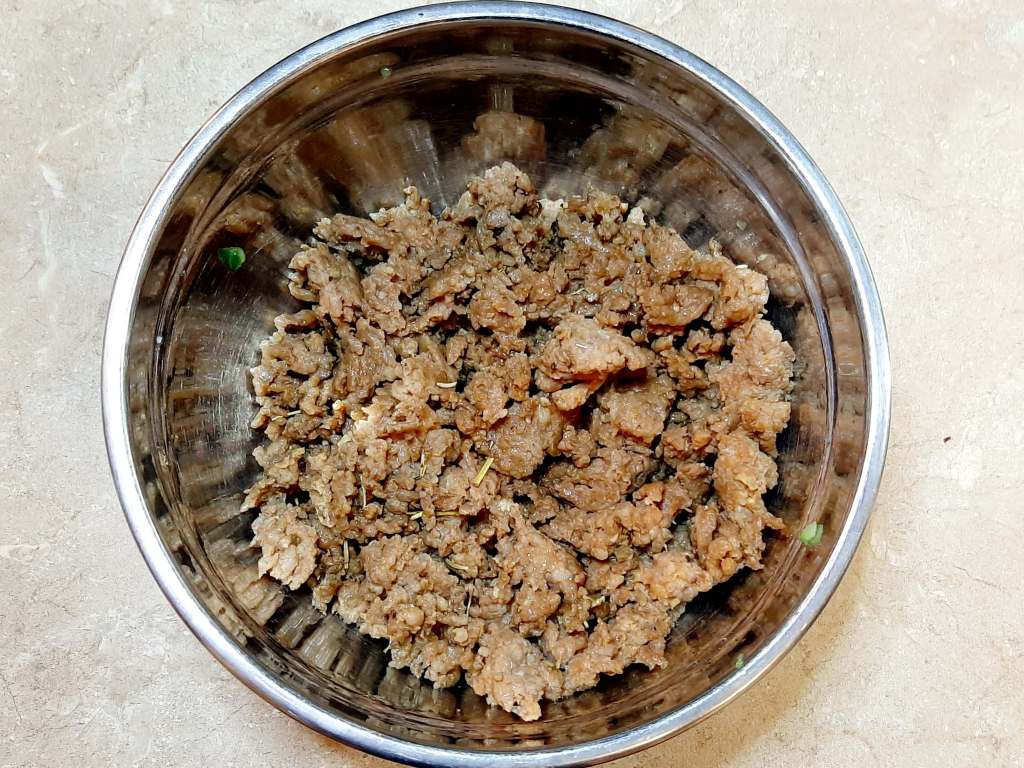
ground meat with spices in metal bowl

Ingredients for Homemade Gyros:

  • 2 tbsp butter or olive oil
  • one onion, peeled and sliced thinly
  • 1 lb each of ground mild Italian sausage and ground beef
  • one green bell pepper, seeded and sliced thinly
  • 1 1/2 tbsp minced garlic, divided
  • one tomato, seeded and diced
  • 2 tsp each of dried oregano, ground cumin, dried marjoram, dried thyme, and ground dried rosemary, divided
  • salt and pepper to taste
  • 12 pita bread rounds or 12 naan flatbreads
  • tzatziki sauce
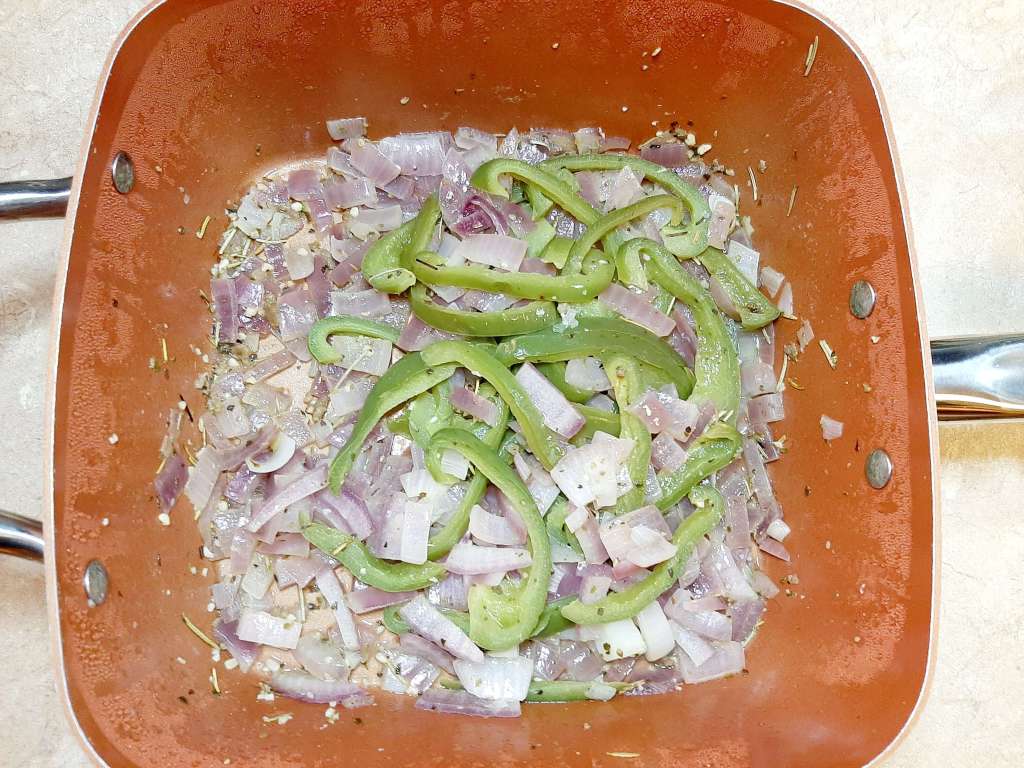
sliced green bell peppers and sliced red onions cooking in square pan

Instructions for Homemade Gyros:

  • Heat butter or oil in large non-stick pan on medium heat. Add ground Italian sausage and ground beef. With a spoon, break apart the meat into smaller pieces.
  • While the meat is cooking, add 1 tbsp of minced garlic and 1 tsp each of the dried spices and herbs. And continue breaking up the pieces of meat till there is no pink remaining. Add salt and pepper to taste.
  • Transfer the meat to a bowl; cover and set aside. In the same pan, add a little more butter or oil for your vegetables. And keep the heat on medium.
  • Then add onion, bell pepper, remaining garlic, and the rest of 1 tsp of dried spices and herbs. Stir till well combined. Next, cover until the vegetables soften.
  • Toast the pita rounds or naan flatbread in the oven for ~ 2-3 mins on each side.
  • And spread tzatziki sauce on the bread, fill with the meat and vegetables; and top with diced tomatoes.

This is not a traditional gyro recipe. Because traditional gyro recipes sort of congeal the ground meats together before cooking them on a rotating skewer. And then the cooked, congealed meat is sliced. Also, there are instructions out there for that kind of recipe, if you’re interested. However, it takes some time to get the meat to congeal. And I don’t have that kind of patience. Sometimes I do, but it wasn’t important for me to have the congealed, and then, sliced meat.

Most meats, like beef, pork, chicken, and lamb go into gyros. Additionally, the spices and herbs I listed for this recipe seem to be common. Though, other recipes might have added or left off one item. So when I started making homemade gyros, I kept the meat ground up, just added the spices, and everything else. Then served them in flatbread. And this is definitely a family favorite. Although, the gyro isn’t complete without the tzatziki sauce.

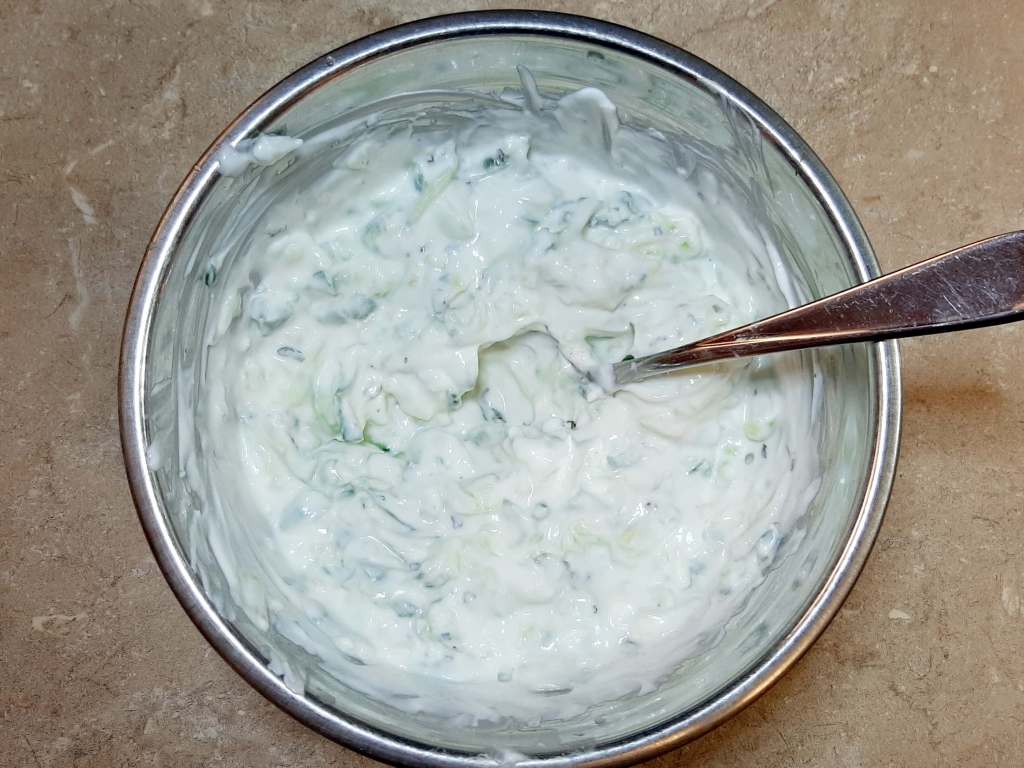
white sauce with spoon in metal bowl

Ingredients for Tzatziki Sauce:

  • 1/2 European cucumber, finely grated
  • salt
  • 1 c Greek plain yogurt
  • 1/2 tbsp minced garlic, mashed with 1/8 tsp salt
  • 1/2 tbsp dried mint
  • freshly ground pepper
  • 1 tbsp extra virgin olive oil

Instructions for Tzatziki Sauce:

  • Toss the finely grated cucumber with a generous amount of salt. Next, leave in a colander in the sink to wilt for ~ 15-20 minutes. Then rinse and drain on paper towels.
  • With a whisk, mix together the yogurt, garlic, mint, salt and pepper to taste, and olive oil. Then stir in the cucumbers. And adjust the seasonings if needed, and serve.

Here’s a link to the original sauce recipe. You’ll notice I’ve cut the recipe in half, because it makes too much sauce. But even with it cut in half, there still remains a lot of sauce leftover.

Thanks for stopping by! If you enjoyed this post, please like, comment, share, and please don’t forget to follow!