Categories
Hens Protecting Your Backyard Birds raising happy, healthy chickens Roosters

What do You do When Chickens Stop Laying Eggs

About 6 months ago I wrote a post regarding signs of elderly chickens. And in it I explained, on average, how long chickens can live. In addition, I described the physical features and habits of aging birds, including egg laying changes. However, what do you do when chickens stop laying eggs?

Well, there are many reasons chickens stop laying eggs besides old age. Moreover, you can prevent a lack of eggs from occurring in some of the cases. Though, in cases like aging, you simply cannot. Continue reading to find out both why chickens stop laying eggs, and what to do about it.

Why Chickens Stop Laying Eggs
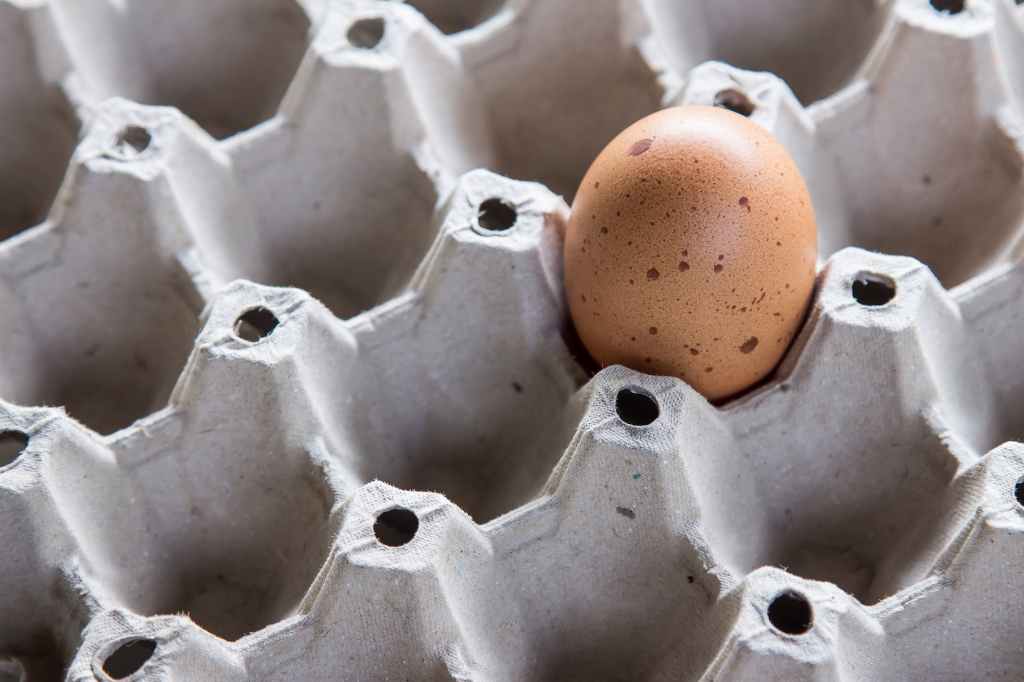
mottled dark brown chicken egg in a biodegradable egg flat
Photo by Aphiwat chuangchoem on Pexels.com

Some of the reasons hens stop laying eggs include

  • shorter days or less sunlight

Hens begin laying when the amount of daylight reaches ~ 14 hours a day in early spring. And maximum egg output occurs when the day length reaches ~ 16 hours a day. Thus, when there’s less sunlight, egg laying will drop off.

When hens molt, rather than using energy for laying eggs, they divert it into regrowing their feathers.

Broody hens will stop laying eggs to set on a clutch of eggs in order to hatch the little peepers for their own.

Egg eating or cannibalism isn’t when a chicken will stop laying eggs. However, it is a terrible habit where a chicken, or many chooks will eat the eggs themselves. Thus, you’ll go to collect eggs, and there will be one or none.

  • extreme temperatures, hot or cold

Either extreme heat or extreme cold will halt egg production. That’s because chickens will need to conserve their energy in either case.

  • health issues

Many health issues, including being egg bound, pests, and parasites can cause hens to stop egg production.

  • inadequate nutrition

If chickens aren’t fed a proper diet, or if they don’t have access to clean, fresh water daily, then egg production will decrease. Likewise, if they are given too many treats or supplements, egg production can be negatively affected.

Sometimes pasture-raised birds lay their eggs elsewhere, other than the coop. However, there are also breeds that are known for hiding their eggs, such as the Ameraucana.

Another major reason hens will stop laying eggs is stress. And that includes stress of any kind: a barking dog or a bullying hen. But adding too many members to the flock suddenly can be just as stressful to your hens.

And the last reason hens will stop laying for a season is predators. If one of your birds is attacked, that particular hen will stop egg output for a season. But if you’re missing eggs in a nest, another predator could be a chicken snake stealing eggs from the nests.

  • and of course, age

Production birds only lay eggs for about 3 years. However, heritage breeds and others can lay a lot longer. Most of my flock are Ameraucana, and the older ones are over 6 years old. And they still lay eggs. Though, they don’t lay every day like they used to.

Solutions when Chickens Stop Laying Eggs
white LED bulb on yellow background
Photo by Riki Risnandar on Pexels.com

If you have hens that stopped laying eggs, you can try

  • adding artificial light

Some poultry farmers use artificial light when there’s less than 16 hours available for their hens to lay eggs. But some, like me, don’t. Because we use this period as a time when our birds can recuperate.

  • switching to a high-protein feed during their molt

This will help your birds convert their energy into regrowing their feathers.

  • breaking the brood

If you don’t want any chicks or a broody hen, break her brood. Either make a broody box or purchase one. But all you do is put the hen in one, in full light, away from the flock for several days. And this should effectively break her broodiness.

There are many tricks offered to stop egg eating. But the only one that truly stopped cannibalism in my flock, without having to kill every bird, was pinless peepers. They’re blinders so the birds can’t see what they’re doing. We left them on for 2 weeks. The birds hated them, but they certainly were reformed!

  • keeping your hens comfortable in extreme temps

If the weather is very hot, keep your birds cool by adding ice to their waterers. Plus, you can make them frozen treats, like the one here. And if it’s very cold, make sure to winterize the coop. If you need instructions, see here.

Other than an egg-bound hen, most health issues that your flock might encounter can be prevented by good biosecurity and a clean coop. However, if you should have an ill hen, quarantine her and take her to the vet. But if you don’t have one where you live, try to find out what’s ailing your bird. And take appropriate steps to help her and the rest of your flock. One of my favorite sites is backyardchickens. Whenever one of my chooks is ill, I check them out.

  • feeding a minimum of 16% protein for laying hens

When hens are ~18 weeks old, they need at least 16% protein layer pellets with increased calcium for shell development. And have a dish of oyster shell available for them as well. In addition, limit treats to only ~ 2 tbsp per day to a hen’s 1/2 cup nutritional requirements. Plus, make sure your birds have access to plenty of clean, fresh water daily.

  • keeping hens cooped until done laying

If your birds are pasture-raised, and they hide eggs or lay different places, you could keep them cooped up till they were done laying. Otherwise, look under trees, bushes, in barns, and every out of the way place you can think of. Chickens are good at hiding eggs, so you might get kids to help look.

  • taking care of the stressor

Having chickens can be like having children. You wear a lot of hats, which means you do a lot of work. You’re a vet, or at least a vet tech, if you live in the country. And sometimes you are animal control. But you’re also a teacher and a student. So, depending on what stress is disrupting egg production, that will determine how you proceed. You won’t use the same solution for a bullying hen as you would a barking dog. That said, separate a bully from the flock for a few days to knock her down a few pegs from the pecking order. Also, proceed with caution when adding flock members; add them gradually. And see how your flock does.

  • making sure your coop and pen are predator proof

The best protection you can offer your flock is by making sure the coop and run are predator proof. That means that no predators of any size can get in anywhere. However, if your birds are pasture raised, the only predators that you still have to contend with are aerial ones.

  • and finally, just try loving them until it’s their time to go

A female chick is hatched with thousands of tiny ova, which are undeveloped yolks. So, chicks are hatched with all the eggs they’ll ever have. And the majority of hens slow down with egg laying around 6 or 7 years old. There’s nothing you can do to magically get an old hen to start laying eggs again.

But that doesn’t mean she’s useless. Far from it. If you only have older hens, invest in a couple of younger ones. And the senior hens will pass on much wisdom to the younger hens. Plus, older gals are great at weed eating and bug patrol. Furthermore, if you want chicks, and one goes broody, they can be great mothers. That’s because broody hens do a better job than we do at raising chicks.

Aside from keeping senior birds, you can slaughter them. Or you can try to find another farmer or homesteader who will take them from you.

What We do when Chickens Stop Laying Eggs
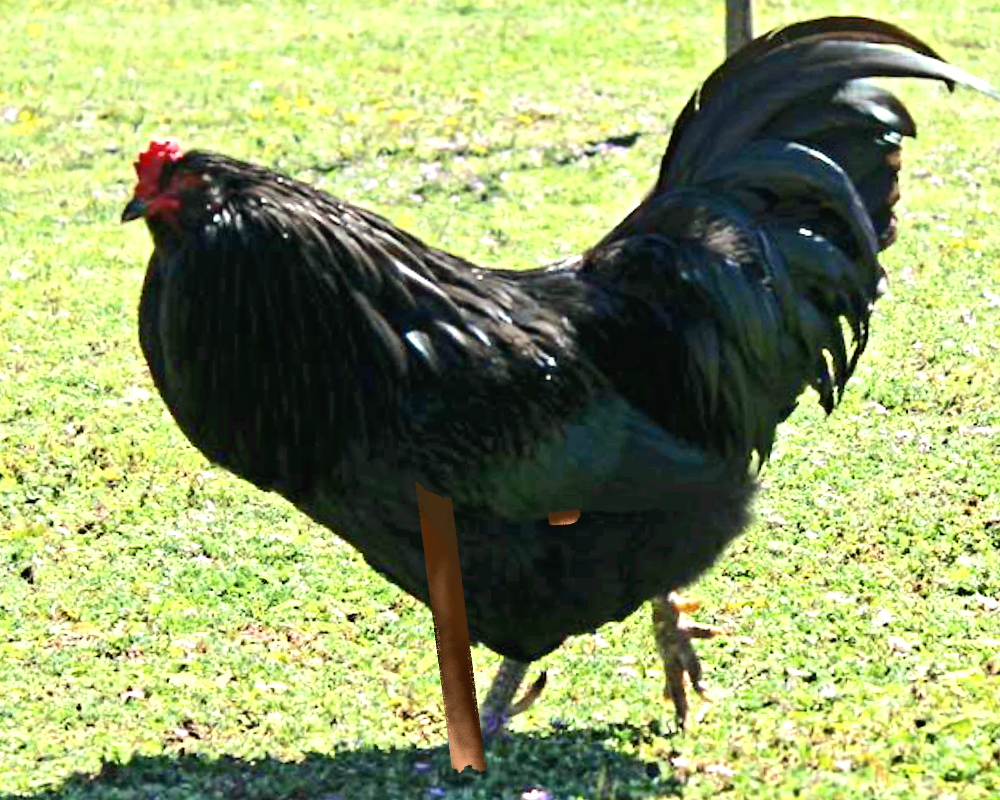
black rooster outside with a digitally superimposed cane
Superimposed Digital Art, Courtesy of Sarah Smith

We saw that chickens can stop laying eggs due to stress, old age, heat and cold, and malnutrition. But illness, broodiness, molting, winter, and predator attacks can also cause hens to stop laying eggs. And cannibalism and snakes can cause eggs to disappear. In addition, there are many different solutions to keep your chickens producing eggs year-long.

We’ve got about 14 or 15 hens who are just over 6 years old. And the boss, Megatron, is ~ 6 years old. He’s the only one who walks with a limp, and has a hard time keeping up with his girls. But that has more to do with his fights with Baby Nay than actual old age. However, I guess those fights did age him.

We keep our birds even when they stop laying eggs at our place. Because they’ve all earned their position just simply by being there. So I guess it’s simply grace and love.

Thank you for taking the time to read this post. Please post a comment and share. And if you don’t already follow, please do so now.

Categories
All animals Chicks Hens non-fowl Protecting Your Backyard Birds raising happy, healthy chickens Roosters

Bird Flu and Chickens

A couple of weeks ago, I wrote a post on factors, such as bird flu, affecting the cost of eggs. Even as egg prices have decreased slightly where I live, HPAI still abounds. What is it? How is it spread? And are people at risk? These are just some of the questions I’ll answer as we discuss bird flu and chickens.

What is HPAI

person with blue latex gloves on holding Petri dish
Photo by Anna Shvets on Pexels.com

While there are 4 types of influenza viruses (A-D), type A viruses are the main ones identified in causing worldwide flu epidemics. Further, whereas types B, C, and D have been detected in other species, including humans, only type A has been recognized to infect birds. Also, avian influenza, a subtype of type A, is labeled as either high or low pathogenicity in relation to genetic features. Thus, HPAI, or highly pathogenic avian influenza is a severely contagious illness caused by influenza type A virus.

History of Bird Flu

headshot of brown goose on lake water
Photo by Simon Reza on Pexels.com

According to the CDC, bird flu was first documented in 1878 in Northern Italy. Fowl plague, its moniker, was characterized by high mortality. And by 1901, it was concluded that fowl plague was caused by a filterable virus. But it wasn’t until 1955 that fowl plague was revealed to be a type A influenza virus. Moreover, in 1981, the term fowl plague was replaced by highly pathogenic avian influenza (HPAI) at the First International Symposium on Avian Influenza.

Then, in 1996, HPAI H5N1 was first observed in domestic waterfowl in Southern China. Additionally, bird flu was subsequently detected in people in 1997, something previously not thought possible.

More recently, as of 2021-2022, a new H5N1 virus with a wild bird adapted gene popped up. Furthermore, it’s caused the biggest outbreak Europe and the US have seen to date.

How does Bird Flu Spread

black and white digital sketch of a chicken sneezing on another chicken with a sign advising them to stay 6 feet apart if ill
Digital Art, Courtesy of Sarah Smith

Given that avian flu is so infectious, how does it spread? Well, based on the USDA website, bird flu spreads directly from bird to bird. However, it can also spread indirectly by coming into contact with something that’s infected. For instance, suppose someone tracks feces from a contaminated farm back to their own farm, and then their chickens walk and peck the ground where said person tracked contaminated feces, picking up the virus. That’s just one example of how bird flu can spread to birds.

Bird flu has caused over 200 million poultry deaths in a host of countries so far.  Additionally, an unprecedented number of non-poultry birds, including wild birds, have died due to the disease. Plus, because of migration patterns of wild birds, they help the virus circulate. Thus, wild birds, rodents, and people are all possible sources of presenting the disease to domestic birds. But what about other vectors?

What are Vectors

multiple flies hovering around faces of 2 cows
Photo by Maurice Engelen on Pexels.com

vector noun

2 a: an organism (such as an insect) that transmits a pathogen from one organism or source to another

“Vector.” Merriam-Webster.com Dictionary, Merriam-Webster, https://www.merriam-webster.com/dictionary/vector. Accessed 19 Feb. 2023.

Over 2 decades ago my father-in-law was asked to assist veterinarians in Great Britain as they were dealing with foot and mouth disease. While he was there, he remarked on how there were a ton of flies on the dead and diseased cattle. He finally mentioned it to someone in charge, even asking what they were doing about the vectors. Unfortunately his observations were not well received, as he was told to keep his mouth shut.

I found this memory poignant, especially in light of all the affected birds from this latest outbreak of HPAI. What are we doing about other vectors? We’re aware of animal, human, and bird vectors that spread the disease. Though, I could only find a couple of examples online, in the US, that even hinted that flies might be vectors. However, this study done over a decade ago didn’t come right out and say that flies spread bird flu. It advised that the flies carried it in the study, so it was possible. But, more tests would be needed.

Though, in the event you want evidence that flies spread diseases, check this site out. It details HPAI outbreak in Japan during 2003-2004, and was linked to the blow fly, a relative of the common house fly. Also, according to the same study above, flies were listed as mechanical vectors. But what’s the difference between mechanical and biological vectors? And what are wild birds and mammals when they spread avian flu to chickens?

Mechanical and Biological Vectors

close up shot of a mosquito on human skin
Photo by Jimmy Chan on Pexels.com

Mechanical vectors, such as flies, pick up an infectious agent and physically transmit it in a passive way. And a biological vector is one in whose body the pathogen develops and multiplies before passing on to another host. Mosquitos are biological vectors for West Nile virus.

Honestly I couldn’t find what wild birds were, whether biological or mechanical. However, since we’re told that birds spread the disease from bird to bird, it would seem they are also mechanical. Although, we’re told as well that wild aquatic birds are natural reservoirs for the virus. Plus, in the intervening years we don’t see the disease before it resurfaces, and it’s mutated, indicates a biological vector is at work. Interestingly enough, birds are reservoir hosts for West Nile virus.

Wildlife, especially mammals, are reservoirs for an enormous diversity of viruses.

1Faculty of Health Sciences, Curtin University, Perth, Western Australia, Australia
2Burnet Institute, Melbourne, Australia
3CSIRO Australian Animal Health Laboratory, Private Bag 24, Geelong, Victoria 3220, Australia
John S Mackenzie: ua.ude.nitruc@eiznekcaM.J
4Address: 20A Silver Street, Malvern, Vic 3144, Australia.

And according to the CDC, aquatic birds, including shore birds and wild waterfowl like ducks are considered reservoirs, or natural hosts, for bird flu viruses.

Symptoms of H5N1 HPAI in Poultry

dead orange and brown colored chicken on grass

Birds infected with the virus may show one or more of the following:

  • sudden death
  • lack of energy
  • reduction in egg production
  • soft-shelled or misshapen eggs
  • swelling around head, neck, and eyes
  • purple discoloration on head and legs
  • gasping for air (difficulty breathing)
  • nasal discharge, coughing, and sneezing
  • incoordination (stumbling or falling down)
  • twisting of the head or neck
  • and/or diarrhea

What You Can Do

Biosecurity is currently the best policy if you have backyard birds. Read below for recommendations:

person washing hands
Photo by Ron Lach on Pexels.com
  • Disinfect clothes, shoes, egg trays, vehicles, crates, etc.
  • Don’t expose cleaned and disinfected tools and equipment to wild birds.
  • Wash hands and shoes before and after entering chicken yard (area).
  • Buy birds from reputable sources; and isolate for at least 30 days to observe for any signs of illness before mixing with the rest of your flock.
  • Restrict visitors on and off of your property, especially from having contact with your flock.
  • Don’t visit other poultry farms, and avoid visitors that have poultry.
  • Keep wild birds and rodents out of the coop and poultry areas.
  • Don’t let your birds have contact with migratory waterfowl or other wild birds.
  • Secure feed and water to guard against contamination.
  • And have a written biosecurity plan.
  • Finally, if you’re working around sick birds, wear PPE; and visit the CDC site for more info.

In the past, simply culling birds and the heat from summer seemed to keep the virus in check. However, with this latest outbreak, it hung around. And now, some countries are even considering poultry vaccines for H5N1. It’s a measure of desperation. Costs and the need to have a vaccine for all of the strains are just a couple of reasons vaccines haven’t been used before.

Are People at Risk

a person holding pen and paper with graphs
Photo by Karolina Grabowska on Pexels.com

Poultry and wild birds aren’t the only animals being affected by avian flu since 2021. Thus far, several mammals in both Europe and the US have been infected by H5N1. Red fox, opossum, raccoons, a coyote, striped skunks, harbor and grey seals, a bottlenose dolphin, a fisher, 3 types of bears, a mountain lion, a bobcat, an Amur tiger and an Amur leopard all have been found positive for the H5N1 virus in the US.

Likewise, seals in Scotland, sea lions in Peru, and lastly, mink in Spain have also been identified with the virus. Given that mink seemed to pass the virus between themselves gave virologists concern. Furthermore, past studies have revealed mink to be vulnerable to avian and human influenza A viruses.

The high seroprevalence of combined avian and human influenza viruses suggests a strong likelihood of co-infections and thus farmed mink could serve as “mixing vessels”…. 

aKey Laboratory of Animal Epidemiology and Zoonosis, Ministry of Agriculture, College of Veterinary Medicine, China Agricultural University, Beijing, People’s Republic of China
bDepartment of Biostatistics, University of Michigan, Ann Arbor, Michigan, USA
cChinese Academy of Sciences (CAS) Key Laboratory of Pathogenic Microbiology and Immunology, Center for Influenza Research and Early-Warning (CASCIRE), Institute of Microbiology, Beijing, People’s Republic of China
dSchool of Public Health (Shenzhen), Sun Yat-sen University, Guangdong, People’s Republic of China
eSchool of Veterinary Medicine and Science, University of Nottingham, Nottingham, UK
CONTACT Jinhua Liu nc.ude.uac@hjl
*Honglei Sun and Fangtao Li contributed equally to this work.

Nevertheless, the CDC advised that humans lack the type of cell receptor in the upper respiratory tract that H5N1 viruses use to cause the disease. Plus, according to WHO, this current strain of H5N1 has caused less than 10 infections worldwide. And only 1 was in the US. In addition, it mainly affects those who have close contact with sick birds. Moreover, there have been no known human-to-human transmissions of the H5N1 virus that’s presently spreading globally among birds.

In Summary

green rotary telephone
Photo by u5e7bu5f71u591au5a92u4f53 3D on Pexels.com

Bird flu has been around a long time. And each time it returns, it’s changed a little bit more. Further, there are a number of ways bird flu can spread to poultry. Additionally, even though it’s been identified in some mammals, the threat to humans is still considered low.

However, if you see any of the symptoms listed above in your birds, you are encouraged to contact your agricultural extension office/agent, local veterinarian, local animal health diagnostic laboratory, or the State veterinarian; or call USDA toll free at 1-866-536-7593.

Thank you for taking the time to read this. Please comment, share, and follow.

Categories
Chicks Hens raising happy, healthy chickens Roosters

Why Eggs Have Gotten So Expensive

Many people continue to be concerned over the exorbitant cost of eggs since November 2022. And everyone wants to know when it’s going to get better. According to the CPI, retail egg prices increased 11.1% ~ 2 months ago. In addition, prices rose 59.9% this past December compared to December 2021. Therefore, from a chicken farmer’s perspective, I’ll explain why eggs have gotten so expensive.

Every so often I’ll glance at egg prices to make sure we’re getting paid what’s fair. To be sure we give away far more eggs than we actually sell. But feed is never given away. Where I live, the cost has doubled since 2020. Anyway, it’s been months since I last saw the price for a dozen pasture raised eggs. Thus, out of curiosity I checked prices the other day. While pasture raised eggs are only ~ $1 more here, store-brand eggs are practically the same price as pasture raised! That’s quite a hike.

But what’s driving the increase? Is it really what we’re being told? Or is there something sinister going on? Stay tuned for the reasons eggs are more expensive.

digital drawing of neon green dollar sign on white background
Digital Art, Courtesy of Sarah Smith

Reasons Eggs are More Expensive

  • H5N1 (Avian Influenza), and HPAI (Highly Pathogenic Avian Influenza), which spells Bird Flu

Firstly, bird flu is an illness that can affect both birds and people. However, HPAI is considerably more contagious. Although, it mainly affects poultry and wild birds. Whereas the human strain of bird flu is treatable, the bird strain is not currently.

Therefore, the only thing to be done is to cull flocks wherever it’s found. Additionally, all farms within a 6 mile radius of confirmed cases are tested. Then those flocks with verified bird flu are also eradicated. Consequently, to date per the USDA and CDC, 58 million birds, including ~ 43 million egg layershave been affected,” involving 47 states. Which indicates some died as a direct result of the disease. Nevertheless, the majority were euthanized.

Given that most eggs sold on store shelves are from production farms, they would have to start completely over. And it takes anywhere from 4-6 months before new hens start laying. So you take 43 million layers out of production around the holidays, and well, there you have it.

  • Inflation

Since mid-2021, world economies have been experiencing a global rise in inflation. From 2020 and 2021, the IRS sent out Economic Impact Payments, or stimulus checks totaling $803 billion. And the US wasn’t the only country that dumped money into the economy. Then, not only did we face supply and labor shortages, but there were price increases in the construction sector.

And then there’s too much demand, and not enough supply. According to IMF, the comeback in demand we experienced in the US strained supply chains and also caused inflation to rise abruptly. 

All of these could realistically be the fallout from Covid-19. However, the war in Ukraine is a different matter entirely. But one that affects inflation as well. For instance, due to sanctions, commodities like metals, food, oil and gas have not only been disrupted, but likewise have been more expensive. And basically all of these things taken together affect egg producers with their overhead: feed, housing, employees, water, vet bills, etc.

Molting occurs predominantly in the Fall, and it lasts about 3 months. I have ~40 birds, 20 of whom molted due to their age. And while I have ducks and young roos that don’t count, I only had 9 chicken egg layers up till recently. But thankfully, our egg production is back up.

So molting is that time of year when chickens lose their feathers and basically have a 3 month long vacation. For established layers, they require that break from all the hard work we put them through. And for new layers, they don’t get one until they’re about a year old. Thus, unless egg producers have new and mature hens, the established, older hens would have been molting and resting up till now. And that would affect egg production and prices.

  • Lastly, What about Price Gouging or Poisoned Feed?

According to Farm Action, a non-profit that fights corporate monopolies, price gouging is exactly what’s going on with egg prices.

While consumers have become increasingly cash-strapped since the pandemic, corporations have enjoyed their most profitable two years since 1950 as their profits jumped 35 percent.

Written and edited by: Jessica Cusworth, Dee Laninga, Angela Huffman, Joe Maxwell, and Basel Musharbash

And the egg producer with the fattest wallet is none other than Cal-Maine. Further, as reported by Farm Action, Cal-Maine’s gross profits rose five-fold.

However, according to Cal-Maine Foods, they don’t sell their eggs directly to the consumer, but to retail customers, like grocery stores, etc. On their website, they go on to say

Cal-Maine Foods sells its eggs at prices negotiated with each customer. In many cases, the Company, and it believes its customers, look to independent, third-party market quotes published by Urner Barry, the leading provider of protein market news and information for the food industry. Urner Barry’s pricing methodologies and processes received third-party assurance that they are aligned with the International Organization of Securities Commission (IOSCO) Principles for Price Reporting Agencies.

Cal-Maine Foods Contact:
Max P. Bowman, Vice President and Chief Financial Officer
(601) 948-6813

The poisoned or RNA feed theory isn’t even worth my time, because it’s so ludicrous. Chickens ALWAYS stop laying for ~ 3 months during the fall. And sometimes in the spring. In fact, people who’ve had chickens for more than a year should also be aware of this fact. See molting above!! Or check out my post on molting.

When Will Egg Prices Improve for the Consumer

photo of a kid decorating an easter egg near a lamp
Photo by Pavel Danilyuk on Pexels.com

Factors like China’s strict Covid policy, and recent relaxing of that policy has and will affect worldwide economies and thus inflation. Likewise the war in Ukraine will proceed to affect economies as well.

Though, at some point the Federal Reserve wants to return the inflation rate to 2%. Plus, according to the International Monetary Fund, so far overall measures of inflation were decreasing. But core inflation was still high.

Regardless, as of this post, prices have either stayed the same or were a little lower on the USDA site. Although, due to demand, likely egg prices will be high for the Easter season. Besides, until HPAI is no longer active and therefore a threat to poultry, the prices will continue to remain uncertain.

3 white chicks outside on the ground
Photo by Feb Larlyn Rabaja on Pexels.com

Things to Do or Not to Do

So you might be wondering if there is anything you can do to help your individual situation. Or do you just grin and bear it? Well first, you don’t want to

  • Smuggle eggs

Per Border Report, between October 1 to the end of last year, U.S. Customs and Border Protection reported a 108% increase in confiscated egg products and poultry at ports of entry. Don’t do it, because it’s illegal. And it’ll cost you, the eggs and a possible fine.

  • Get your own chickens

Not only has egg production been affected by bird flu, but obviously chicks and chickens have been too. And again it takes a chick 4-6 months to mature enough to lay an egg. Plus, there are many upfront and continuous costs involved: the coop, feeders, waterers, and feed. Then you have to think about predators, illnesses, and accidents.

However, you should ask yourself whether you’re committed to seeing it through. For example, after the heyday of Pandemic chickens, when things started to feel normal, hundreds of US chickens were surrendered to sanctuaries. And many of those organizations are still at max capacity. If you aren’t going to have time for chickens when they get inconvenient, messy, sick, etc, or the economy improves, then don’t get chickens.

On the other hand, there are some things you can do, such as

  • Buy eggs from local farmers

Supposing you live somewhere not hit by bird flu, reach out to people who already have backyard birds, and support them!! I’ve looked on my Facebook groups too and checked prices for eggs. And like me, my fellow chicken farmers are way below store prices. It’s obvious none of us make a profit. If I could at least cover the cost of feed, that would be great, but I doubt that even happens.

Therefore, get on FB and check out some chicken groups, if you don’t know any backyard chicken farmers. There’s gotta be one near you. And start shopping for eggs.

  • Purchase alternative eggs

Even if you can’t get backyard chicken eggs, you could still find backyard duck, quail, or guinea eggs. They each have distinct flavors. And some are better for certain dishes than others. However, you could also try JUST Egg, which are plant based eggs.

Furthermore, there are other egg substitutes for baking. For instance, buttermilk, applesauce, yogurt, pumpkin puree, and banana are just a few options.

So, Why Have Eggs Gotten So Expensive?

brown eggs on brown wooden bowl on beige knit textile
Photo by Pixabay on Pexels.com

Aspects such as the war in Ukraine, inflation since Covid, highly pathogenic bird flu, and molting have affected egg production and prices. But with China easing its draconian Covid policy, global economies have improved. And inflation has started to wane. However, with Easter coming up soon, and bird flu still hanging around, it may be awhile before egg prices drop to previous levels.

Though, there are options you can take to avoid the high cost of eggs. You can purchase from local backyard groups. Or you can try alternatives such as duck or guinea eggs. And there are even plant based options available.

Thank you for reading this post. If you enjoyed it, please like, share, and post a comment. And please don’t forget to follow!

Categories
Hens Protecting Your Backyard Birds raising happy, healthy chickens Roosters

How Many Hens Should You have per Rooster

Since this blog’s inception, I’ve brought up ratios of hens to roosters many times. But depending on which website you visit, and whether you’re wanting chicks, there are conflicting proportions. So today, I’ll officially answer how many hens should you have per rooster. Further, we’ll also explore chicken mating, and possible problems associated with it.

I’ve seen ratios anywhere from 6 hens per rooster to double digits. Plus, the literature indicates some breeds mate more aggressively than others. However, when I tried to find out which breeds exactly, only aggressive chicken breeds showed up; not aggressive mating chicken breeds.

How Many Hens Should You have per Rooster

mixed flock of ducks and chickens outside
Bakugo is the white duck making a b-line to Megatron. She always finds a way to spend time with him.

The smallest proportion I read of implied that you could safely have one rooster with 2 to 3 hens, if you so choose. Although the quotation specifically highlighted that the birds were adults, not juveniles.

Though I disagree with this quota for a few reasons:

  • First, chickens are considered adolescents until they reach ~ 17 weeks.

It’s at this point that backyard birds become sexually mature, which means they can breed, start to lay eggs if hens, or fertilize them if roosters.

I have had 5 real roosters, since the first 9 didn’t count. And all of them, including the adult males, tread hard on the gals until the boys are around 3 or 4 years old.

For instance, Casanova, our first real roo, just started to be gentle before he died at ~ 3 years old. I imagine he was gentle because he was older and lighter; not because he was an adult. (He was the smallest rooster, and probably chicken, we had.)

And now my current senior rooster, Megatron, has slowed down considerably since I first got him. He is now over 5 years old, and in the past couple of years, he has become a more gentle lover to his girls.

But it’s at this specific age that a rooster’s chances of fertility decreases.

  • And lastly, I have over 30 adult hens, ~ 8 juvenile hens, and 2 adult roosters, one whom I informed you has slowed down.

So Megatron’s son, Tiny Nuts, who is around 1 – 2 years old is the main roo servicing the gals. And he has currently torn up maybe 10 hens’ backs; all in different conditions. Some with a few feathers out, some with a lot of feathers out. And some hens with back and head feathers out. All by himself, while he has mostly 30 hens to himself. And we’re supposed to believe that this adult is considered gentle? Yeah, I’m not buying it either.

Chicken Romance

Before I answer the main question, I’m going to dissect the courtship of chicken romance. It’s certainly different than human romance.

Cockerels first ready to mate are all over the place, running hither and yon from one hen to the next, all because they’re trying to sneak some nookie in behind the boss’s back. And they’re uncoordinated, rough, and generally look like they don’t know what they’re doing. Plus, the girls are all taken by surprise. And some of the hens are older than those boys and don’t want to be ridden by another roo.

However, as the cockerels mature into adults, they pick up some tricks to wooing the hens. They include

This is where the rooster will find a treat and make the look, look, look noise to attract a hen, all in the hopes of garnering her favor.

  • and dancing

Most people are familiar with the rooster dance. And it’s where the rooster drops one wing to the ground as he shuffles around the hen whom he’s interested in. Typically at the end of the dance he’ll try to mate with her.

Although some roosters aren’t interested in performing any tricks to woo the hens. They’re all business and just take charge. Casanova was really good about wooing the hens; I like to think it was because he was so small, and so needed to make a good impression. And Tiny Nuts is good about wooing. But that could be due to him being the bottom roo. On the other hand, Megatron could care less about that kind of stuff. He’s the boss.

Chicken Mating

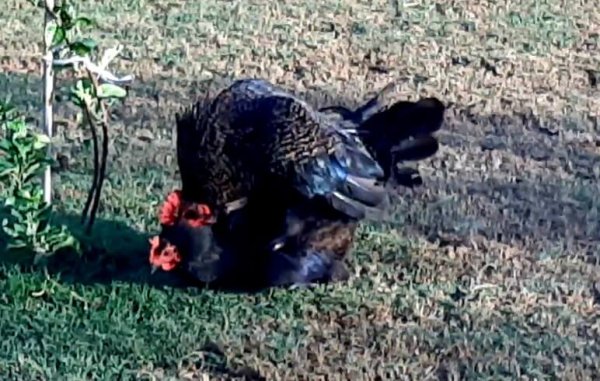
2 chickens mating on grass outside
Baby Nay caught in the act.

Consider this a biology lesson in chicken procreation. But I’m sure it’s nothing you’ve never seen before. And generally chicken sex is fast, lasting no longer than a few seconds.

Typically, in a willing partner, the rooster will go up to the hen, and she will squat for him. Then he will grasp her neck feathers with his beak as he climbs onto her back, balancing himself with his feet. This act is referred to as treading. Roosters have no outward appendages; everything is internal. So both of their cloacas must touch in order for him to transfer his sperm, in what is known as the cloacal kiss. And once they are finished, both shake themselves. Plus, he doesn’t thank her for her time, give her a kiss, or even a backward glance before he’s on toward the next possible hen.

In addition, rooster’s sperm can last about 2 weeks inside of one hen. And if she’s a healthy hen that lays daily, that should equal about 14 fertilized eggs. But it takes about 25 hours for the sperm to fertilize the next egg in the hen’s body. Also, interestingly enough, hens can store sperm from more than one rooster at a time. And a single rooster can mate up to 30x a day, producing as much as 35,000 sperm every second of his life, which is 40x more sperm than a human male.

Potential Problems with Chicken Mating

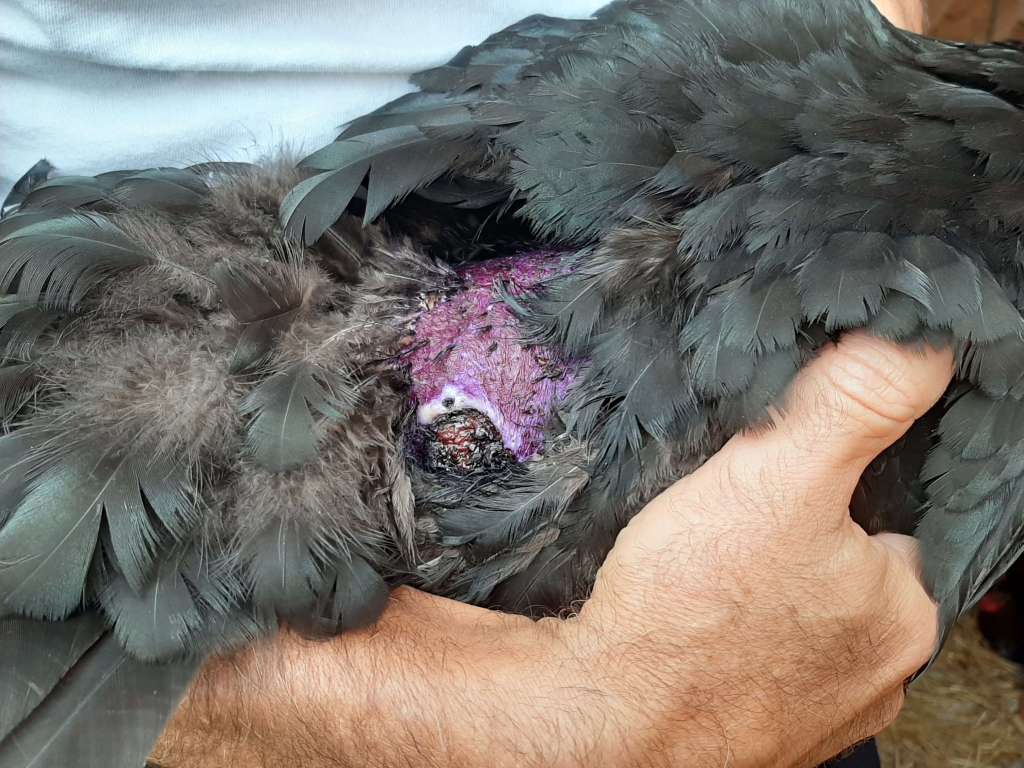
purple stain on laceration on black chicken's back
Baby Nay did this to his favorite hen when we had him. Well, she ended up going broody, and we locked him in rooster jail; so she was able to heal perfectly without any more assault.

I already explained what it looks like with sexually mature cockerels. But if you have several, it will look like chicken gang rape, I kid you not. And the boss rooster won’t be able to control it. He may even join in to show his dominance, however the gals are the ones to suffer. That’s what Casanova did with every one of his 7 sons the first time we incubated eggs. I guess, he decided, if he couldn’t beat them, he’d join them.

Other signs of mating issues include

  • missing back feathers on hens’ backs
  • missing neck feathers from hens’ necks
  • skin lacerations where feathers are missing
  • and fights consistently breaking out between roosters

If you see any of the above, then it’s time to do something about your chicken mating situation.

Ok, So, How Many Hens Should You have per Rooster

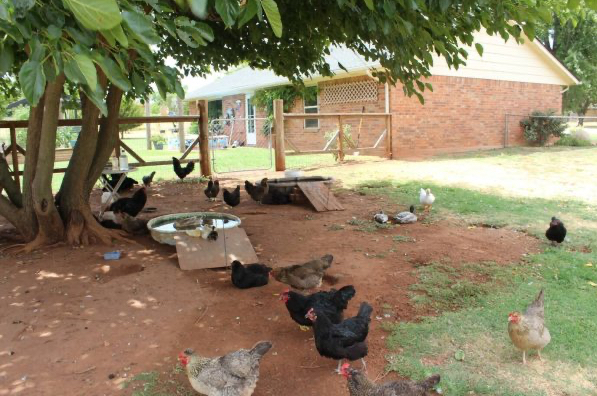
mixed flock of domestic birds under a shade tree with kiddie pools

All right, so having only 2 to 3 hens per rooster is not feasible, because we learned that even though roosters are considered adults after their first molt (~ 1 year old), they don’t settle down until they’re around 2 or 3 years old. That’s when they mellow with the ladies and start treating them right. At least that’s been my observation with all of my roosters: a small Cream Legbar and all of my Ameraucana and Easter Egger roosters, all of whom are considered docile.

Therefore, if you’re seeing any issues with your hens then

  • put a limit on the number of roosters

Roosters are highly virulent until they reach ~ 3 to 5 years of age, which means they may mate aggressively until they start to slow down. They don’t even have to be an aggressive breed: case in point, my roosters. None of mine are considered aggressive breeds. Yet they still tear up my hens, no matter how many I have available for them.

So what’s the magical number? I personally think 6 is too small. Your hens will get damaged with 1 rooster per 6 hens apiece. Therefore, the more the merrier, if you can spare them. However, if you’re wanting to specifically breed your birds, then it’s recommended to have 10 hens per rooster, in order to maintain fertility.

  • separate the injured hens

Any hens with lacerations should be kept out of the breeding pool until they have healed. And apply Vetericyn or Gentian Violet Spray .5% daily. Plus, once they’re better, and feathers have started to grow, place a chicken saddle on their backs to prevent any more issues.

Many sites recommend putting the saddles on before the hens have healed. Though I noticed the feathers on our hens never grew back unless and until the saddles were off. Thus, the separation of the rooster(s) and injured hen(s).

  • isolate the roosters until needed for breeding

If you’re wanting fertilized eggs, or to breed your flock, keep your roosters separate from your hens in a distinct enclosure. In this way your hens won’t be misused.

To Summarize

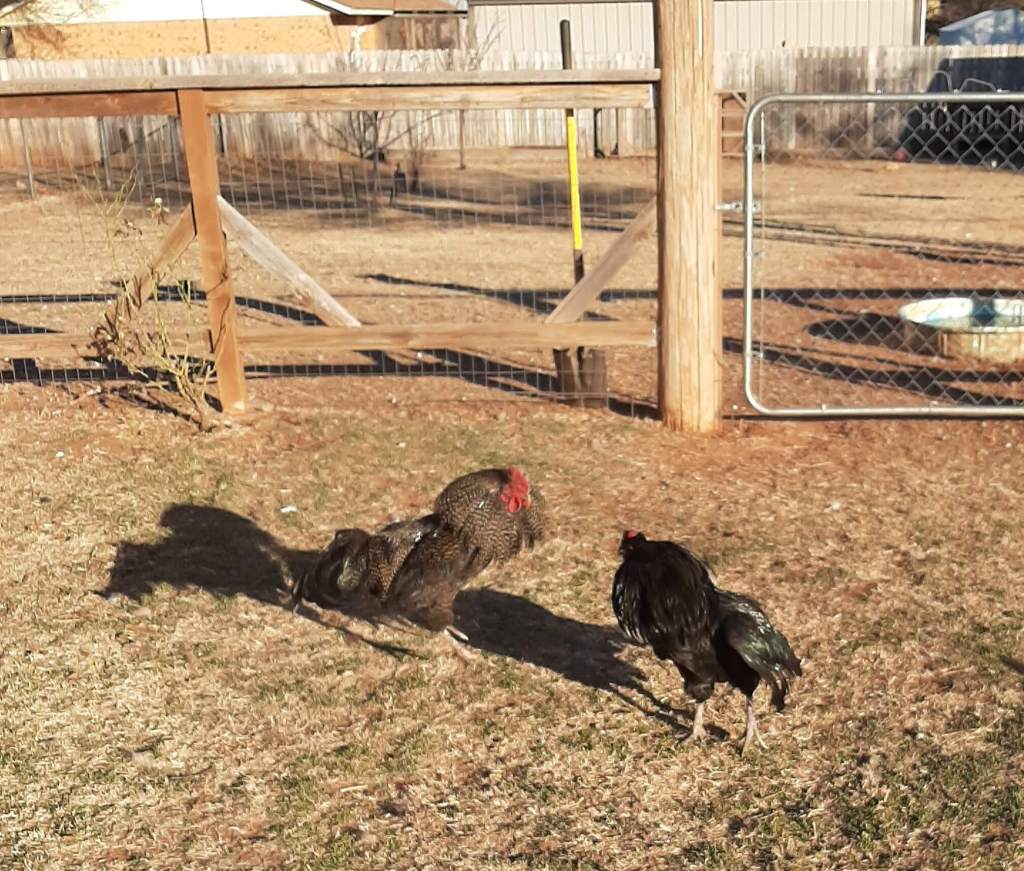
one spotted olive egger rooster and one black Ameraucana rooster fighting outside

We learned that roosters are highly virulent, and therefore, mate aggressively until they’re about 3 years old. And because of that, it’s best to have at least 10 hens per rooster if you’re breeding them. Less than that, the roosters will definitely injure your hens with feathers torn out and back lacerations. Furthermore, we learned all about chicken romance and mating. And also that if there aren’t enough hens per rooster, not only will the hens be at risk for injury, but the roosters will constantly fight.

How many hens do you have for your roosters? And how do they get along? Your comments are appreciated.

If you enjoyed this post, please like, share, and please don’t forget to follow!

Categories
Chicks Hens Protecting Your Backyard Birds raising happy, healthy chickens Roosters

Chicken First Aid Kit Contents

I’ve been an animal lover for 4 decades. But it wasn’t until 2015, or since chickens, that we started collecting what would be considered animal first aid items. If you have backyard birds long enough, sooner later, something will pop up, requiring you to have a few essentials. Thus, I thought it would be helpful to share some basic chicken first aid kit contents.

From the moment we’ve had dogs and cats, we’ve never had to perform any type of first aid on them. On the other hand, our fur babies have a veterinarian, whereas our feather babies do not. And unfortunately a lot of the advice online can be contradictory. Plus, some issues necessitate quick action. Therefore, we’ve had to learn how to take care of our birds ourselves. In addition, when we started out, we had a small flock. So, little by little, we began adding items to what became our chicken first aid kit.

Chicken First Aid Kit: The Container

chicken first aid kit with assortment of bandaids, scissors, electrolytes, etc, in a blue and clear plastic box

When we first started making our kit, little did we know that’s what we were doing. Hence, ours was in our medicine cabinet, until one day it was gigantic and no longer fit. Now we have everything in a tackle box that’s easy to locate and move. So get a caboodle, makeup box, or a tackle box. But make sure it’s

  • Portable
  • Within easy reach
  • And easy to carry

Chicken First Aid Kit: Chicken Hospital

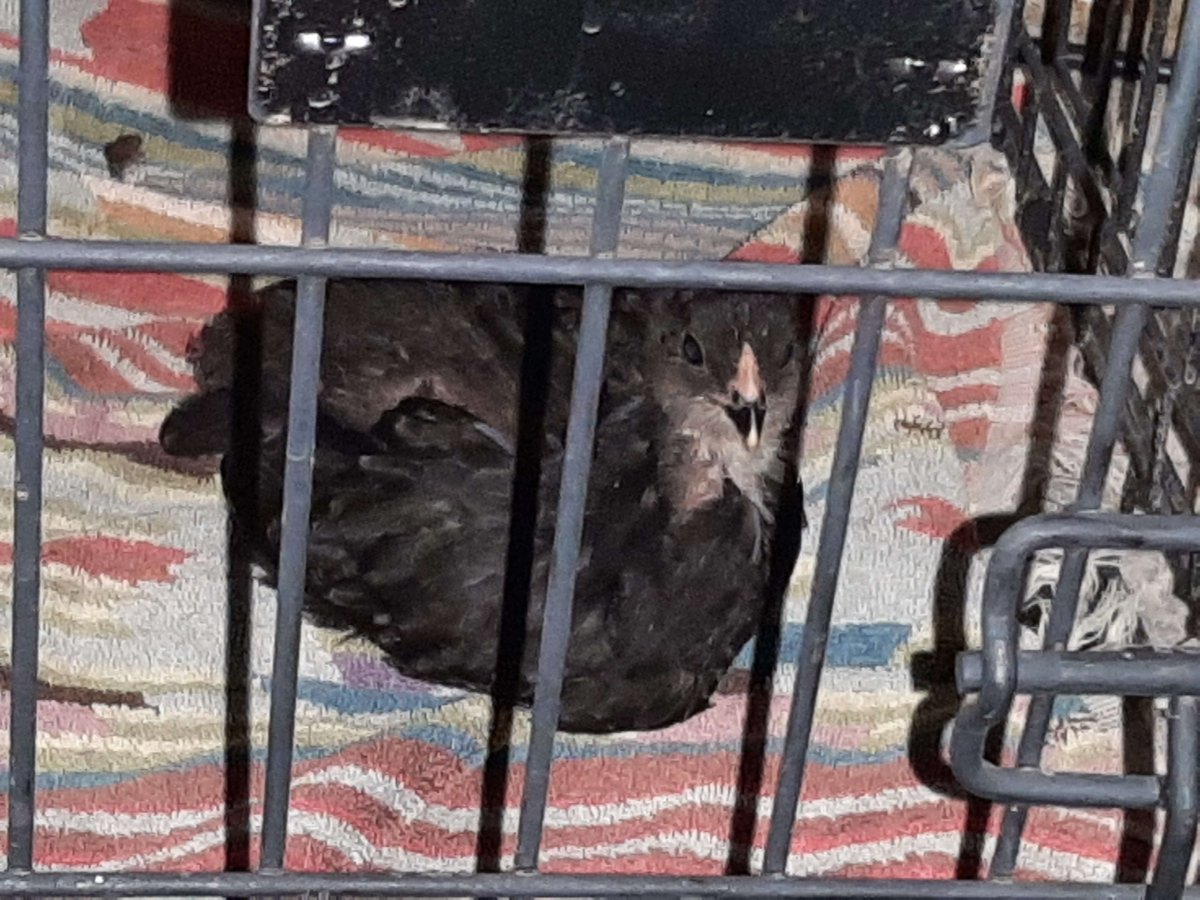
black metal pet crate with old towel on top of it

Since most injuries and illnesses require separating the chicken from the flock, this is where you will house them until they are well enough to mingle back with the flock. Ideally you need

  • A pet crate or carrier

If possible, make sure the chicken hospital is big enough for the patient to be comfortable during their stay.

  • And old towels

Towels you no longer use are to help make the patient comfortable.

Some injuries aren’t serious enough to warrant total isolation from the flock. For example, if you have a hen with sores on her back from an overeager rooster, then she can stay in the the safety of the crate while still in the coop. That way she won’t worry about pecking order issues.

But more concerning problems of contagious illnesses demand the chicken be separated to prevent spreading the illness. Further, urgent medical issues require the bird to be isolated to help calm them down.

Online discrepancies abound, regarding whether to leave the chicken patient in the coop or isolate them. And both have valid reasons for their points. Personally, I’ve done both, depending on the nature and/or seriousness of the issue. But all the times I’ve kept my chicken patients away from the flock, they’ve been calm, and they didn’t seem lonely. In addition, my reasons were justified for keeping them isolated.

Chicken First Aid Kit: Disposables

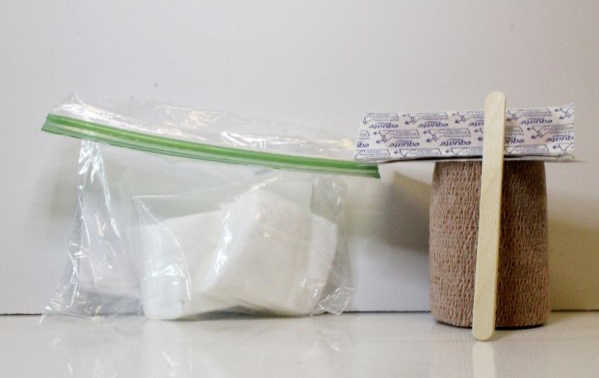
cotton 2x2s, Coban, bandaids, and popsicle stick

When I made this list, I really wasn’t sure how to itemize it. As you’ll notice, some of these things can go in multiple categories. Plus, you potentially have some materials in your house now, which can also be taken from your own first aid kit; just be sure to replace anything you swipe from your personal kit. However, for the disposables, you need

  • Q-tips
  • Non-stick gauze
  • Disposable gloves
  • Coban or vet-wrap
  • Bandaids
  • And popsicle sticks for splints

Chicken First Aid Kit: Dealing with beaks, nails, and spurs

battery-powered nail file and superglue

Rather than putting these few items in their prospective categories, I just made their own section. Further, they all use the same supplies, such as

  • Dremel tool or other battery-powered tool
  • Superglue
  • And styptic powder or alum

Chicken First Aid Kit: Tools or Instruments

box of assorted sutures, hemostats, scissors, and surgical forceps

Once again, some of these you should have in your medicine cabinet. Although, with the rest of these items, we collected from various trips to the emergency room for sutures. And since hospitals just throw suture kits away after using them, we asked if we could keep ours. The rest I ordered. Therefore, in your kit you should have

  • Tweezers
  • Scissors or surgical grade scissors
  • LED headlamp
  • Surgical forceps
  • Hemostats and resorbable sutures
  • And disposable scalpels

Chicken First Aid Kit: Antiseptics

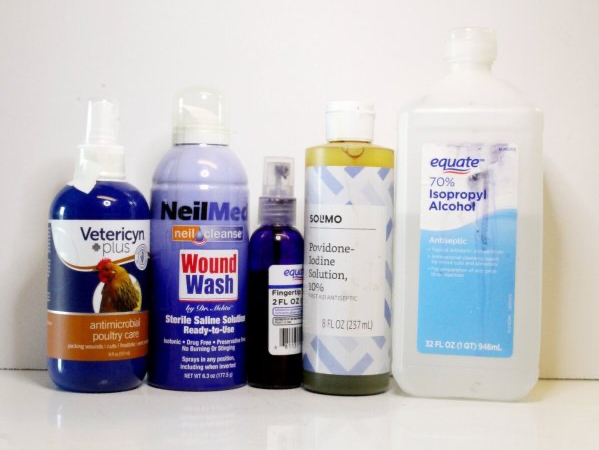
assortment of antiseptics and poultry first aid care

With the exception of rubbing alcohol, I had to order all of the items in this section, at one time or another. So make sure you have

  • Rubbing alcohol (to sanitize instruments)
  • Gentian violet .5%
  • Iodine
  • Sterile saline (for washing wounds)
  • and Vetericyn

Chicken First Aid Kit: Anti-inflammatories and Salves

big bag of epson salt, almost empty bottle of astroglide, and tube of hydrocortisone

From having a hen who’s egg-bound to having one with sour crop to having another one with vent prolapse, the following is what you’ll need in your chicken first aid kit.

  • Salve or Vaseline (for mites or frostbite in the winter)
  • Epson salt (has many uses)
  • 1% hydrocortisone (for vent prolapse)
  • and a Water-based lubricant

Chicken First Aid Kit: Medicine, Vitamins, Electrolytes, and Pain Relief

assortment of poultry medicine and vitamins for illness and injury
  • Neosporin
  • Enfamil poly-vi-sol infant multi-vits (without iron)
  • Medicine dropper
  • Electrolytes
  • Probiotics
  • Vet-Rx (for respiratory issues)
  • Fishbiotics (which is amoxil 500mg, for surgical procedures like impacted crop)
  • **And topical anesthetic spray, like hospital formula benzocaine (also for the above mentioned surgery)

**There is some mis-information, and thus confusion on multiple sites as to whether you can give any anesthetic to chickens. For example, multiple sites claim you can’t give anything to chickens if it has caine on or in it. And that’s not true. In fact, I watched a Dr perform a surgery on a chicken, after he injected it with anesthetic. And as far as I know, all anesthetics contain caines. Further, the chicken did not die; she survived the surgery and the anesthetic.

However, the real issue is epinephrine, which is added to local anesthetics to prolong local anesthesia and prevent additional blood loss. Thus, in someone who might have heart issues, or a small animal, it could present problems. But because benzocaine is only a topical, it is clearly the better option for backyard chickens. You can read more about it here.

Chicken First Aid Kit: Advice

advice lettering text on black background
Photo by Anna Tarazevich on Pexels.com

The items you see in bold are some of the first, and only, items we used while first involved with chickens. Though now it has definitely grown and evolved. You too may also already have some things you use on and for your birds. So the materials in bold are a suggestion only, to have on-hand what you will eventually need.

My last bit of advice is when Googling your bird problems, read at least 3 other suggestions, and not necessarily the top 3. They might not be right. And after you’ve received 3 suggestions from Google, cross reference them. For instance, if I read that something won’t work or is harmful, I Google why that something won’t work, like what will happen, especially if there isn’t a link to the original article. You’ll be surprised by how many answers you get that will contradict what you were just advised.

Lastly, taking care of injured or sick chickens is just like anything else: it isn’t cookie cutter perfect. Nobody knows your birds better than you. You will have to adjust and use your intuition based on your understanding of your flock. These are all suggestions according to my experience with my flock. And it has worked for us. But I Google several sources, and not the most popular ones either, and adjust the care instructions to gear them toward my flock.

Have you made a chicken first aid kit? Or have you had to use first aid on a chicken? Your comments are appreciated.

If you enjoyed this post, please like, share, and please don’t forget to follow!

Categories
Chicks ducks Hens other fowl Protecting Your Backyard Birds raising happy, healthy chickens Roosters

Can You Mix Ducks with Chickens

Chickens are often the first bird homesteaders will tackle before raising other livestock. They cite practical reasons: food, composting, and pest control. Since ducks are some of the smartest and hardiest, they debut on the farm after chickens. But before getting any birds, I’ll answer the question Can you mix ducks with chickens.

You can, in fact, raise chickens and ducks together. However, there are some slight differences with both kinds of birds. And, with careful consideration, you should have no problem mixing both. So, whether or not you’ve purchased any ducks, just continue reading.

Brooding Facts for Both Ducklings and Chicks

chick feed in a shallow dish with chicks in a brooder

Recently I wrote an in-depth article explaining how to raise ducklings and chicks together. So I’m only going to list the main points.

  • Provide the same feed for both

Contrary to popular belief, you can give medicated feed to ducklings, as I explained a short while ago. But no matter what, by the 3rd week, make sure the protein is no more than 18%, or your ducklings will be at risk for something called Angel’s Wing. And provide niacin in the form of brewer’s yeast, so the ducklings can thrive. (This needs to be provided lifelong in the duck’s diet.)

Also, regular chick fountains and nipple waterers work well with ducklings. However, shallow pans for feed are ideal due to their bills.

  • Similar brooder temperature for both

There is only a 5° difference between both birds when starting the brooding process. Therefore, just observe them to see whether they are cold or hot. If they huddle together, they’re cold. And if they move as far away as they can from the heat, then they are hot. And adjust accordingly.

  • Clean brooder daily

Both ducklings (and ducks) drink as they eat to prevent choking. And this causes a big mess in the brooder that needs to be cleaned on a daily, sometimes several times a day, basis.

  • Harassment

Depending on the number and breed of chicks and ducklings you have, could determine who does the bullying and who gets bullied. In my experience, our chicks have always done the bullying until they were juveniles. But by then, the ducks were much larger, thus the roles were reversed.

It’s definitely simpler to raise chickens and ducks on their own. However, it’s not unrealistic to raise them together either.

Teenager Ducks and Chickens

mixed flock of birds outside on dirt ground with blue triangle of feed

At this stage of development, your ducks and chickens are going through puberty. You know, their voices crack and they look fugly. In addition, you might notice your ducks bullying the chickens they once hung out with. But by the time they’re all adults, this behavior generally stops.

The 3 ducks we recently raised with our juvenile chickens bullied their brooder buddies. And they even tried to bully one of our cats. But that only lasted until the 2 juvie drakes were sold to someone in need of them, so the lone female no longer feels the need to bully. Thus, it’s the other way around again. Plus, when we raised Squirt, the boss drake, he was raised alone by me. Therefore, he really didn’t bully anyone, and no one bullied him. I’m still constantly learning about ducks. And I know I don’t know all there is to know about them.

Advice for Smooth Desegregation

kiddie pool with ice in the shade
This picture shows ice in the pool; and that’s due to the triple digit heat lately.

Depending on the time of year and temperature will determine when you move your newbies outside. For instance, if it’s spring and still chilly out, then wait till the chicks are ~ 5-6 weeks old. However, if it’s summer and hot in the evenings, like it’s been lately, you don’t necessarily need a heat lamp. But still wait for the chicks to get to 5-6 weeks old for size. Then you need to

  • Check your coop space

Ducks need twice as much space as chickens do. And if your chickens use a ramp to get in the coop, you might need to come up with something so the ducks can get in too.

Also, ducks don’t use nesting boxes. Therefore, just put some straw on the floor of the coop, and they’re fine.

  • Circulate the air in the coop

You likely already have your coop well ventilated with your existing flock. However, since ducks emit ~ 90% moisture, there needs to be adequate circulation in the form of predator-proof windows and air exhaust vents on the roof.

  • Gradually mix your new ducks and chickens with the established flock

Put your juvenile mixed birds in a pen where they and your primary flock can see each other without aggression for a few days to a week.

  • Provide water

This source of water is different from the drinking water. Though you will see both the chickens and ducks drinking from it. But if you don’t provide this water source for the ducks to bathe and preen their feathers, they can develop wet feather.

Mixing Adult Ducks and Chickens

a couple of chickens and ducks mixed in with kiddie pools outside under a big shade tree

Up to this point I’ve covered the basics from brooding ducklings and chicks together to integrating the juveniles with the adults. From the time the ducks are adults, they no longer hang out with the chickens they were raised with. Unless they happen to be eating, sharing snacks, or drinking together. Or unless you have a species-confused duck, like me.

Now it’s time to go over some final important details.

  • Continue to supply the same type of feed for ALL backyard birds

Once the ducks and chickens you raised are adults, they can eat layer feed like everyone else. And continue adding 1 TBSP brewer’s yeast to 1 cup of feed.

  • Carry on with same feeders and waterers

Since your duck-raised chickens are used to eating out of a shallow pan, continue that with the newbies. However, with your established flock, you can try keeping the technique you’ve been using. Though, if they start eating the newbies’ food, you may need to just switch everyone to the new method. And the same goes for their waterers.

  • Provide a watering hole

This is one of the most important points, because ducks not only love water, they need it. And not just drinking water either. They need access to a source of water to swim and bathe in. But again, it doesn’t need to be custom. You can just purchase a kiddie pool, and they will be content.

Also, when ducks swim, they poo; and they drink from this water source as well. And the chickens might too. So it needs to be changed at least twice daily.

At about this point, you might be wondering if chickens will drown in the kiddie pool. And the answer is debatable. Sure, chickens can’t swim like ducks. Plus, their feathers aren’t waterproof, and they lack webbed feet. But since they don’t like water the way ducks do, they usually only approach the watering hole to drink. From the time we’ve had our ducks and kiddie pool, no chickens have drowned. Though chicks should definitely be monitored.

Can You Mix Roosters and Drakes

black rooster stops by mixed mallard drake outside by a tree
In this picture, it looks like the 2 males are sharing a moment.

Given both roosters and drakes can be territorial, it’s only natural to wonder if you can have both at the same time. I usually only keep 2 adult roosters at any time. And they’ve never had a problem with the drake, whichever one I had, even when it was the sex-crazed Kirishima.

But it’s true that drakes might try to mate with hens. And this is usually the case when there aren’t enough females for the drakes. Just as there is a proper ratio for hens to roosters, there’s a proper ratio for ducks to drakes. Proper in this sense maintains harmony in the flock.

Therefore, to prevent abuse to your hens and ducks, and any fighting between roosters and drakes, provide enough females for both. You will find various recommendations on this subject. But I advise you to err on the side of caution, especially regarding mating season and drakes. Each rooster needs ~ 10-12 hens, while drakes require ~ 3-6 ducks each. You know what they say? The more the merrier.

What About Flock Dynamics

mixed flock of ducks and chickens outside near 2 kiddie pools under shade tree

Now that you’ve hypothetically (or realistically) integrated ducks into your flock, has the pecking order changed? Did you notice whether the ducklings, then juvenile ducks had a hierarchy remotely similar to the chickens?

Most duck lovers agree, me included, that ducks have a pecking order. Though it’s way laid back compared to chickens: they may chase, peck at (in their own way), or quack at someone. But usually the group doesn’t gang up on that someone, like chickens do.

In addition, the boss in each group is the male. But if there are 2 roosters, it is generally the senior rooster, unless he is weaker or has been challenged and fallen from grace. Drakes are different. The senior drake is more concerned with mating, from what I’ve observed, and so that influences most things. We had 2 juvenile drakes recently and Squirt ignored them; he’s only interested in the females. However, I’m happy to report, he hasn’t killed any ducks, unlike his predecessor. And the juvenile drakes, from what I observed, were just living life, being kids.

Also, my roosters stay away from Squirt, although I’m not sure why. But then, they stay away from the ducks altogether; almost pretend like they’re not there. On the other hand, Squirt will get in Megatron’s face and yell at him only when Bakugo is flirting with him. Thankfully they haven’t come to blows yet.

So, Can You Mix Ducks with Chickens

6 different types of ducks under a tree near a fence

While raising chicks and ducklings together can be difficult, it’s not theoretical. Plus, they form a unit until they become adults. And at that time they tend to stay with their own kind. Once adults, they might ignore one another, but they don’t squabble or fight each other. Furthermore, males of both groups are boss of the yard. However, if there was ever any contest, the drake would be the clear winner. Though it’s the duck’s callous disregard of the pecking order that makes one think they don’t even have one. But they do, in their own duck-ish way.

I sincerely hope I’ve answered any questions you might have had about mixing ducks with chickens. Do you currently have any ducks? Or are you thinking about adding any? Your comments are appreciated.

If you enjoyed this post, please like, share, and please don’t forget to follow!

Categories
Chicks Hens Protecting Your Backyard Birds raising happy, healthy chickens Roosters

How Many Chickens Should I Have

Possibly you’ve seen the memes related to backyard chicken owners, with laughable signs of poultry addiction. They’re pretty funny and can be spot on. We were like that in the beginning too: Buying chicks, adolescent hens and roos, and always keeping our eyes open for more. But how do you know when you have enough? Or is it something you should figure out in advance? Well, I’m going to help answer the question, how many chickens should I have?

Assuming you’re not a commercial chicken breeder, and you already have birds, you likely know the legal situation of owning them where you live, whether in the city or suburbs. I live in the country on only an acre. And there are no limits like they have in the cities.

But if you’re interested in getting into chicken-keeping and you live in the city, a lot of cities are now embracing raising chickens. However most don’t allow roosters due to crowing. Plus, there are limits to how many birds you can keep. So, if you live in an area with restrictions, that answers the question about the number of birds you can have.

Although, if you live on acreage, you have more freedom in the amount of birds you can own. In addition, it will affect whether or not you’ll keep roosters, because then it’s solely your decision. And since space won’t be an issue, collecting too many birds will be a temptation. Trust me.

How to Decide Chicken Numbers

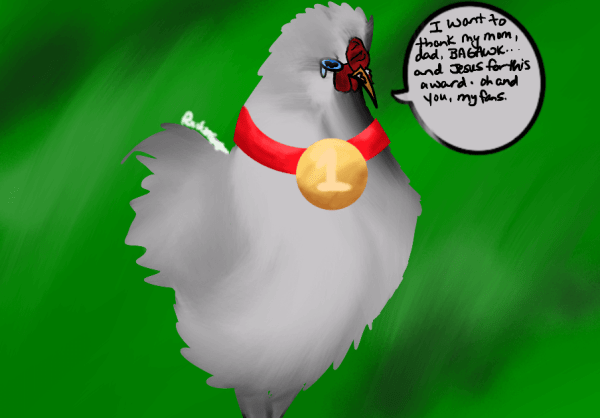
digital art of white Silkie receiving an award
Digital Art, Courtesy of Sarah Smith

Before answering our question, I’m going to present some facts that influence chicken-keeping. And, in effect, they will help determine how many birds you should have.

Decide the Amount of Birds Based on Purpose:

  • Layers
  • Or show chickens

So the first way to come up with how many chickens you should have, is knowing your reason for having them. Are you getting chickens to sell eggs? Or do you want show birds for competitions?

Solution to Choosing Birds Based on Purpose:

If you’re getting layers, settle on how many eggs you want a week. Also, do you have a family? And are you going to try to sell eggs? Some breeds produce more eggs, and some less.

However, if you’re only getting chickens for personal use, then starting out with 3 to 4 hens will yield ~ dozen eggs weekly.

Similarly, for show birds, think about how many birds you need to enter competitions. But if you’re new to showing chickens, starting out with 3 birds is fine, as long as they’re all hens.

Decide on Number of Chickens by Your Space:

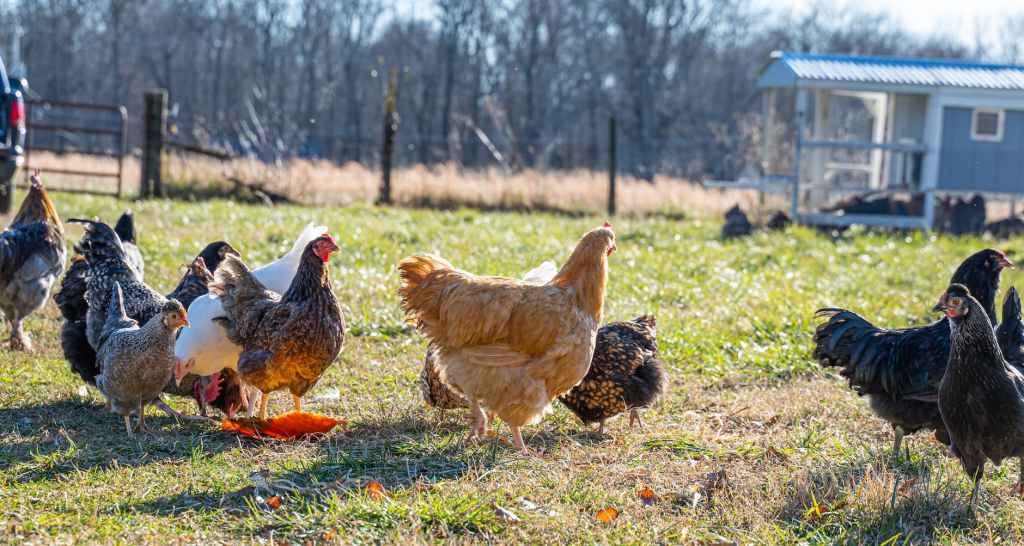
chickens on grassy field
Photo by Styves Exantus on Pexels.com
  • Calculate how much space you have for any and all chickens
  • And if you already have a coop with run, then measure its dimensions to determine how many chickens you can fit in it

Most experts agree that each chicken needs ~ 3 to 4 square feet in the coop. That’s where the hens lay eggs and the birds shelter at night. And if there are predators, your birds will go there to hide.

In addition, figure another 5-10 square feet per bird in the run. The purpose of the run is managed safety for the birds to get exercise and daylight. But it’s not ideal for chickens to stay in confined space. They do best when they can forage and have free access to the whole yard. However, if you decide to keep your birds confined all the time, then calculate at least 10 square feet per bird.

  • And for pasture-raised or free-range chickens, plan on at least 108 square feet per bird

If you choose to have pasture-raised chickens, account for predators. So you’ll need a fence with hardware cloth to keep your chickens in and predators out. Living where we do, on only 1 acre, we don’t have that many. But we have neighbors with 5 acres who suffer coyote attacks, as well as other predator depredations to their flocks.

Determine Amount of Birds by Cost:

  • Financial commitment

Initial expenses are higher the more birds you have: if you don’t have a coop, you either need to build one yourself. Or you’ll have to buy one, or hire someone to build one. Plus, your monthly expenses on feed and bedding will be more. We spend ~ $200 a month on feed. And you’ll have added vet bills with more chickens. Not to mention, if you have electricity to your coop, that’s another expense that’s increased the more birds you have.

  • Can be labor intensive

Regardless of who makes the coop, they need one. Besides that and as a result of them eating, chickens poop a lot. So the more you have, the more poop you’ll have to clean out of their coop and run. Even if you clean in the recommended way, if you have 30 birds, it’s still a lot of work. Although, if you have a tractor coop and run, cleaning it won’t be as much of an issue, as I bring up here.

My 20-year-old daughter thinks we have too many birds. But I’m not there yet. Yes, we have over 30 chickens and several chicks. But some of our birds are close to retirement age with signs of a decrease in egg production, which is why I have chicks now. I’m preparing for the future.
So, How Many Chickens Should I Have

3 brown red Ameraucana hens by a wooden fence outside
From center going clockwise, Davis, Bumblecade, and Smiley.

To recap, if you live in the city or suburbs, check with your municipalities to find out their regulations. And that will give you the information you need. Though, if you live in the country, determining numbers really comes down to how many you can manage, financial and otherwise.

However, 3-5 hens is a great start to chicken-keeping no matter where you live. It’s kinda like just getting your feet wet. But the one hard and fast rule is that there has to be a ratio of no less than 10 hens to every rooster. Or else your hens will get abused by too much attention. I’ve seen it, and it isn’t pretty. Therefore, just make sure you get all girls.

If you have chickens already, how many do you have? And are you happy with that amount? Also, how did you decide on your chicken numbers? Your comments are appreciated.


Thank you for taking the time to read this. If you enjoyed it, please like, share, and please don’t forget to follow!

Categories
Chicks Hens Protecting Your Backyard Birds raising happy, healthy chickens Roosters

How to Take Care of Chickens in Hot Weather

Last month several cities from Texas to California experienced triple digit temperatures. And the heat was made worse some places by humidity. Plus, due to La Niña, the heat’s to last for many areas. Further, we all know how important heat safety is for people. But what about animals? For instance, do you know how to take care of chickens in hot weather?

I’m sure everyone’s heard or read the story of the recent heat that killed the ~ 2000 head of Kansas cattle. Although cattle can sweat to some degree, chickens can’t. Therefore, they rely on us to make sure they don’t overheat.

Most poultry people say that chickens will pant in 80° weather. However I think that can depend on where you live. If you live further north, your birds will be used to temperatures there, not where I live. And vice versa. So you see, birds can acclimate to the weather.

For example, I have a flock comprised of mostly Ameraucana chickens, and they don’t start panting until the temperature gets to the 90s. However, the juvenile birds aren’t used to the temperatures. Thus, they look more bothered by the heat than the adults. Also, if the weather were to spike suddenly, then that could be an issue for all of them.

Additionally, chickens normally lose heat through their combs, wattles, and other non-feathered areas. But once the temperatures rise, heat loss changes to evaporative, which causes water loss. And a lot of water loss causes changes in electrolyte balance.

Signs of Light and Moderate Heat Stress

  • Chickens may pant, but otherwise still run around normal
  • And they may hold their wings away from their bodies

Solution for Light to Moderate Heat Stress

kiddie pool filled with ice water in the shade
  • Provide fresh clean water in waterers
  • Add ice to water
  • Cool down the run with hose
  • And provide icy treats

Dangerous Signs of Heat Exhaustion

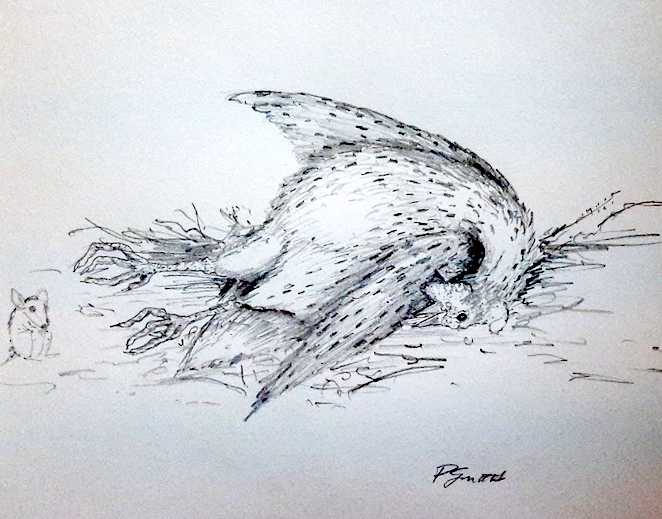
black and white sketch of bird with neck twisted over at awkward angle and mouse looking on
Sketch, Courtesy of Paul Smith
  • Panting heavily
  • Wings held away from body
  • Pale comb
  • Or lethargic, limp, or unconscious

Solution for Heat Exhaustion

If you have a chicken in the above conditions, act quickly, because they are in danger of dying. The most important thing is they need to be cooled quickly.

  • Submerge them (to their necks) in cool water, NOT ice water.
  • And then move them indoors until they recover.
  • Also, provide them with electrolyte water in a medicine dropper, careful not to aspirate them.

Preventing Heat Stress and Exhaustion

mixed flock of chickens and ducks under oak tree

It’s much easier to prevent a problem than trying to fix one when it occurs. Since we already know it’s going to be a hot summer, especially in the Midwest, let’s plan on an ounce of prevention.

Shade

  • Trees in the yard

This is more of a longterm project. But when we moved into our house over 7 years ago, there were only 2 decent sized trees and a few small trees. Since living here, we’ve added several fruit trees and pruned the others. Now the birds have a choice of where to sit in the heat of the day.

  • Tarps or cloths on the run

If your run doesn’t have a roof, or it gets full sun, then add some type of shade for your birds.

Cooling Down the Coop and Run

person spraying chicken coop down with a hose
  • Misters

For evaporative cooling, this is an inexpensive solution. However, if, like us, you have well water, then you’d have to add a salt system to your outside water. Then that would require a whole-house water filtration system. And it could be cost prohibitive. So…

  • Hose the run

Spray down the dirt in the run with the trusty hose. So long as you don’t make it muddy, it will cool it down for the birds. You can also spray the outside of the coop for added benefit.

Ventilation

Likely your run will have enough ventilation. But coops are usually smaller. So install

  • Roof vents
  • Predator-proof windows to increase airflow
  • And if you have electricity to your coop, then add a fan for increased circulation. But be sure it and any cords are out of the birds’ reach.

Water

electrolyte solution for chickens
  • Provide multiple sources of fresh, clean, cool water
  • Locate them ideally in shady spots
  • When it starts heating up, add ice, ice blocks, or frozen water bottles to cool the water
  • Also, you can add electrolyte solution to the water
  • And since chickens won’t get in a kiddie pool, provide shallow pans of water for them to wade in

Feed

Given that digestion increases body temperature, birds won’t eat as much during hot weather. And you may notice egg production decrease as well. Therefore,

  • Feed your birds early morning or later in the day when it’s not as hot
  • Limit scratch
  • And provide frozen treats

Suggestions for Frozen Treats

cut up pieces of watermelon wrapped in Saran Wrap
  • Freeze 2 halves of a watermelon; then put them in the shade for your chickens to nibble on. It provides them with cool, refreshing water and ice. And it keeps them cool.
  • With 2 cans of whole kernel corn, fill each cup of a 12-cup muffin tin ~1/2 to 3/4 full and freeze. Then serve to your chickens in the shade.

Chicken Ice Cream

  • 1-2 c of plain non-fat Greek yogurt
  • 1 frozen banana, thawed slightly; then sliced
  • 2 c frozen blueberries

In a large plate or medium bowl, mix all of the ingredients together. Then serve to your birds in the shade.

I have been making the above treats for my chickens since we started our real flock. And at first, they would react strongly to the frozen blueberries. However, now they’re all very used to them and welcome the cold treats. Plus, it’s funny to see them get brain freeze. They just shake it off and grab some more.

With the heat we’ve had, and are expected to have this summer, I have a list of things I’d like for our birds. Space is already at a maximum, so I want to increase the size of our coop, to make room for the newbies. Some of our hens and our senior rooster are in their older years. No telling how much longer they’ll be around.

Also, my husband needs to cut out a couple decent sized windows on their coop for air flow; then predator-proof them. And I would love to get an automatic waterer for them. But the only source of water is on the opposite end of our acre. We built their coop where there is more shade. So in order to supply them with an automatic waterer, we’d have to dig a trench and add pipe. My husband is going to look into it. With the amount of birds we have, it’s definitely worth it to me.

What do you do for your birds when it’s hot? Have you ever had one suffer heat exhaustion? What did you do? Your comments are appreciated.

If you enjoyed this post, please like, share, and please don’t forget to follow!

Categories
Hens Protecting Your Backyard Birds raising happy, healthy chickens Roosters

How to Clip a Chicken’s Wings

Recently I wrote a post about certain breeds of chickens that could fly. And in it I mentioned three ways to prevent your birds from taking flight. Today we’re going to look more closely at wing clipping. Because, if you’ve never done it, it can seem daunting. Also, I’ll explain how to clip a chicken’s wings. However, first, let’s find out whether or not you should clip their wings.

Reasons to Clip a Chicken’s Wings

mixed flock of chicks around raised garden bed with coop in the distance
This was our first raised garden bed, before we built the 4 1/2 foot fence dividing the yard. The chickens easily destroyed the garden, even with the chicken wire.

If you have pasture raised chickens, then you probably don’t have them penned in an enclosure all day. Which means you likely have fence line separating your property from your neighbor’s. And if you have one of those flighty breeds, they possibly frequent your neighbor’s yard. Therefore, the main reason to clip your birds’ wings is to keep them in their yard and on your property. And the other reasons to clip your chickens wings include:

  • To restrict your chickens from destroying your garden, if you have one
  • In addition, to keep them from getting mauled by a predator
  • And lastly, to prevent them from getting run over by any vehicles, if you happen to live close to any roads

On the other hand, if you keep your birds in the run, then you don’t need to worry about clipping any wings. But just having a fence won’t deter a determined bird. Because, as I mentioned in my last article, some breeds can fly over 10 feet!

Pros and Cons to Clipping a Chicken’s Wings

person holding out freshly clipped wing feathers of a Black Ameraucana hen
We had to clip this hen’s wings after administering first aid; she flew into a neighbor’s yard, and my husband rescued her from being nipped by their dogs. Thankfully they weren’t big dogs, or the damage would’ve been worse.

A couple of the advantages of wing clipping are that

  • It’s safe and painless if done correctly.

Compare it to a dog getting its claws trimmed; but NOT to declawing a cat. Or it can even be compared to a human getting a haircut.

  • In addition, your chickens will re-learn behavior.

If you’re new to this, you might be scratching your head, saying, What? But it’s true, chickens can be motivated and taught certain behaviors. I’ve witnessed it in my own birds. With each bird that needs and gets its wings clipped, they no longer need to be re-clipped, because they’ve learned not to cross those forbidden boundaries.

  • And wing clipping is temporary, since chickens molt.

Thus, new feathers come in.

The disadvantages to clipping chickens’ wings include

  • If done improperly, it can cause bleeding
  • Also, if birds are in open pastures, roaming at will, then wing clipping limits their ability to get away from predators
  • And finally, some people think it makes the birds look less attractive

When to Clip and When NOT to Clip

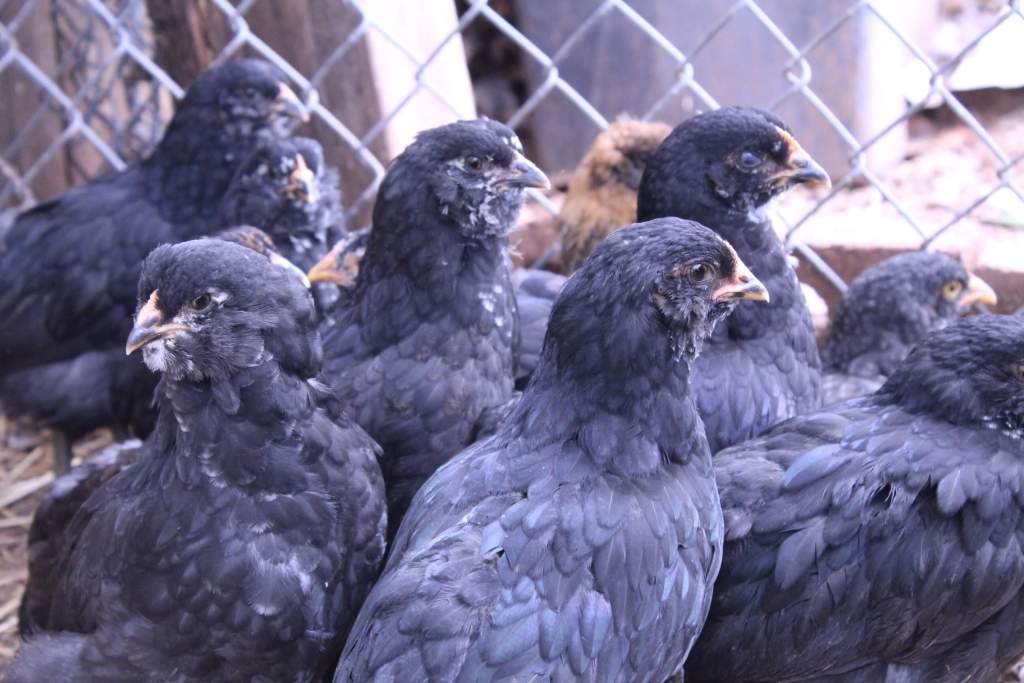
mixed flock of mostly black juvenile chicks

Believe it or not, there are actually better times and situations in which to clip your chickens’ wings, if that’s something you’re considering.

  • First off, don’t clip any chickens’ wings unless they have their adult feathers.

Chicks go through several molts before they’re finally considered adults themselves. And if you clip their wings while they’re juvenile, you’ll just have to do it again. And again. Also, when feathers are growing, there will be blood in the shafts.

Growing feathers are dark or black, while fully formed ones appear clear or white.

you can clip as soon as the birds have all their adult feathers and it becomes necessary. (Emphasis mine)

Therefore, if your birds aren’t showing signs that they’re flying over any fences, then there’s no need to do any wing clipping.

  • And lastly, I already pointed out that birds in open pastures, roaming at will, would be hindered if their wings were clipped.

The BEST time to clip your chickens’ wings is when you have adult backyard birds that are repeatedly being a nuisance, getting into the neighbor’s yard, your garden, a busy road, or trying to get mauled by some animal. And most, if not all, sites recommend you first catching your birds. Forget that. Who wants to chase around a bunch of chickens all day?

Rather, here’s the alternative: Before letting them out in the morning one day, have someone help you clip their wings, one bird at a time.

Materials Needed to Clip a Chicken’s Wings

  • Partner to help you

Having someone assist you with clipping your birds’ wings will make the job easier and go faster.

  • Good pair of scissors

You need sharp scissors to cut through the shafts; alternatively, you also could use sharp wire cutters

  • And styptic powder or alum

In the event you cut too short, and a feather starts to bleed, dip the feather in some styptic powder or alum, until it’s coated.

Instructions for Clipping a Chicken’s Wings

person in pink shirt holding Black Ameraucana rooster with one wing outstretched
Tiny Nuts already had his wings clipped, as you can see by the straight edges.
  • Get your partner and supplies; and without letting any birds out, (if that’s possible) set-up shop for wing-clipping

Since we can stand up normal in our run without trouble, that’s where we usually take care of things, like wing clipping. However, your coop and run may be different. If it’s smaller, you’ll have to get creative.

  • One person needs to hold the bird firmly, making sure one chicken wing is held securely against the chicken, so there’s no flapping, while the other person will clip the free wing
  • Next, have the person with the scissors locate the primary feathers; are the shafts dark or clear? If they’re clear, then they’re safe to trim
  • With a steady hand, only trim back the 10 primary feathers about 50% of the way; (unless you know your bird is a flyer, start small)
Notice the primary feathers.

Now, it’s at this point that a lot of sites suggest you’d be finished, because supposedly having one clipped wing would unbalance a chicken. And I also tried that approach my first experience with wing clipping. However, all of my Ameraucana chickens can fly with this unbalanced design. Hence, we clipped more. And when that didn’t work, we clipped more, and jaggedly.

  • Thus, you can trim only one side, but if you have one of the flighty breeds, like me, you just might have to go back and trim more than just the primaries and make it look ugly; remember to check the shafts, and if they’re clear, you can trim them.
digital art of a chicken's wing
Digital Art Courtesy of Sarah Smith

Again, most sites adamantly advise against trimming the secondary feathers. But obviously they’ve never had Ameraucanas; otherwise they’d never suggest such a thing. Though there are a couple of sites that are familiar with the more determined flyers. So, if you have birds like I do, and you want to protect them, then you need to clip more than the primaries. It’s that, or risk them getting into trouble.

Conclusion

Black Ameraucana hen in front of brick wall
We’ve only had to re-clip this hen’s wings one other time after her molt; she learned her lesson after that.

Wing clipping, if done correctly, is a safe and painless way to prevent your chickens from flying from the safety of their enclosures. Whether a few chickens or the whole flock like to get out, clipping wings can offer some respite.

Clipping a chicken’s wings is only temporary, and many sites suggest repeating the procedure annually. However, I disagree. Just like waiting to see if wing clipping is even needed, wait and see if repeating the process is necessary.

For example, I have only had to repeat the procedure on one hen after her molt. The whole idea for me is to re-teach my birds, because they are teachable, contrary to what anyone might think. When their wings are clipped, they’re grounded for that time frame. So when their molt is ended, and their wings are in and they’re free again, hopefully they’ve learned not to go where we don’t want them to go. And that’s just what I’ve personally discovered happens with my own birds.

What do you think about wing clipping chickens? Have you ever done it?

Thanks for reading this post. Your comments are appreciated. If you liked this, please like, share, and please don’t forget to follow!

Categories
All animals Chicks Hens non-fowl raising happy, healthy chickens Roosters

Signs You’re a Crazy Pet Parent

We spend a lot on our pets. Not just in money, but also in time. Americans reportedly spend ~$2300 annually just on their cats and dogs alone. And that doesn’t even take into account chicken, rabbit, and reptile lovers. But there are more signs you’re a crazy pet parent than spending money on your pet.

While there are plenty of “crazy lady” memes, I use the term crazy a bit more endearing. Additionally, I don’t single out just women, because I’ve found that men can be just as fond of their pets. However, what does “pet parent” even mean?

The term pet parent is considered by some people concerned with the rights of animals to be more acceptable than owner .

Collins English Dictionary

But it’s really just someone who looks after and cares for their pet.

Now I’ve broken this up into three sections. And the first set of signs you’re a crazy pet parent that we’re going to examine is the cat lover. Cats are mysterious. And they can be elusive or playful. Maybe you’re guilty of being crazy for cats. Or you know someone who’s heading down that path? Just continue reading to find out.

Signs You’re a Crazy Pet Parent: for Cats

tortoiseshell cat lying on a person's lap while they're asleep
This is Meow Meow, when she still lived in the house and there was only Moses to deal with. She liked to sleep on me.

You might be a crazy cat person if you

  • hardly go on vacation, because…what would happen to your cats?
  • may even read fiction books about cats with your kids
  • talk to your cats, and reply to them when they meow
  • have more than a couple of cats
  • gladly make room for your cat to be comfortable on your bed; BUT if some human tries the same, you push back
  • buy your cats presents
  • don’t get mad if your cat steps on your laptop keyboard, because she wanted to be near you and get your attention; however, now you just anticipate her and close your laptop to prevent any mess-ups
  • sleep with cat food on the nightstand so the kitty knows where it is; cats are creatures of habit, right?
  • don’t mind if the cat scratches the furniture
  • get them special treats
  • have cat themed items
  • FaceTime your cat in the event you’re ever away
  • celebrate your cat’s birthday
  • sing to your cat or make up songs about your cat
  • and if your cat takes your chair when you vacate it, it’s ok; you just take another one and move all of your stuff over

The second set of signs you’re a crazy pet parent that we’re going to investigate is the chicken lover. Chicken popularity has been going strong since Covid. So that means more crazy chicken parents. And the newer parents you are, the crazier you are. Trust me, I know. But that doesn’t mean that old chicken parents stop being crazy for their backyard birds. We just share our joys with fellow crazies.

Signs You’re a Crazy Chicken Parent

person wearing a purple and pink chicken t-shirt

You might be a crazy chicken person if you

  • talk to your chickens
  • don’t run the chickens out of the garden even if you’re spouse tells you to
  • make special treats for them
  • cook oatmeal for your family; and then make extra for your chickens, because they love it
  • thank the chickens after they eat the treats
  • name all of your chickens
  • have chicken t-shirts and wear them proudly
  • read chicken blogs
  • have chicken themed items in and out of your house
  • save food for your birds, and ask others to do so as well
  • encourage the rooster; and believe that he actually listens
  • are happier seeing and watching your chickens than TV; and they think you’re pretty darn special too
  • talk about your chickens to anyone who will listen, but you’re starting to notice their eyes glaze over
  • might have even let a weak baby chick sleep in your bed, snuggled in a hand towel
  • and when you go outside, your backyard birds flock to you

Finally, the last signs that you’re a crazy pet parent we’re going to consider is the dog lover. Dogs have been man’s best friend since, what seems, the beginning of time. They’re faithful, loving, and trustworthy. What’s not to like?

Signs You’re a Crazy Pet Parent: for Dogs

a dog lying on the floor chewing on a toy, surrounded by toys
Photo by Mathew Coulton on Pexels.com

You might be a crazy dog person if you

  • set up play dates with your friends’ dogs
  • FaceTime with your dog when you’re ever away
  • leave TV or music on for your dog when you’re ever away
  • buy your dog toys
  • flavor your dog’s food, because they don’t like plain dog food
  • take your dog on outings
  • let your dog sleep on your bed, even if they take up most of the bed
  • spell words out so your dog won’t understand
  • don’t mind dog hair on your clothes, furniture, or the occasional fur in your food
  • baby-talk to your dog, no matter their age
  • love giving your dog belly rubs, and your dog loves it too
  • let your dog chew on you, because it’s how they say, “I love you”
  • have birthday parties for your dog
  • usually don’t go out of town for long, or go far
  • ignore anything your dog does that could be construed as bad behavior, because you love your dog; and “they’re such a good dog,” you say in the baby voice
  • and if you’ve ever stayed at a non dog-friendly hotel before, you might’ve snuck your dog in. Don’t worry. I won’t tell, if you won’t

There are some common traits all of these pet parents have in common that I have yet to list. Therefore, if you have cats, dogs, and chickens, please keep reading.

You Might be a Crazy Pet Parent if

person's hand holding white picture frame that's sitting on end table with 2 other white picture frames with photos of different cats
Photo by cottonbro on Pexels.com
  • On occasion, you’ve been known to spend more on pet food, bedding, litter, etc, than on your own groceries.
  • Furthermore, you have more pictures of your pets than your children.
  • And you talk more about your pets than your kids. In addition, you’re more animated when you share about your pets.
  • Additionally, you post more on social media regarding your pets.
  • Also, going out of town for any type of vacation is difficult, because of all of your pets. So you don’t even know what a vacation is anymore. But it’s worth it, because who will love your pets like you do?
  • And you admit that the word “fret” is in your vocabulary regarding your pets occasionally.
  • Finally, you might be a crazy pet parent if your neighbors are constantly trying to bring you strays.

Conclusion

This concludes the signs you’re a crazy pet parent. And I confess that I’m guilty of 98% of them. But it’s ok, because I love my pets. And if it turns out that you’re a crazy pet parent, it’s perfectly ok. Because, you’re accepted.

Also, I’m going on vacation next week for 10 days. So I might not post. We haven’t had a real vacation in 4 years. But back then we didn’t have the extra cats and our dog that we have now. We had Moses, but he was allowed to come on vacation with us then.

In addition, the place where we’re going now is not pet-friendly. Although, that hardly matters, because Sophie would need tranquilizers to go on vacation. Anyway, this will be the first time that we left Sophie and Poppy for an extended time. So we have some anxiety about that. Therefore, if you think of it, please pray for our pets and neighbors. We have a lot of pets. Over 30, and some chicks that we’ll eventually sell. Thus, it’s a huge responsibility, however we have great neighbors.

Are you a fellow crazy pet parent? Do you struggle with going out of town because of your fur or feather babies? Or do you have awesome neighbors who help you out? Let me know how you handle these issues in a comment. And thanks for taking the time to read this post. Also, if you enjoyed this piece, please like, and follow for more.