Providing helpful information regarding our feathered, feline, and canine friends while also sharing fun stories. And locally we provide pet sitting services.
Eggs are considered a perfect food, because they’re one of the best sources of protein. And they contain all the essential amino acids. Not to mention there are supposedly 100 ways to cook them. Apparently that’s why chef’s hats have all of the folds they have, for all the numbers of ways to cook an egg. And that’s just a couple of egg facts. But I have more that you might not be aware of.
Eggshell Colors
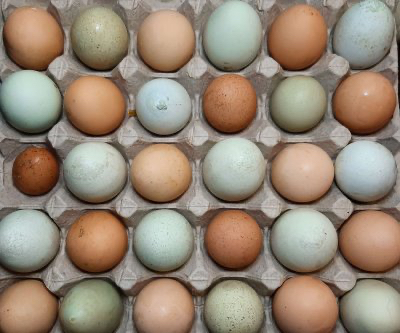
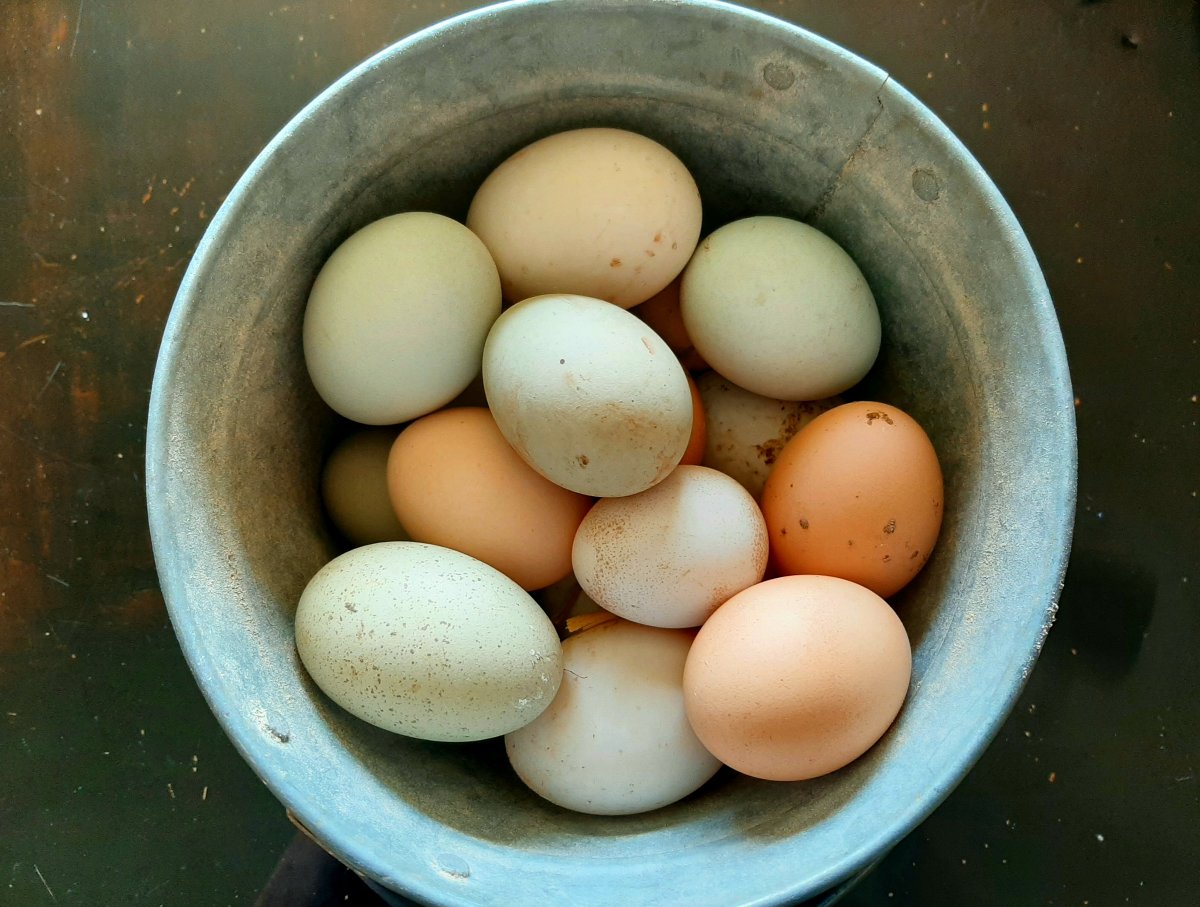
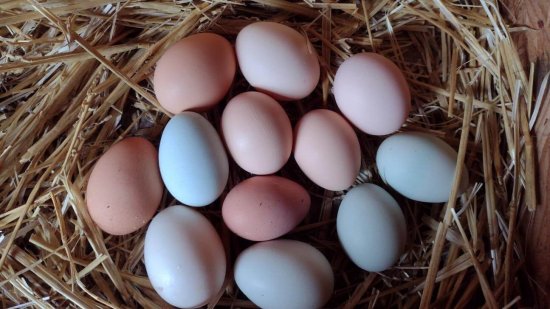
There are 3 common eggshell colors, which are white, brown, and blue. However the uncommon ones are dark brown, pink, olive, and cream.
Also, shell color depends on the breed of the hen that laid the egg. But shell color doesn’t determine how healthy the egg is.
Additionally, in grocery stores, brown eggs are more expensive than white eggs. And that’s because hens that produce brown eggs are typically larger than their white egg-laying counterparts. Thus bigger birds equal more feed and thus more costs, which get passed onto the customer.
Biggest Egg Fans
Japan consumes the most eggs, with an average of 320 eggs eaten per person in 2020. And they also import most of their eggs. However the average American eats almost 300 eggs annually.
Top Egg Producer
In the United States Iowa produces the most eggs with 17.1 billion eggs in 2019!
Biggest Egg
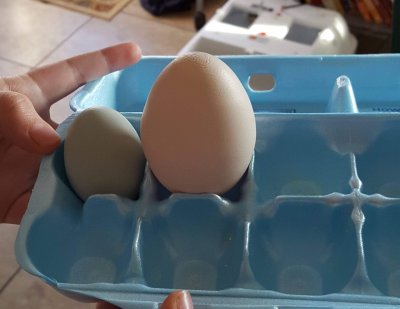
This is the biggest egg we ever got. And Natalie, our broiler, laid it.
In 2010 Harriet the hen, from the U.K., laid an egg weighing ~7 ounces. And it measured ~8 inches in circumference. Additionally, when it was cracked, there was another egg inside!
It takes 24-26 hours for a hen to produce an egg. And within half an hour of laying the egg, the process starts all over again.
Also, some chickens lay eggs every day, while others lay only every other day. And then there are some hens, for show mainly, that will only lay an egg once or twice a week. But sometimes a hen could even lay twice in the same day. Although that’s rare.
Yolk Color
What’s the deal with yolk color? Well, yolk color tells you about the hen’s diet primarily. And if you buy eggs from a farmer, it’s a great indicator of their environment and health. Also, eggs that have a richer color taste better. Some store-bought eggs can have a darker yolk, but that could be because the hens are being given marigold to produce the darker color. But a true pasture raised hen will forage, eating grass and bugs, and not just the feed alone. Thus her egg yolks are naturally rich.
I get this question a lot. And no, chickens don’t need a rooster to lay eggs. So eggs from the grocery store should be unfertilized. Besides the majority of the hens are in cages, therefore they wouldn’t be mixing with each other anyway.
Eggs Have a Long Shelf Life
Eggs don’t have an expiration date in grocery stores. However store bought eggs can last up to a month. But if you purchase eggs from a farmer, they can last months as long as they haven’t been washed, due to something called bloom.
Furthermore you can tell how old an egg is based on its buoyancy. So if you have an egg that’s questionable, just put it in a cup or bowl of water. And if it floats, it’s old. But if it sinks, or stays at the bottom of the cup or bowl, then it’s fresh.
I hope you enjoyed these egg facts, and thanks for reading! Feel free to comment or ask a question.
There are a variety of chicken egg colors. But most of the time we only see white and brown. Though I’ve heard that some stores carry blue eggs. I sell blue (and brown) eggs to some neighbors and people I work with. However I also give a lot away. Recently I was asked, “What causes chicken eggs to be blue?” Do you ever get this question? Or have you asked it yourself?
I think people are under the impression, that because the shell is colored differently, somehow it will affect the taste. But that just isn’t the case at all. Although all farm fresh eggs taste differently compared to store bought eggs. That is if they’re free-range or pasture raised eggs. And that’s due entirely to the hen’s diet, not to the shell color.
Additionally, I think people get the idea that shell color determines how healthy the egg is. And once again, that isn’t true. But eggs from large farms, where the chickens are all caged, are going to taste different from the eggs my birds produce. And just why is that? To a large extent, that’s due to the bird’s freedom to forage. If a bird is caged all day, without interaction from her peers or social order, she’s basically just a machine. Or a tool. Eggs from a farm taste richer. And the yolks are more orange than yellow, signifying a healthier diet for the hens. Which will result in more omega-3s and vitamins for those who consume them.
Well, firstly, most egg colors are determined by the hen’s genetics. And all eggshells are made of calcium carbonate, including the white ones. They’re just lacking pigment. But also, all eggshells begin as white. Although eggs that have shells in colors other than white will have the pigment levied on them as they make their way through the hen’s oviduct. Kinda like the hen is painting the egg. Weird, right?
The pigment, known as protoporphyrin IX, is responsible for staining eggs brown. Which is deposited later in the whole process, only making the eggs brown on the outside. So, certain hens only lay brown eggs, while others only lay white. But where did the blue come from?
Well, blue eggs also have a gene that’s essential to their pigmentation called oocyan. The key differences between protoporphyrin IX and oocyan is that blue eggs are blue inside and out. And the gene oocyan got there because of a retrovirus, called EAV-HP, hundreds of years ago. This was learned in a study completed around 2013 by the University of Nottingham.
This is our Cream Legbar hen, just one of many of our hens that lays blue eggs.
Furthermore, one of the first birds to have acquired the blue egg trait, and thus the virus, were the Mapuche fowls of Chile, possibly 500 years ago. Consequently, these birds are ancestors to French, Spanish, North American, and British chickens, such as the Araucana, Ameraucana, and Cream Legbar chickens, to name a few. And Asia has their own breeds with the oocyan gene, the ancient Dongxiang and Lushi.
But the virus isn’t harmful. In the case of causing pigmentation in chicken eggs, it’s actually pretty cool. We’re all profoundly aware that viruses can cause sickness, including foodborne illnesses. However they can also change an animal just slightly, like EAV-HP did, resulting in blue eggshells.
I hope you enjoyed this post, and I thank you for taking the time to read it.
Perhaps you’re familiar with the term ‘Easter Egger’, if you have backyard birds. Or maybe not, if you don’t. No, they don’t lay Easter eggs, in case you’re wondering. However their eggs do resemble those we color for our kids. Which is how they got their name, after all. So, just what are Easter Egger chickens?
Well, in the U.S., really an Easter Egger chicken has come to be recognized as any chicken that has the colorful egg gene, oocyan. Although, traditionally an Easter Egger chicken was, and is, considered a hybrid. Meaning, it’s the result of crossing one breed of chicken with a blue egg-laying breed, like Ameraucana or Araucana chickens. Also, they don’t have a set standard like other breeds. Therefore, Easter Eggers are not recognized as a breed by the American Poultry Association.
History of Easter Egger Chickens
Even though there are ~8 blue egg producing chickens around, there are only 2 chicken breeds that are currently accepted in the APA. And one of those is the Araucana. However the ear tuft gene can be lethal, causing few eggs to hatch. Additionally, those that hatch may die within a week. So, Ameraucanas were bred in response to the lethal tuft gene of Araucanas, by breeding Araucanas with other breeds of chickens. Sound a bit like Easter Eggers? It does to me too. Except the only thing that qualifies as a breed is whether the bird fits the standard. And there isn’t one for EEs.
Though there is a standard for Araucana and Ameraucana chickens. Usually the standard is based on color (of the bird), egg color, bird size, legs (whether they’re clean or feathery), the type of comb they have, and in the case of Araucanas, if they have ear tufts and are rumpless. And for the Ameraucana, if they have beards. However, if you have a chicken that matches one of these standards, someone might still claim you have an EE, simply because you got it from a hatchery, rather than a breeder.
So What are Easter Egger Chickens?
Now that we’ve covered what they are not, a breed, we’ll go over what they are. Since they are backyard birds resulting from a cross with a blue egg-laying breed, the hens can lay an assortment of colors. Green, olive, and blue are the most common egg colors that they lay. Although they can also lay pink, brown, and cream eggs. These birds have also been named ‘Rainbow Layers’, and no wonder! Although the hen won’t change what color egg she will lay from day to day. Which means, if she lays a blue egg, she will only ever lay a blue egg. But if you have a number of these birds, you will most likely have a number of different colored eggs.
Easter Eggers are also docile, which means they’re very laid back. Additionally, the hens are typically good layers, laying ~200-280 eggs per year. And when the hens are fully mature, the eggs will end up being large. Or extra large in some cases. Moreover Easter Eggers are dual purpose, indicating that the birds are also good for meat. Although they tend to run small. Hens might weigh ~4 lbs, while roosters tend to weigh ~5 lbs.
Also, since they have Araucana or Ameraucana in their backgrounds, they can take on some of their traits. Like ear tufts, beards, being rumpless, etc. And they come in a variety of colors. Plus, Easter Eggers don’t spend a whole lot of time being broody. Which is great, because they’ll be laying eggs instead.
This is our other rooster, Baby Nay. He has crooked beak, but it’s not as evident currently. He must’ve chipped it.
EEs are great for first time backyard bird keepers due to their happy disposition. And they’re a good choice for families with children because of this fact. Also, they aren’t prone to health issues. But they could get run-of-the-mill mites in their beards or tufts, if they have them. And Araucana chickens have a genetic deformity that causes their beaks to grow crooked. Additionally, the condition, scissor beak, can worsen over time, making it difficult for a bird to eat or drink on its own. Although many birds can also live long, healthy lives with the right kind of care. EEs could get this condition as well, though not as frequently.
Typically Easter Eggers do quite well in most environments. And they can cope with heat as long as they have shade and plenty of water. Furthermore, they usually do well in the winter too. And because of their comb size, they don’t ordinarily suffer from frostbite. Also, they do well foraging for themselves, which is a great way to supplement their diet. But they also put up with confinement in the coop well. Although they prefer to free range.
In Conclusion
Easter Eggers are a great all around dual purpose bird, even though they aren’t considered a breed. They’re easy to raise and are good with families. And they’re popular simply because they come in a variety of colors as well as their eggs. They’re sociable, curious, and tolerant. And they lay a lot of eggs. So they are productive and fun, making them a great complement to any flock.
Both roosters and hens have spurs, though you might only see a nub on the latter. And both the breed of bird you have and their level of growth will determine the size of the rooster’s spurs. So in this post I’m going to discuss how to remove a rooster’s spurs. You’ll find a few “easy” methods out there for doing this. And if you have a backyard flock, you might even have tried them. But the technique I’ll cover, for removing a rooster’s spurs, is both gentle and safe.
This is an adolescent rooster. You can’t see his spur nubs in this photo.
A rooster’s spurs are kind of like small appendages on each leg. They’re made up of soft tissue and covered in the same hard substance as his claws and beak.
And when a rooster is a young cockerel, his spurs begin as small bony protuberances. But some are so small, you might not even notice them. Some cockerels may have fully developed spurs as young as 3 months old, while others will take as long as 9 months. However, as he gets bigger and fully develops, the spurs get bigger, start to curve, and form pointy tips. And as long as the spurs are untouched and remain intact, they’ll continue to grow.
Why Remove a Rooster’s Spurs
Roosters have spurs as a defense for themselves (and their harem of hens) from predators. They also have and use their spurs for protection against the competition, aka other roosters. So, if you remove their spurs, they’ll no longer have that natural defense. Therefore, why would you want to remove them?
There are a few reasons that might cause you to de-spur your rooster, such as
if he’s aggressive with family members and other pets
he’s aggressive and/or hurting the hens
or the spurs are getting so long that the rooster is in danger of hurting himself
In the first two options, the roo could be aggressive. There are many sites that claim if you remove a rooster’s spurs, he’ll actually become tame. That makes me want to laugh. Because I haven’t personally witnessed this. And we removed the sheaths (the hard keratinous material that covers the spurs) on our first rooster’s spurs. Twice. Though he continued to attack us as soon as the sheaths grew back.
The only reason Casanova avoided attacking us during that time-frame was because his spurs were unprotected and thus sensitive. It had nothing to do with him being tame all of a sudden. Some people endorse cauterizing a cockerel’s spur nubs so they don’t develop. But I have no experience with this. However I will suggest that the hormones aren’t located in the actual spurs. An aggressive rooster will attack regardless. But if he has no weapon at his disposal, it will just be hot air.
If you have an aggressive rooster and hope to tame him by de-spurring him, you’ll be disappointed. Whether a rooster is aggressive or not is not based on his spurs. However, if he has an aggressive streak, he will most likely utilize them to attack.
So, if you have a belligerent roo, you’ll have to decide whether or not it’s worth it to remove his spurs. This decision should be based on where you live, whether or not you have predators, weighing both the pros and the cons.
The last option where the rooster is in danger of hurting himself can also be combined with him hurting the hens, if he isn’t doing it intentionally. This can be when he’s mating, if his spurs are exceptionally long. In this case the hens will reject him more times than not. But it isn’t his fault, because he just needs some assistance.
This is a close-up of Megatron’s spurs currently. Trimming, rather than any of the other methods, requires maintenance if you wait like we did. It can be a slow process, but you don’t want to hurt the rooster.
Our rooster Megatron has never attacked us. And until Baby Nay, our 1 year old concurrent rooster, he didn’t fight other roosters. In addition, living where we do particularly, the biggest predator threats our birds face are from the sky. Consequently, Megatron’s spurs were getting extremely long, I noticed, a couple of years ago. They were curling inward, and eventually they would pierce his legs. Thus, he was starting to walk funny. And I observed that he was failing more times than succeeding in the love department. Therefore, I concluded that his spurs needed attention.
With our first roo we used the hot potato method. It’s where you basically cook a baked potato. Then, you put the hot potato on the spur. Furthermore, wait a few minutes. And then the sheath will come off after some manipulation. I don’t recommend this method on a rooster with long spurs. Casanova’s spurs, at their longest, were half the size of Megatron’s. And that’s because he frequently used them. As always, we were his targets.
Since Megatron’s were so long, I didn’t want to do that. I knew that he would most likely bleed due to their size. And I didn’t want that to happen. So I recalled that we were given a battery powered pet nail file by a neighbor. Which is very similar to a Dremel. We used it to trim our roo’s spurs. And it did the job without hurting him. Or scaring him.
Now I’m going to go over how to remove a rooster’s spurs by trimming them.
How to Remove a Rooster’s Spurs by Trimming Them
First, you need to gather your supplies. Because, once you get started, you don’t want to have to stop, since it could add more stress to the bird.
Supplies for Removing a Rooster’s Spurs Via Trimming
Partner
This is a 2 person job; 1 person needs to hold the rooster. And someone else does the actual trimming. So make sure you have help.
Towel
This is to wrap around the rooster to help him feel secure.
PPE gear, ie, gloves and masks
You definitely want to wear a mask when the dust from the rooster spurs starts blowing.
Battery powered pet nail file or Dremel
You can get these at pet stores, online at any home improvement store, or on Amazon.com.
Hydrogen Peroxide
This is to clean the wound just in case you trim too far and cause your rooster to bleed.
Styptic Powder
Styptic powder stops bleeding. But, if you don’t have any, you can use alum. It’s found in the spice aisle at the grocery store. However it doesn’t contain any benzocaine to prevent pain. So, if your rooster is bleeding and you use alum, just know that your rooster will probably, at the very least, flinch.
Instructions for Removing a Rooster’s Spurs by Trimming
Once you have your supplies, you’re almost ready to remove your rooster’s spurs. The best time to accomplish this is at night. Some people even wait till their birds are already in the coop for the evening. However, you know your birds’ temperaments better. If you think you can trim his spurs when the sun is down, with just a headlamp, then do that.
We wait until the end of the day at our house. But not when it’s completely dark. So that means we have to catch the rooster. Although, that’s ok, because he’s pretty calm.
So once you have your rooster,
You or your partner wrap the roo securely in the towel
Cover his head, but ensure he can breathe.
While he’s firmly held by one person, the other person uses the battery powered nail file, beginning on one spur
The person who’s trimming needs to hold the roo’s foot. And start away at the tip of the spur like you’re sharpening a pencil.
Avoid trimming down to the quick
Rooster spurs have a ‘quick’, just like fingernails, that can be seen as a darker area within the spurs. That said, if you happen to hit the quick, that’s what the peroxide and styptic powder or alum are for. Clean the spot gently. And either dip the spur in the styptic powder or alum, whichever you have.
Round off the spurs
Don’t make the spurs pointy, so he doesn’t inadvertently hurt the hens or anyone else.
Give your rooster a treat
This last part is entirely up to you. But if it’s not completely dark, and you happen to like your roo, then give him a treat for enduring his pedicure.
If you have chickens, have you ever heard the crow of a rooster when you don’t have a roo? Or if you do have a rooster, swear that it wasn’t his particular ‘crow’? Today I want to bring up the subject, do hens ever crow. You might not realize it, but yes, they do! And there are different reasons and causes for it which I’ll also cover.
Now let’s discuss why hens will crow like a rooster. First, you want to verify that your she is really a she. Sexing adult chickens is pretty easy compared to sexing chicks. So once you’re positive you’re dealing with a hen, most of the time a crowing hen has to do with the pecking order. If there isn’t a rooster, sometimes the most dominant hen will then take on a rooster’s duties. Which includes crowing.
However there could also be times when you have a rooster and you hear the sound of another, foreign crow in your backyard. Most sites claim that a hen will NOT crow if there are other roosters around. But I’m here to tell you that’s not true. We have 2 adult roosters on our property. And I’m extremely familiar with their individual crows. The other ‘cock-a-doodle-do‘ came from one of our hens. And she mangled it.
I immediately went outside to see who was doing it. Although she must’ve been shy, because she stopped after the second crow. I have a suspicion that it was the co-parent of the broody hen we had. She’s a pretty dominant hen, in a sea of mostly docile birds. I think she crowed to warn off any possible danger to their clutch of chicks. Or possibly to tell the other chickens to stay away. Yes, I’m speculating, but I haven’t heard any more crowing. But then, they no longer are raising their chicks.
What?!? No, that’s not a typo. You might already be aware of this if you’ve had backyard birds for a while. But just in case you’re unfamiliar with this phenomenon, chickens are one type of animal that can go through a sex change, where they actually can change genders. However it also can happen to ducks.
Both female ducks and hens have only 1 functioning ovary. And both are on the left side. While the one on the right side is held in reserve. However if the left ovary gets injured by either trauma or illness, then the right one will start developing. And sometimes it develops into a male reproductive organ, except they won’t be able to father any young. At least not in the chicken’s case.
A hen that starts developing into a rooster will begin to take on more than just his crow. She will start to acquire bigger wattles and a more prominent comb. She’ll also grow more colorful plumage like that of a rooster. Additionally she will start to mount the other hens. So, in essence, she will be a he, in all but when it comes to actual reproduction.
If you have a hen that’s crowing, and you want to stop it, there are things you can try. If she’s crowing due to pecking order issues, try isolating her for a few days. Usually this will sort out any hierarchy problems, because chickens don’t like to start back over from the bottom. However sometimes it’s necessary if there’s bullying by a dominant hen.
If, on the other hand, you actually have a rooster instead of a hen, then you will have to come to a decision on whether you want to keep him. Or whether you even can keep him. And the same goes for if you have a Longcrower hen.
But if you in fact have a hen that is going through gender change, there’s really nothing that can be done. Other than deciding on if you will keep him once he’s completely transformed, although there’s only ~ 1 in a 10,000 chance of that really happening. Also, there has not been anything reported about a rooster changing into a hen, as of yet.
I hope you enjoyed this post, and as always, if you have any questions or comments, please don’t hesitate to ask or leave a response!
Today’s post is about how to sex chickens. Some of you might not have ever had to do that. Especially if you order from a reputable hatchery. But even then sometimes you might get a cockerel you didn’t order. Or you might order a straight run. Also, if you ever incubate your own eggs, or get a broody hen who hatches chicks, then knowing how to sex chickens is a great piece of wisdom to have.
So how do you sex chickens? And is it the same for chicks as it is for juvenile birds? Well, the answer to the second question is . . . kind of. It just depends on the bird. However I’ll get to that soon enough. But first, we’ll cover how to sex baby chickens or chicks.
How to sex baby chickens
How to Sex Baby Chickens
So, with chickens, a cockerel is a male chicken. And he will become a rooster. Additionally, a pullet is a female chicken, who will be referred to as a hen when an adult. And now let’s discuss how you can determine if the chicks you ordered are in fact pullets. The first method is
Vent sexing
Vent sexing is manually examining the reproductive organs of poultry. It’s also the most precise way to determine gender of all domesticated birds. However it is NOT recommended for people unfamiliar and untrained in it. Vent sexing chicks can hurt the chick if done incorrectly. That said, we definitely do not attempt it at our property. Not to mention, it’s quite invasive to the chicks. Although if you’re getting chicks from a recognized hatchery, chances are good that they’re vent sexing.
Feather sexing
Feather sexing is a technique to identify the gender of a chick based on the rate of feather growth. However it’s a sex-linked trait, which means the chick’s father has to be bred to grow feathers fast. While the chick’s mother has to be bred to grow feathers slowly. Otherwise trying to feather sex a chick won’t work, because not all chickens can be sexed this way.
I’ve never tried to determine the gender of our chicks using this method. And usually it’s because I’m too caught up with all of the chicks to even think about it.
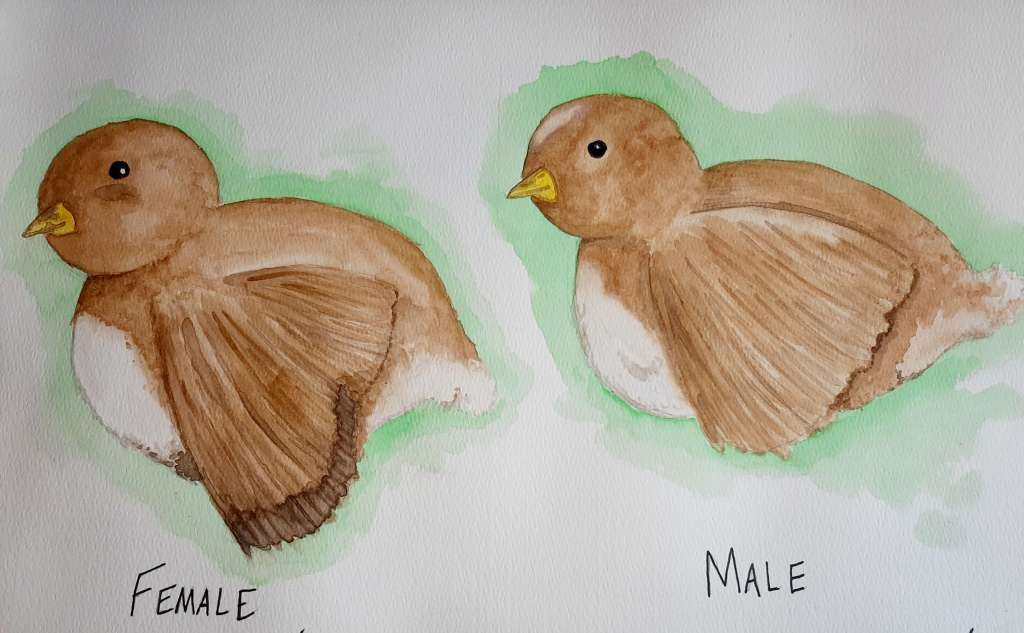
Another option using a bird’s feathers is by looking at their wings. A pullet will have different lengths while a rooster will have all one length. If you try this method, just remember to be careful with the day old chicks. Also, this practice isn’t foolproof like vent sexing.
Sex link chickens
This is an example of a sex-link hen, a Black Sex link. However she’s an adult.
Sex link chickens are hybrids that show differences in the colors of their plumage. Or a spot will be present on one sex and not on another, between cockerels and pullets. Which makes sexing them a lot easier. Although you would have to order sex link birds in order for this to happen. But sometimes you can sex link your own birds, if you have a mixed flock, like I’ve done with some of mine.
How NOT to Sex Juvenile Chickens
In a moment we’re going to cover how to sex juvenile chickens. Because there are some differences. A juvenile backyard bird is considered a teenager anywhere from 4-17 weeks old. Whereas chickens from ~16-24 weeks of age are regarded as adults, because they hit sexual maturity, and hens can start laying eggs.
Some of the most common ways people predict chicken gender are also some of the most erroneous ways. And these aren’t limited to backyard chicken owners only. Additionally, they continue to use these flawed methods over and over again. They include determining sex by:
Large combs and wattles
This is our hen, Oddball. Her mother was a Black Sex link, and her father was a Cream Legbar. And she has a massive comb.
This is another example of a hen with a really big comb. Her father was the same as Oddball’s, but her mother was a Silver Laced Wyandotte.
The thinking is if the bird in question has a large comb and wattles, they must be a rooster. But I’m here to tell you that is simply wrong. Especially if you have a mixed flock. I have 2 hens that have massive combs that put my rooster to shame. So judging a bird by the size of its comb and wattles is totally unreliable.
Crowing
Roosters start crowing generally around 5 months of age. But some crow sooner, while others crow later. Some of the hybrids we’ve had crowed a lot sooner. However crowing alone isn’t the best indicator, since hens also can crow.
Size
When chickens are developing, people think that if there’s a bigger bird, it must be a cockerel. And this is a reasonable expectation if the lineages and ages of the birds are the same. When backyard chickens are mature (16-24 weeks), they will be bigger than females of the same breed.
If you have a mixed flock, then your chickens will come in a variety of sizes. So determining gender is more complicated, because you’re no longer comparing apples to apples.
Character
This is a picture of one of our most aggressive hens when she was younger.
It’s true, roosters can be aggressive, authoritative, and protective of what they consider ‘theirs.’ And a lot of times you can see them demonstrating this behavior as chicks. However it’s faulty to assume, that if you’re witnessing these mannerisms, that you have a cockerel.
Because hens that aspire to reach the top of the pecking order will also display these temperaments. Furthermore, you might notice this behavior with the chicks. There will be one chick that is more aggressive. It could be a cockerel. However it could also be a pullet.
Ok, so how do we sex chickens? Juvenile or otherwise?
The Best Way to Sex Chickens
The first method for determining the gender on your own backyard birds is
First, give your birds some time. Unless you have birds that can be sex linked, just give it a few weeks till you can do some real investigating.
Then look at their feathers
This is a cockerel; you can tell by his tail feathers.
This is a pullet, because her tail is more like a fan.
You’re NOT determining gender by the rate of growth of feathers. You are looking at specific feathers. Around 8-12 weeks old, cockerels will start getting saddle feathers, which are close to their tail feathers. And they’re long, narrow, draping, and pointed. So, if you start seeing those, then you have a cockerel. And that is the absolute best way for backyard chicken owners to sex chickens.
The hackle and sickle feathers won’t come in till the roosters are fully adults. Which by then you will see the tell-tell rooster tail that curves up and down. There definitely won’t be any mistaking that.
And since the saddle feathers are the clearest distinction between hens and roos, and also start to fill out first, this is the preferential point of reference.
This is another picture of 4 cockerels and 1 hen we incubated. You can clearly see the differences in the feathers.
This is an adult hen, and her tail looks like a sail.
On some of my images I’ve mentioned how my hens have tail feathers that resemble sails. Not all hens from every breed will be like that. Hence not all of my hens have sail-shaped tails. But a lot of them do.
The more chickens and chicks you have, the more you will be able to recognize features of a cockerel and pullet. And gain more confidence along the way. I hope I’ve helped you figure out how to sex chickens. Now all you need to do is put it into practice.
Today’s post is about a terrible habit that can afflict our backyard birds. And one that’s difficult to break, that can also become almost infectious. It’s about egg eating in chickens. And if the birds leave any evidence, it gets all over the place, producing a sticky, dirty mess. We’re also going to come up with how to stop chickens from eating their own eggs. But first we’ll cover why they do it.
So why does it happen? Well, let’s assume for the moment that you’ve done your homework, (which I’ll go over momentarily). And you still wind up with missing eggs or egg-eaters. I think the number one culprit is that an egg will accidentally get broken. And voila! Now there’s both egg shell and yolk on the ground or in the nest. Chickens are naturally curious. They check out the ooey gooeyiness. And once the birds determine that the yellow gold inside is edible, they’re instantly hooked.
Now, how would an egg accidentally break? Because that’s important. Sometimes, not always, but sometimes you can prevent egg breakages.
Ways Eggs Will Break
Eggs can accidentally break due to thin shells, either caused by a hereditary defect or nutritional deficiency. If the chicken eggs are breaking due to thin shells, put out some oyster shell for your birds.
Now I’m going to list other reasons why chickens will eat eggs.
Other Reasons Why Chickens Eat Their Eggs
Not collecting eggs enough times during the day. If you’re experiencing egg-eating with your chickens, collect their eggs more often throughout the day. The longer the eggs sit outside with the birds, the more opportunity the birds will have to peck and possibly eat them.
Not enough nesting boxes. Ideally, provide 1 nesting box per 4 hens. Because, if there aren’t enough boxes, the hens will crowd into the same box, and break eggs.
Provide plenty of soft nesting material in the nesting boxes. If the material is squished down and flattened, the eggs could get broken. So make sure to change nesting material as needed.
Make sure the coop is dark where the birds lay eggs, because hens prefer laying in the dark. So, to discourage non-laying actions in the coop, organize nesting boxes along the inner-most wall, where it’s darkest. You can also add curtains to nesting boxes. And remove artificial light, if you have it.
Feeding eggs and eggshells. There are many sources that say you can give your birds eggshells. However, if you do that, make sure the eggshells are ground up. Because birds have good and long memories. And if you don’t, they’ll figure out where you got the eggshells from. If you feed your birds eggs, cook them first, so it doesn’t resemble what’s in a broken egg.
Dehydration is another possible cause of egg eating. The thought is that if a chicken is dehydrated, it will get what it needs from the eggs. So be certain to provide fresh, clean water daily.
Now that I’ve covered the reasons why they do what they do, I’ll go over how to stop chickens from eating their own eggs.
How To Stop Chickens From Eating Their Own Eggs
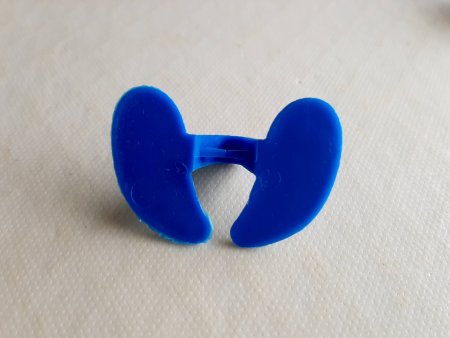
This is the what a Pinless Peeper looks like from a chicken’s point of view.
You might have done all of the above suggestions. And still you have egg eaters. I have read recommendations for culling the egg-eating hen. What do you do if you have several birds that are eating eggs? Even after you’ve done the above suggestions? Do you kill all of the egg eaters?
Some people recommend trimming their beaks. And if you have a steady hand, that might be a good idea.
But when we had several hens eating eggs, even after we started collecting eggs more often, I didn’t want to get rid of all of the hens I loved. They would lay an egg, and then eat it. So I found Pinless Peepers. I’ve mentioned them before. They act as blinders, and they prevent bullying and cannibalism. And egg eating.
Therefore, I ordered them. And once they arrived, we caught the chickens, and put them on their beaks. It wasn’t easy. And the birds absolutely didn’t like them. Most, if not all, of the hens had one on. I think my rooster was the only chicken not sporting a Pinless Peeper. Because he was the only one who wasn’t eating eggs.
It didn’t take long for those blinders to do their work. All of the hens hated them so much and wanted them off so badly. I think we left them on for 2 weeks. But when we removed them, each bird was a new convert.
After using the Pinless Peepers, we ended up having only 2 unreformed egg eaters. One hen of which we gave away to someone who had a lonely rooster. And the other hen died, but not directly as a result of us. Although, we had discussed it.
Thanks for reading this post. Have you ever had a chicken eat eggs before? If so, what did you try?
Having backyard birds is fun most of the time. However, very little in life, in any part of our lives, doesn’t require some type of maintenance. And that includes backyard chickens. So, in this post, I’m going to go over the best way to clean the chicken coop.
If you have chickens, or have had chickens for quite a while, by now you’re aware that waiting for the muck to pile up isn’t the ideal way to scrub down a chicken coop. It’s an easier job on us, and healthier for the birds, if we tidy up regularly. Thus, this will be divided into daily, weekly, and monthly duties. Also, it’s important for you to wear a mask while dealing with the dust this can produce.
Best Way to Daily Clean the Chicken Coop
At the end of each day, remove any leftover or remaining food in the feed dishes or feeders.
Allowing any remaining food to sit overnight can attract predators. Or pests and rodents. So, protect your flock, and don’t entice bugs or rodents by leaving food out. Empty out the feeders when your birds go in at night. And refill the feeders and waterers in the morning with fresh food and water.
Toward the end of the day, before the birds settle in, scrape off the feces from the chicken coop.
Bird poop, including that of your backyard chickens, has bacteria. So each day it needs to be cleared off, with a trowel or putty knife, from dropping boards and roosts. And then it can be added to your compost, if you have one.
Also, be sure to collect eggs.
If you have a lot of backyard chickens, this will need to be done a couple of times a day. Because if you don’t gather the eggs, they’re liable to break and make a big sticky mess when they pile up. Also, if the eggs break, the hens might eat the eggs. And then they might start breaking eggs on purpose, which is a bad habit to break.
Best Way to Weekly Clean the Chicken Coop
Change out the nesting materials.
Whatever nesting material you use for your birds collects bacteria and ammonia. Thus, it needs to be refreshed weekly, otherwise, it could lead to health issues for your chickens.
Disinfect waterers and feeders.
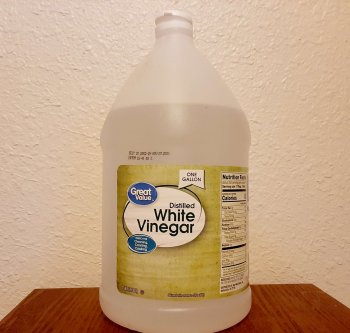
You can make a DIY solution of equal parts vinegar and water to kill bacteria. And then scrub the waterers and feeders. Though, if you have a lot of birds, you might need to do this twice a week.
Wipe down walls and ceilings of the coop.
Spiderwebs/cobwebs and dust accumulate if not cleared away on a regular basis.
Best Way to Monthly Clean the Chicken Coop
If you remember to stay on top of the daily and weekly jobs of cleaning the coop, then the monthly tasks won’t be as difficult to handle.
Scrub the chicken coop.
Clean the walls, doors, and ceiling with the vinegar solution. And if you have windows, use a nontoxic glass spray.
Scrape the roosts.
Use a trowel or putty knife to scrape the excess droppings that have built up; and then disinfect with the vinegar solution.
This is a more in-depth, deep cleaning that only has to be done bi-annually. And ideally you should schedule it in the spring and fall.
Remove old nesting material, feathers, and droppings.
Use shovels, brooms, trowels, and a putty knife to accomplish this. Once done, add what you’ve collected to your compost.
Remove any remaining dust.
Using a hose, rinse down the coop.
Next, wash all the surfaces.
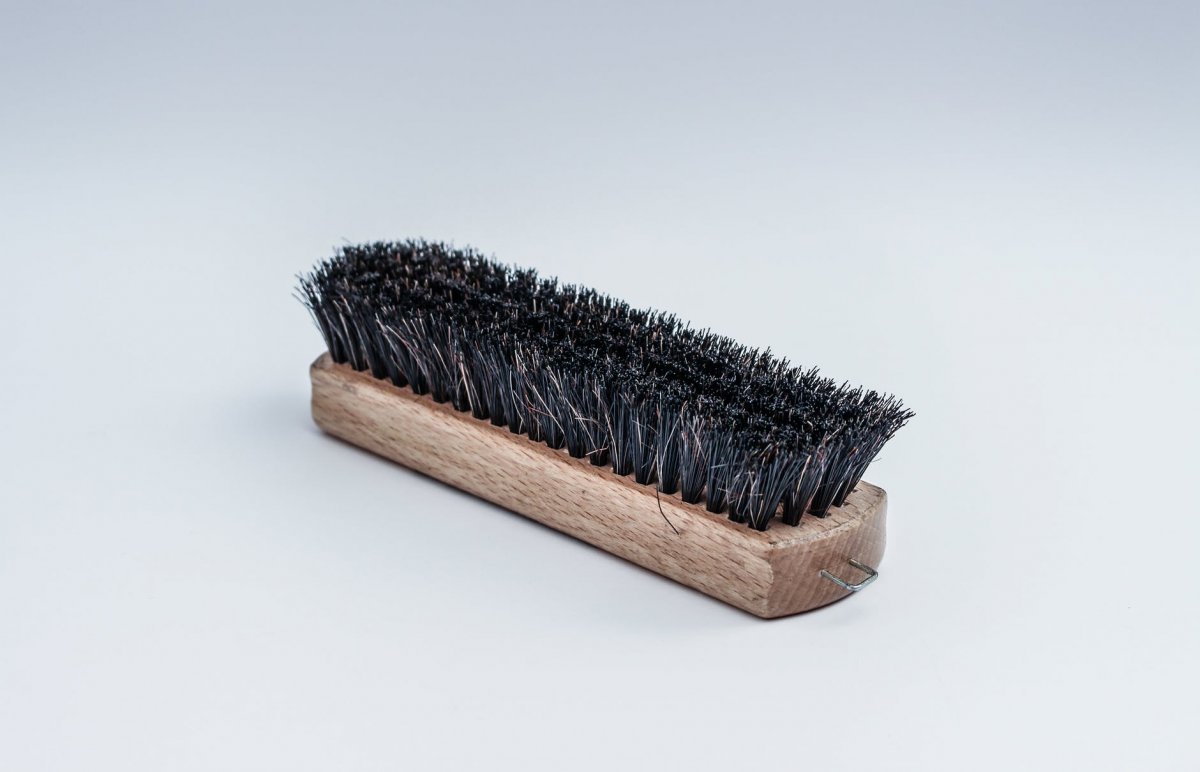
Use a brush and your vinegar solution to cleanse and disinfect the chicken coop. Make sure you clean the nesting boxes too! Afterward, give everything a thorough rinse with the hose.
Dry out the coop.
Try to get out as much excess water as you can. And then keep the doors (& windows, if you have them) open in order to dry out the chicken coop. If you have portable nesting boxes, put those and the feeders in the sun to dry faster.
Spread more nesting materials in coop.
After everything is fully dried, put more nesting material in the coop and nesting boxes. Wallow out depressions in the boxes where the hens will lay, because otherwise, the hens will scratch out the material.
I already mentioned wearing a mask when cleaning the chicken coop. This is very important, because birds carry diseases, some you’ve never even heard of. Also, you might think of wearing gloves and only shoes for out in the chicken yard. This is so you don’t bring anything into your home from the birds.
Only use natural cleaners like vinegar. And avoid anything that contains bleach, since that can be harmful to backyard chickens. Also, while you’re out cleaning their home, check to see if anything needs to be repaired. If there are sharp edges, a bird can get hurt. Or if there’s a hole in the wire, a predator could slip in.
If you have any questions or anything to add, I’d love to hear from you!
Today I’m going to talk about hens adopting chicks. But not just about broody hens, though that will be brought up too. I’ll also discuss when there’s a broody hen that hatched chicks and another hen decides to co-parent with that hen.
Will Broody Hens Adopt Chicks that are Not Their Own
The first question we’re going to try to answer is Will broody hens adopt chicks that are not their own? Technically speaking, none of the eggs a setting hen is on are really her own eggs. Not long ago I covered the topic of broody hens. But when the eggs hatch, the broody hen then becomes the new generation’s mother, in effect.
However, some people have tried fooling a broody hen by placing chicks from elsewhere under her. And they’ve succeeded in getting the hen to adopt the chicks. I can also verify that it works.
This is Davis with her chick that survived the snake attack.
2019 was our first year we had success with broody-hen chicks hatching. But only a couple of days later a chicken snake got one of the chicks. And it devastated Davis, our broody hen. She was scared, and her remaining chick was lonely without its sibling.
So we went to the feed store and found one that looked the most like the chick we lost. We weren’t sure what Davis would do. We reasoned that it would be a 50/50 shot either way. She would love it or hate it.
We brought it straight out to her, in daylight, prepared to rescue it at any moment if she rejected it. Davis sniffed the store bought chick and walked away. She knew it wasn’t her baby. But at least she didn’t kill it. Her remaining chick, on the other hand, immediately gravitated toward the bigger, store bought chick. They became inseparable. And over time Davis started treating the imposter chick like her own.
It is best to make sure your hen is broody before attempting to fool her. And it’s recommended to introduce a chick or chicks to the broody hen at night in the coop. Although, we didn’t and it still turned out ok. However, the hen we tried to fool is one of the sweetest hens we have. I doubt I would try this during the day on a hen that doesn’t have as nice a disposition. Read this for more information on introducing chicks to a broody hen, if you’re interested.
Davis with her adopted spotted chick, and the hen in front of her is the co-parent, Soundwave.
Will a Non Broody Hen Adopt Chicks?
So what about non-broody hens adopting chicks? Strictly speaking, no, they don’t. Though, some people believe that you can encourage a hen to go broody. But whether that’s true or not, I don’t know. My birds do not have problems going broody. In any case, the hen would no longer be non-broody if you made conditions favorable to broodiness. And the result was that she turned broody.
Our newest broody hen, standing on the right, with Plo, the co-parent, and their chick is on top of Plo.
Co-parenting
What do I even mean by the word co-parenting? Well, the dictionary basically describes co-parenting as the sharing of parental responsibility. This is actually in reference to human children. However, it can certainly apply to chickens as well. Because, when there’s a co-parenting hen, that is exactly what she does. She helps the hen, who did the work of incubating and hatching the eggs, raise and take care of the chicks.
But I bring up co-parenting in a blog about hens adopting chicks, since that is essentially what the co-parent is doing. The co-parenting hen adopts the chicks as her own. She did not labor for them, and yet she treats them as her own.
The first time I saw this behavior, it was in Soundwave, Megatron’s hatchery-mate. When she first came to us, she was the tiniest hen we had. Although, she was one of the meanest hens and took every opportunity she could to abuse the hen on the bottom of the pecking order. So, naturally I was surprised when this mean hen started displaying maternal instincts.
At first I thought, maybe she’s going to kill the chicks that Davis hatched. However, over the course of a few days, she’d cuddle with Davis and allow the chicks to sleep with her. And soon Soundwave was spending her days with Davis and the chicks, trying to teach the babies how to forage for food.
I’d never heard of chickens doing this before: Assisting broody hens raise chicks. My mother-in-law, who’s had chickens for at least twice as long as me, has never had a hen co-parent. She never heard of it either until I brought it up to her 2 years ago.
Davis and her two chicks. Her adopted chick is on the right.
Since our first experience with co-parenting hens, we’ve witnessed it happen two more times. And one hen is a repeat co-parent. She helped raise a chick last year. And this year she assisted one of our Easter Eggers with a clutch of 3 chicks.
Plo, the hen who’s co-parented twice, actually starts out broody first, before she co-parents. And throughout her co-parenting, she acts broody, though she isn’t mean like the hen who did all of the work. But when Soundwave co-parented, she never acted broody at all. She was just slowly drawn toward the chicks and Davis, until she was helping Davis out.
There isn’t a lot of information out there about this phenomenon. But I think it’s amazing that these birds, which normally aren’t close like this, would raise chicks together.
If you have backyard birds, have you ever witnessed this behavior yourself? I would love to hear your stories!
Chickens can, and do, lose feathers from time to time. And most of the time it’s nothing to worry about. However, it’s always a good idea to inspect your flock to determine where the feather loss is coming from. Are all of the birds affected? Is it general feather loss? Or is it only in one spot on a few birds? We’ll cover all of these questions why chickens are losing feathers.
Chickens Losing Feathers Due to Molting
In another post I covered the topic of molting in detail. But I’ll go over some quick points. If your backyard flock is molting, it typically affects all of the birds. It also can affect any part of their bodies. Some chickens completely lose all of their feathers, while others might only lose the ones around their faces and tails.
Also, molting usually occurs in late fall and lasts about 3 months. There are some breeds that can molt in the spring as well. However, it isn’t as drastic as the fall molt. So, if your birds are losing feathers at some other time, chances are good that it isn’t molting causing the feather loss.
If your backyard birds are molting, the most important things you can do for them are
to feed them a higher protein feed with 20% protein.
don’t handle them much, because they are sensitive due to feather loss and new growth.
keep the stress low and don’t add new birds during this time.
and be sure to have plenty of clean, fresh water daily and proper air ventilation in the coop.
Feather Loss on a Chicken Because of a Broody Hen
Another common reason for feather loss is when you have a broody hen or hens. A broody hen is a hen that stops laying eggs, and instead stays on a nest of eggs all day, several days to weeks long until she hatches some chicks.
With a broody hen you will not see a lot of feathers all over your yard. Because it’s restricted only to that one hen. Or hens, if you have more than one broody hen. The feather loss will also be confined to the coop, since the broody hen won’t leave her eggs. And the feathers will usually be missing from the hen’s chest, where she plucked them out herself, to make a proper nest for her clutch.
If you have a broody hen, and don’t want to break the broodiness, the most important things you can do are to
separate her from the rest of the flock by putting a partition wall made of chicken wire in the nesting box she has chosen.
provide fresh, clean water and food daily.
and give her access to frequent bathroom breaks.
If you don’t want your hen to be broody, then you can break it by completely separating her from the flock. You don’t want her to be able to see them, or vice versa. And try to keep her in a room or area that is well lit.
Chickens Losing Feathers Because of Parasites, like Mites or Lice
Another cause of feather loss in chickens is from external parasites like mites or lice. Usually it presents on the bird’s back where they have been over-preening and plucking in order to get relief. There will be other symptoms if mites or lice is the cause of feather loss, like reduction in egg production. And the birds will also have pale combs and wattles.
If you suspect that external parasites are the culprit, you can check the bird’s vent area for scabs or signs of inflammation. Many people claim that you can’t see mites. However, that’s not entirely true. Sometimes you can see them on the feather shafts or on the undersides of where your birds roost at night.
Lice also can typically be seen on feather shafts. However, they also migrate toward the vent area as well. If you pull back your bird’s feathers from her vent, often lice will be seen, trying to hide.
If you have verified that you have a bird with lice or mites, then the most important things you can do are to
treat your whole flock immediately or as soon as possible with Ivermectin. (0.2 – 0.4 mg per kg topically at their shoulders where they can’t reach and once more in 2 weeks.)
you can also use petroleum jelly on your birds’ legs to smother leg mites and prevent eggs from hatching. However, this will need to be done a few times to make sure the parasites are all gone.
finally, you can prevent external parasites by keeping the coop and run clean and by providing your birds areas where they can dust bathe. We also add food grade diatomaceous earth to the coop and dust bathing spots.
Predator Attacks that are Causing Feather Loss
Sometimes predator attacks will leave no evidence of the crime. And others will leave behind feathers. At times that might be all you see. In one of my other posts I described how one of our Ameraucana hens was attacked by a hawk. More often the hawk doesn’t leave behind its prey. Although, in this particular case, the hawk dropped our hen.
Another time our neighbor’s dog got one of our broilers. We didn’t have feathers in our yard; they were scattered all over his. If you suspect an animal attack, first inspect your birds for missing feathers on their backs or tails. They will act scared and could be in their coop hiding, if there was a predator attack. Also, check for any injuries and open wounds.
Once you’ve determined that your bird was attacked by a predator, and it’s still alive, the most important things you can do are to
separate her from the rest of the flock in a safe and comfortable environment with fresh, clean water and food.
keep stress to a minimum, because she is scared or even possibly in shock.
clean the wound by flushing with warm sterile salt water or 0.05% chlorhexidine.
and, if your bird was bitten by a predator, call a veterinarian to get an antibiotic.
Feather Loss Due to Over-mating, or an Aggressive Rooster
The final cause of chickens losing feathers is due to aggressive, or over mating, by a rooster. Thus, you will not see feather loss in roosters if indeed mating is the cause. Because only the roosters get on the hens in order to mate.
Sometimes this type of feather loss can start out in a small patch near the tail feathers. However, if left untreated, the spot will only grow. It can get so bad that the rooster pulls the hen’s skin, and then the hen is in danger of infection.
Most of the time, when I’ve considered this type of feather loss in our flock, it has usually been the hens on the bottom of the pecking order. Not always, but most of the time. And then there are the times when the roosters will have a favorite hen. And consequently, she will get entirely too much notice.
You can determine if over breeding is the reason for the feather loss just by whether or not you have any roosters. And if you do, then observe your backyard flock. Or, more specifically, your rooster. Watch how he interacts with the hens. Does he have a favorite? Is he rough? Does it always seem like one hen is getting way more physical attention than the rest?
If you have a hen with feather loss on her back caused by over mating, the most important things you can do are to
examine your hen for broken skin. And, if there isn’t any, you can invest in saddles for your hens or make some yourself.
if your hen has broken skin, clean the area with warm sterile, salt water, and add either Battles Gentian Violet spray or Blu-Kote to the wound. Both treatments look similar when applied.
assuming the wound is large and in danger of infection, rather than using Blu-Kote or Battles Gentian Violet spray, you need something stronger. Povidone-iodine is an over the counter, broad spectrum anti-microbial that’s recommended in these cases. Which you can find at WalMart or on Amazon.
in case you have to treat your hen for a wound that requires an anti-microbial due to broken skin, you need to keep the rooster away from that hen. You can accomplish this by keeping her in a separate spot, not entirely isolated from the flock. But possibly where you keep your broody hens. This way she can heal without continually getting re-injured.
monitor her progress and call a vet if she doesn’t show signs of improvement.
to prevent feather loss on your chicken’s back due to over-mating, make sure you have the proper hen to rooster ratio. Most people agree that no less than 10 hens per rooster should be the absolute minimum.
and, safely trim or file your rooster’s claws.
Hen with a saddle on.
Sometimes you will have the proper ratio of hens to roosters, and still one of your hens might get feather loss on her back. We currently have 27 hens with 2 adult roosters. And 7 juvenile chickens with 3 juvenile roos, which are not mating yet, thankfully.
Our second rooster has now chosen a couple of senior Ameraucana hens and a couple of Easter Eggers as his favorites. And the EEs backs are torn up. Thus, we’ve locked him in chicken jail so the girls’ backs can heal.
I hope you enjoyed this post. Please feel free to comment or ask questions!




























 Chicken Girl