Providing helpful information regarding our feathered, feline, and canine friends while also sharing fun stories. And locally we provide pet sitting services.
Author:KS
I breed Black Ameraucana chickens and Easter Eggers that are Black Ameraucana mixed with either Cuckoo Maran or Barred Rock. And I donate eggs to people or organizations in need. Further, I've started chicken and other pet sitting in my area. Details are on my About page.
Pot pies are some of my favorite foods to cook. They’re versatile, taste good, and just plain goodness. Furthermore, they have an interesting history which includes live birds. But I, for one, am glad we don’t use live animals in pot pies anymore. Below you’ll find a beef pot recipe with pie crust. This is one you’ll want to plan about 3 hours for. However, it is well worth the wait. Additionally, you could just as easily make it ahead, refrigerate, and then bake it when ready.
First, put the meat and flour in a gallon size baggy; shake baggy to evenly coat the stew meat.
Next, in a 5-quart Dutch oven over medium-hi heat, heat ~ 3 tbsp of olive oil; and cook the beef till brown, adding more oil as necessary. Stir frequently.
Then remove the beef, reducing heat to medium, and add the onion to drippings. And cook ~ 3 minutes or till almost tender, stirring occasionally.
Stir in wine, water, bouillon, Worcestershire, and pepper, stirring to break up the bouillon.
Add potatoes, mushrooms, and steak; heat to boiling. Then reduce heat to low. Cover and simmer 2 hours or till meat is fork tender.
Spoon mixture into a 2-quart shallow casserole. Preheat oven to 400°F. Prepare the pastry; roll out to fit 1 inch larger than casserole dish.
Fit crust loosely over meat mixture; trim back pastry overhang about 1 inch, and make a fluted edge. With point of knife, make slits in crust.
Bake pie ~ 40 minutes until brown and bubble. Cover loosely with foil if the crust browns too quickly.
Finally, serve immediately.
Do you have a favorite pot pie recipe? Even though it takes some time, I still love this beef pot pie recipe. If you made it, what did you think?
Thank you for stopping by! Please share, and if you don’t already follow, you can do so now.
Recently my youngest daughter and I started walking mornings. And we typically take the same route each time. But, there are a lot of dogs any way we choose to go. Unfortunately for us, none of the dogs are confined to their yards. In the US, 4.5 million people become victims of dog bites. Of those, half are children. If you live in the city limits, you’re likely in a safer walking environment than where we live. However, if not, do you know how to protect yourself from a dog attack while walking?
City limits require dogs to be on the owner’s property. That’s how it is here in Oklahoma. And I’m sure it’s no different elsewhere. Though, when you get outside city limits, the laws are extremely loose. Or at best, they’re murky. So, when walking, you have to be very cautious. And if you have children with you, be extra vigilant.
As I said, there are a ton of dogs just where we live. In fact, a dog we’ve never seen before nearly attacked Sarah on our walk a few days ago. Below you’ll find facts on dog attacks, such as
Any dog can attack and bite when afraid or surprised. But fear aggression is a behavior that some dogs develop or are predisposed to have. Often it can happen when a dog has experienced trauma, such as abuse, or wasn’t adequately socialized while young.
Also, being surprised has its roots in anxiety, which is linked to fear. In addition, dogs who are startled awake can be bewildered and disoriented. Moreover, this is especially characteristic of older dogs, if eyesight and hearing are failing. So, if you’re out walking and a dog comes out of nowhere, looking like they’re about to attack, your approach might’ve startled them.
pain & illness
No one likes to be sick or in pain. Not even our canine friends. Plus, being sick and hurt can be very stressful for dogs. Thus, if an ill or injured dog is approached, they’re more likely to attack, because of fear of more pain. This situation is more probable in the home environment, with your own dog. Or it could happen when you visit someone you know.
possessiveness
This is also called resource guarding. Additionally, it happens when your dog acts aggressively over items they perceive as their own. Food, toys, furniture, your own clothing, and even you are all examples of things dogs guard as their own.
Sophie, our Aussie, has gotten more possessive since having 3 heat cycles. She’s possessive of her food, a hoodie of Paul’s, and most recently, a crate we used while on our trip to South Dakota. When Paul tries to take his hoodie back, she gives all kinds of indications she’ll attack.
protective
In the wild, dogs live in packs and naturally protect one another. With domestic dogs, the pack might consist of the dog’s owner, other family members, especially helpless family members, and other house pets.
Generally, protective dogs are inherently prone to being protective. Or they’ve been trained to be protective. In addition, they have the socialization to understand an actual threat properly.
and predatory
Predatory behavior is usually hereditary and not fear based. What is more, it’s commonly related to dogs chasing small animals or other pets like cats or ferrets. For instance, our last dog, Moses, used to chase wild bunnies and birds when we lived in Dallas. However, he never killed anything, and he’d stop chasing when we’d call him. Further, when we moved here, he helped us keep the chickens in their yard.
But, this is why some dogs chase bicyclists, cars, skaters, and even running children as well.
Signs Dogs Will Attack While You’re Out Walking
Now that I’ve covered some statistics and reasons dogs attack, we’ll look at signs to watch for while out walking. Furthermore, quite possibly the first signs to heed will be a running and barking dog. And if you see any of the signs below, be on your guard.
growling
snapping
snarling
baring teeth
lunging
hackles raised
ears flat against head
lips compressed together
yawning
showing whites of eyes
pacing
panting
tail tucked under
cowering
staring at you
again barking
and running up to or at you
When I was looking up information to prevent dog attacks, of course everything was the same. Besides that, none of the information seemed proven, like it would actually work if you were about to be attacked by a dog. So, it made me wonder if somebody pulled the ideas out of their hat.
And one of the suggestions meant I could no longer go walking: avoid houses where there are dogs. That’s almost every single house here. Didn’t I tell you practically all of our neighbor’s have dogs, and they’re not confined? Plus, I know that’s the case in similarly rural areas. Therefore, we’ll skip preventative measures, and go straight to the next step.
Protecting Yourself from Dog Attacks While Walking
Again, because a dog attack happens so quickly when you’re out walking. you don’t have the luxury to think about what to look for. Thus, when going out, take the following on your walks:
a good stout walking stick
and treats
If you see a dog rushing your way, do the following
First, stay calm and avoid eye contactwith the dog.
It’s been proven that dogs can sense fear and anxiety. And that is more likely to get you attacked if that’s what you’re giving off. Plus, if you’re dealing with an aggressive dog, and you make eye contact, the dog will take your eye contact as a challenge.
Next, get something between you and the dog, preferably that good stout walking stick.
Most other sites don’t have a preference regarding what you put between you and the dog, just something. However, my partiality to the walking stick is that it has greater reach between you and the dog’s jaws. Thereby, my hopes are that the walking stick will keep any chomping teeth away from you.
But if you’re not going on a walk, except to your car, then by all means, use whatever you have on hand: an umbrella, purse, briefcase, etc.
Thenfirmly, command the dog or dogs to go home. Use words likeNo.Down. Back. Home. etc.
Don’t yell at it and don’t scream or run away.
Yelling, screaming or running away can get the dog’s arousal further stimulated and escalate the situation. Moreover, if you run away, the dog may very likely see you as prey and try to run you down.
Now the treats.
Multiple sites and people I know recommend carrying treats for stray dogs while out walking. The idea is to toss any strays some treats, so they don’t find you threatening. Eventually they may find you their personal treat bringer.
Therefore, if the commands don’t work, toss milk bones at the dog’s feet, before they reach you. Thus, you have to act fast. Then move diagonally away from the dog till you are beyond them.
What to do if a Dog Attacks You Anyway
Say you’ve done all of the above, but a dog lunges for you anyway. What do you do then? If the dog lunges at you, be sure to cover your vitals: one knee upto protect your stomach and abdomen. Though, if the dog jumps toward your face, quickly cross your arms over your face and hold them there.
Or you can drop to the ground and curl into a tight fetal position. Also, put your hands behind your neck, with your head down, and your knees up, as close to your face as you can. It’s better to be bitten on the arm than on the face or neck. And be as still as you can until the dog goes away. And don’t pull awayif and/or when you get bit. Don’t reach out toward the dog; and don’t stick any fingers out, because you just might lose them.
When the dog leaves, assess your injuries and call for help. Based on the severity of your wounds, either call 911, or immediately go to the ER to get checked out. Not only is rabies a concern with dog bites, but infection is also a serious risk. Next, as soon as you’re able, you need to identify the dog’s owner. Check this site out for more info on what to do in the event a dog bites you.
So, How do You Protect Yourself from a Dog Attack While Walking
When you’re out walking, don’t forget to bring your trusty walking stick and dog treats. And if you meet an aggressive dog on your walk, be calm, don’t go toward it, and avoid eye contact. Also, put your walking stick between you and the dog. Then if it starts toward you, say, “No, go back,” in your commanding voice. However, if it ignores your commands, toss it a milk bone to distract it. But, if that fails, and the dog attacks anyway, protect your vitals and be still until it leaves.
The dog that almost attacked Sarah was a pug mix. And it came from out of nowhere. Plus, it’s either a new dog the homeowners got or a houseguest. We’ve seen the other dogs there before, because they’ve barked at us many times. But they’ve never attacked. When the dog was on top of us, (our legs) I had the walking stick. Although, it didn’t do much good, since the dog was already at our feet. Regardless, in my commanding voice, I said, “No. Down. Get back.” At which point, the owner came outside and called the dog back.
Most of the dogs that accost us on walks are Maremma sheepdogs. Though, they’re nice. And the only thing I worry about for them is that they’ll get hit by a car. I hope none of you have ever been attacked by a dog. Although, have any of you almost been attacked by dogs while walking? If so, what did you do to protect yourself?
Thank you for taking the time to read this post. I appreciate your comments. Please share, and if you don’t already follow, you can do so now.
Since we’re no longer moving to Dallas, “I’ve finally decided what I wanted to do when I grow up.” I recognized a need based on our own whenever we want to go on vacation, or just need to go out of town. So, if you live in the Oklahoma City Metroplex and have chickens, ducks, and/or farm animals that make it difficult for you to travel, then give me a call. Further, I’ve added the details to my About page for more info, if you’re interested.
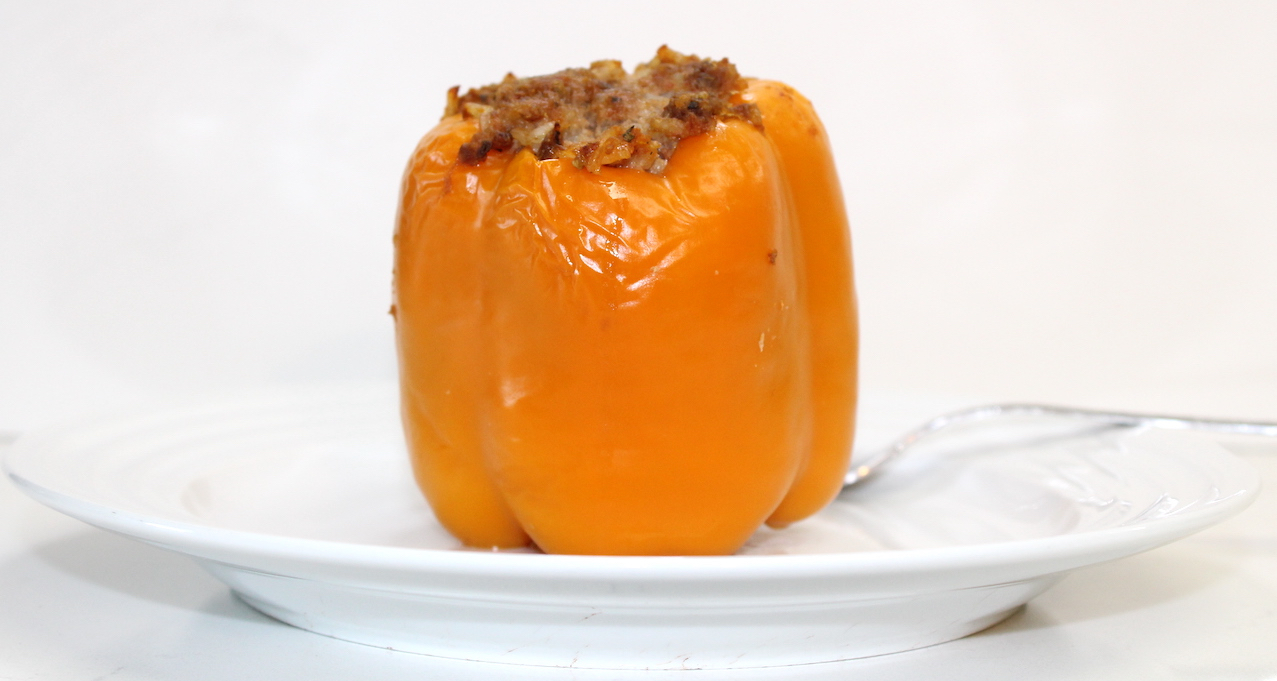
Stuffed peppers have been around for a long time. Since every culture has their own recipe, unfortunately, no one really how they got started. But, one thing is clear, they are delicious. And there are a number of ways to prepare them. The recipe I’ve included has some Polish roots, relevant to how it’s made. Plus, the majority of it was handed down from my mom. Though, she hasn’t cooked stuffed peppers in a while. Thus, I filled in the blanks based off of memory. So, please enjoy this traditional stuffed bell pepper recipe.
Traditional Stuffed Bell Pepper Recipe Ingredients:
6 to 8 bell peppers
2 c cooked rice
1 lb ground beef
1 egg
1/4 c to 1/2 c Italian style breadcrumbs
14 1/2 oz diced tomatoes
1 tsp each of salt, dried granulated garlic, oregano, and basil
and 1/4 tsp dried marjoram
Stuffed Bell Pepper Recipe Instructions:
First, preheat oven to 400°.
Next, clean bell peppers and remove stems and insides. Set aside.
Then hand-mix rice with next 6 ingredients. And stuff mixture into peppers.
Further, place each pepper into greased baking dish. Also, cover with aluminum foil, and bake for 40 minutes, or until instant read thermometer inserted in middle of stuffed pepper reads 160°.
As you saw, the peppers don’t require any pre-cooking. The meat and peppers are supposed to be raw. Although, the rice should be cooked. Hence, if you have any leftover rice, that would work great. Additionally, you’re basically making meatballs mixed with rice, which then gets stuffed into peppers. It’s one of the easiest meal preps I’ve ever had.
Besides, you can serve these peppers as an appetizer. Or make them the centerpiece of a meal. And pair with your favorite side dish. Alternatively, you can change out the meat for pork, chicken, or even seafood. Moreover, instead of rice, you can try quinoa, orzo, or barley. Furthermore, if you love veggies, add more variety. Do you have a favorite recipe for stuffed bell peppers that you’re willing to share? I’d love to hear it! Or let me know if you tried this recipe.
Thank you for your time. Please share this with others. And if you don’t already follow, you can do so now.
Have you ever wondered how ducks get clean? Or perhaps, you’ve watched how they do it. Plus, is it the same as other birds? While we’re on the subject, do ducks get sick if they can’t get cleaned?
I realize my duck posts are typically more popular. However, I also know I don’t write about them as frequently. Although, one of my ducks deserves more to be said about her. So, I’ll try to remedy that in this article as I address how ducks get clean.
All birds preen to maintain feathers by using their beaks to clean plumage and take care of parasites. Additionally, for aquatic birds, preening spreads oil from the preen gland with the beak over feathers to keep them waterproof.
Submersion
In addition, ducks will submerge their heads in water to clear out their eyes and nostrils.
Showers or rain
Yes, ducks love the rain. Very likely if you have ducks, you’ve seen them gamboling in the rain. Or, even if you’re watering with the hose, they’ll stand under that as well to get clean.
Have you seen a duck dust bathing before? No, I’m not joking. Ducks will, at times, dust bathe. In fact, Bakugo, our Pekin, has been known to dust bathe with the chickens.
What Happens if Ducks Can’t and Don’t Clean Themselves
Ducks are known to be more resilient to sickness and pests than most other domestic birds. However, that doesn’t mean they can’t or won’t get sick. For instance, just by having an insufficient amount water for these birds can create issues, such as
Photo by u0414u0435u043du0438u0441 u041du0430u0433u0430u0439u0446u0435u0432 on Pexels.com
wet feather
Another term for a duck’s feathers being water-logged is wetfeather. And there are multiple thoughts as to the cause. But one of the reasons is having an inadequate water supply for your ducks.
foamy eye
Typically a duck that has foam or bubbles in its eyes has an underlying respiratory infection as well. Though, this condition is said to be preventable if ducks have sufficient water to submerge their heads in.
and dehydration
Whether it’s too cold or in the middle of a heat wave, outside animals, including ducks, are at-risk for dehydration. Furthermore, ducks can’t go ~ 8 hours without water. That’s how important it is to them.
Moreover, one of the most important reasons ducks need water is to drink while they eat. You see, they take a bite of food, then a sip of water, all so they don’t choke to death.
Things You Can do to Help Your Ducks Get Clean
Photo by Pixabay on Pexels.com
Since ducks need water for their health and life, it’s absolutely essential to provide enough of it. However, for most commercial outfits, the struggle has been to find the right type of watering system for ducks. For example, if ducks are long exposed to wet litter in the coop, they end up getting diseased feet. So, that’s not an ideal situation either.
Therefore, to prevent this for your backyard ducks, try pasture-raising them. That way ducks can have all day access to water. And you won’t have to deal with the constant mess. Plus, they won’t be exposed to water-ridden litter, which breeds disease. In addition to that, get
shallow water pans or keepwaterers by food
Keep water near food for ducks, so they don’t choke. Although, don’t leave any in the coop, because they can go overnight without water.
kiddie pool or small pond
Unless you just want to, you don’t have to get anything elaborate for your ducks. They will be totally ecstatic with a kiddie pool from WalMart. But, depending on how many ducks you have, you may need to get more than one.
Also, ducks poop, eat, drink, and clean themselves in their swimming hole. But they still require clean water to drink to be healthy. Therefore, at a minimum, clean out the swimming hole once daily.
In Conclusion
You saw that the main way ducks and all birds get clean is by preening. However, ducks prefer to add water to their routine as well. This is to prevent certain diseases and to remain waterproof. Moreover, if you have ducks, make sure to add waterers by their food to prevent choking. And get a kiddie pool for them too.
Many of you know that I was going to take my pets on vacation last week. In fact, we went to South Dakota with our dog and cat. And just like last year, I’m going to share some highlights of this trip. The plan was to pick up the rental car Tuesday night around 5pm. But, unfortunately, the rental car company changed the time to 7pm. Sarah has martial arts Mondays and Tuesdays. So, by the time her class was done, and we picked up the car, it was ~ 8pm when we got home. Thus, it was too late to get Itty and Sophie accustomed to a different vehicle.
It would have been nice to let our fur babies explore the rental car. Though, that wasn’t an option. Therefore, when we left early last Wednesday morning, they were both super anxious. So, I pulled out all the guns: ThunderJackets, calming chews, Rescue Remedy, etc. However, nothing was helping. Sophie was barking non-stop, while trembling Itty was crawling over everything incessantly. We were maybe 30 minutes to an hour into our drive when we administered the sedatives to them both.
This is after the sedatives took effect.
The sedatives took around half an hour to kick in. Although, after that, the drive was more peaceful for everybody. However, our pets weren’t completely knocked out, which was great. Sophie and Itty were simply much calmer and more relaxed. Regardless, every time we’d pull in to get gas or stop for food, Sophie would still bark. And then Itty would get up to look around. Nevertheless, I haven’t been able to cuddle my kitty so much since she was an itty bitty kitten. I have to admit, it was really special.
The medicine wore off after ~ 12 hours for both Itty and Sophie. Though, we didn’t bother giving them anymore. We just carried on, because there were only a few hours remaining till we made it to our destination. With all the potty breaks and snacks, it took 15-16 hours total to arrive in Hill City. Plus, Itty and Sophie didn’t get sick. However, I didn’t feel that great. I hypothesize it was a combination of sitting in the back, being a bumpy drive, and also the winding roads.
Our Airbnb was a cozy 2 bedroom 1 bath basement rental on 8 acres. Unfortunately it rained the entire time we were there. Thus, we didn’t get to do any hiking. And yes, I said 1 bathroom for 5 people. Yes, somehow we survived.
Regrettably, it had been wet, gray, and cool our entire stay. As a result, the conditions were definitely not ideal to take Itty and Sophie on any outings. Pets aside, we visited Mount Rushmore in Keystone. And did a lot of shopping in Custer in the rain. Plus, we had wonderful food everywhere we went. In addition, we even toured a museum in Hill City. But the best part of this vacation was getting to spend time with my daughter, Rebekah.
I wouldn’t say Sophie and Itty were exactly comfortable in this home away from home setting. Sophie kept trying to simultaneously herd us and play with us. And after Itty smelled her surroundings, she mainly stayed hidden the whole time. Therefore, my thoughts never strayed too far from them. But especially so when we had to leave them in the Airbnb. I tried not worry, though it was difficult.
This is when they were much younger.
For those of you new to my blog, you may be wondering why we don’t just board them. Or you might be asking why we brought them in the first place. When we had our last dog, Moses, we could, and did board him. Also, due to his temperament, our neighbors could watch him. Hence, he was never an issue to leave at home. Although, now we have around 40 birds, 2 cats, and a dog. But both Itty and Sophie were abandoned as babies. That’s how they came to us as well. As a result, they have major separation anxiety. While Sophie doesn’t like being separated from any of us, Itty has separation anxiety only with me. On account of this, we simply don’t board them.
Additionally, most of our neighbors are much older than Paul and me. Plus, there aren’t any kids older than Sarah; she’s 12. Otherwise I could hire a teenager to help out. Regardless, Itty got locked in a bedroom for 3 days without food, water, and her litter box last year. Furthermore, our neighbor who watched them last year, who also took care of our birds and Cake this time, fell and had to go to the ER twice. Thankfully, he didn’t fall at our house. And it was unrelated to us completely. Other than having to get stitches, he’s doing well. Though, for a time, our birds and Cake were on their own. FYI, the reason we didn’t take Cake with us is because she detests all other animals. She doesn’t mind people. In fact, she loves the people. But put her around another animal, and she’ll start a fight.
Given that we had another 15-16 hour drive back, we left at 6am Sunday morning. Prior to loading the car, we dispensed the sedatives to our fur babies. No use going through the struggle, only to have to do it anyway. Sadly, the ThunderJackets didn’t help. The Rescue Remedy did, but only in conjunction with the sedatives. Hopefully, over time, the Rescue Remedy will be enough on its own. However, the drive back was much better than the drive to South Dakota. And once we walked in the door of our house, both Sophie and Itty were totally at peace.
During our vacation, we were kept abreast of the home weather situation via our neighbors. As many of you know, we live in Oklahoma, tornado headquarters. Though, the last tornado to hit Blanchard was in 2011. Nevertheless, the homes in our neighborhood are ~30 years old or older. Despite this, there was still a ton of water. For instance, our coop was flooded. And that’s never happened. Plus, we lost a duck. We don’t know if she died; she’s just gone. Although, everyone else is accounted for.
So proud of my kids!
All in all we had a good time in South Dakota. We enjoyed visiting with family and seeing cool places. And I would love to say it wasn’t stressful at all with Sophie and Itty. But I would be lying. It just shows me we need to do more conditioning with them both. And we’ll do that by taking them on more short car trips till we build up to longer ones. Though, there is a silver lining to all of the stress on both parts. I feel like Itty and I are closer than we were before. For example, she sleeps closer to me than she did before, even during naps. Moreover, Paul feels like he and Sophie have a stronger bond than before. I know our pets were anxious about the trip, because I could see it in their behaviors. But I also know that they would much rather be with us than be left on their own.
Thank you for taking the time to read this. I hope you enjoyed it. Do you take your fur baby on vacation with you? Or do you have someone you trust to watch them? Any advice on taking pets on vacation? I’d love it if you shared. I told my husband that the next vacation I wanted it to just be him and me; that the kids could watch all the pets. Plus, I’d love to go somewhere warmer. Maybe another beach trip. Please share this post. And if you don’t already, you can follow now. Thanks again!
If you have a very anxious pet, you know what it’s like. For example, they might act terrified of strangers or situations. However, it could seem like aggression to others. Further, taking them to the vet may feel like a huge ordeal. Or taking them on any kind of outing, even one that’s fun, can be challenging. But what if you want to take them with on vacation, or you’re moving? So, you might have wondered at one time or another, Can I sedate my dog for travel?Or my cat? We’ll explore these questions and some possible alternatives for traveling with your pet.
Not long ago I mentioned that my family and I were making a trip to South Dakota. Plus, we’re taking Itty and Sophie, our house pets. And we’re renting a vehicle. Thus, to prepare, I had both of them seen by their veterinarian. Since Sophie is super nervous in car trips, even short ones, the vet prescribed a sedative for her. But there are different thoughts on the issue.
What’s the Problem
Most mammals, including cats and dogs, can suffer anxiety. Moreover, sometimes the anxiety and fear is so bad, it affects both pets and pet parents.
Though, for our purposes, we’ll focus more on travel anxiety. Yes, travel anxiety is a real issue. And not just for pets. It also affects people. And travel anxiety has some of the same symptoms as generalized anxiety. Below you’ll find signs that your cat or dog might have travel anxiety.
So, what causes travel anxiety in pets? Well, it’s possible your pet is afraid of your car or strange situations if they lack good socialization. Or they could associate the car with anything scary or traumatic. For example, your cat might have travel anxiety, because she associates your car with the vet. Or your dog might have travel anxiety, because his first petparents abandoned him at your house.
But both cats and dogs can experience motion sickness. Although, it occurs more often when they’re babies. And they can outgrow it when adults. Thus, that can be the issue as well. Or the memory of motion sickness can be the problem, if your pet is an adult.
Obviously preventing cat and dog travel anxiety is preferable to sedating our beloved fur babies. Therefore, if you have a kitten or a puppy, use what’s referred to as desensitization. When they’re little, start training them for car rides. That’s similar to socialization. Anyway, desensitization is basically just getting your pet comfortable with your car. Taking small, extremely small steps, while giving praise and treats to your pet along the way. But, over the course of some time, you will, eventually, take your cat or dog on a short drive. You can read more about desensitization in detail here.
However, if, like me, your pet already has travel anxiety, you still need a solution. And you can’t travel back in time to change the past. Thankfully there are options. People in the know refer to this option as counter-conditioning. This assumes you have time to put this into practice. Though, if you do, counter-conditioning teaches your pet that your car, and thus traveling is super fun. As I mentioned, it takes time, particularly if your pet already associates your car with something absurdly un-fun.
Counter-conditioning uses some of the same techniques as desensitization. Although, along with car rides, you take your pooch somewhere fun, like the dog park. For example, if you’re flying with your pet, you would take either your cat or dog to the airport to get used to the airport sounds and smells. But after the session at the airport, take your dog somewhere fun. However, counter-conditioning looks different for cats. Since cats get scared easily, it resembles desensitization more. Rather than taking your cat anywhere else, offer more rewards, like added treats and playtime.
OTC Calming Aids
Say you’ve tried the suggestions above, but your pet is still nervous. Or maybe you don’t have the time to work with them. What do you do in that case? Don’t worry. You don’t have to cancel your trip or board your pet.
First of all, there are over-the-counter and homeopathic aids available, such as
According to their website, ThunderShirts or -Jackets are similar to swaddling a baby, by applying a gentle, constant pressure to your pet’s torso. And research suggests that this type of pressure can release a calming hormone like oxytocin or endorphins.
cat or dog pheromones
Both cats and dogs release pheromones after giving birth, to calm their babies. Plus, these pheromones have been copied synthetically, And both are available in a variety of forms: diffusers, sprays, or collars.
Rescue Remedy specifically for pets
For years people have been using Rescue Remedy for anxiety. It’s a homeopathic remedy, made from the essence of plants and flowers. But make sure you get the one that’s alcohol-free.
and playing pet-specific music
Species-specific music has been going on, at least, since 2009. And animals like their own music simply, because they can hear it and feel it. Unlike with our music, they have no idea what’s going on. Also, there’s cat-specific and dog-specific music. I guess when we go on our trip, we’ll just have to take turns playing each.
Prescription Medication
If you still observe any of the signs listed above in your pet, then notify your vet. As I mentioned, car sickness is one of the main reasons why pets dislike cars and traveling. Additionally, motion sickness and travel anxiety share symptoms. Thus, if your pet shows signs of travel anxiety, call and discuss the symptoms with your vet. And the veterinarian will be able to confirm if your pet has motion sickness. Plus, if necessary, they can prescribe medicine to help.
Sometimes your pet may still need, or even benefit from a prescription sedative. However, it’s important to discuss this with your veterinarian. Moreover, if they prescribe something, do a trial run before your trip. For instance, give your pet the recommended dosage while at home to make sure there are no side effects. While some pets won’t experience any effect, including sedation, others will have the opposite effect. Therefore, it’s essential to try it in a safe place first. You absolutely don’t want your dog to be super hyper while on a long drive.
Experts like the AVMA discourage veterinarians from prescribing sedatives to pets for travel by air. They argue that pets that have been given sedatives or tranquilizers are at a higher risk of respiratory and cardiovascular problems at high altitudes, especially snub-nosed breeds. Plus, most airlines won’t allow pets that are sedated.
Over the long-haul, counter-condition your dog or cat to travel with treats, playtime and praise. And continue to expose them to airports, cars, and pet carriers. Also, leave their carrier or crate out several days to weeks till they get used to it, and get in it on their own. This will make traveling with your fur baby much easier to manage.
Tire your fur baby out before travel
Because exercise helps dispel nervous energy, take your dog for a walk. Or play hard with your cat the night before your trip.
Limit food consumption
By limiting your pet’s access to food, it’s less likely they’ll have motion sickness or need to use the bathroom. Also, a pet that needs to use the bathroom might be more distressed when traveling. This is particularly important while traveling by plane.
Pet travel anxiety and generalized anxiety look a lot alike. Plus, the causes for both are very similar. However, there are both ways to prevent and treat travel anxiety in your fur baby. By using desensitization when they’re little, you can teach your pet that traveling is fun. Though, if your pet is currently suffering from travel anxiety, then use counter-conditioning.
Additionally, there are over-the-counter remedies to help you and your pet. From anxiety wraps and essential oils to pheromones and species-specific music, there’s something for every pet. And lastly, there are a number of prescription medications available, including actual sedatives, in the event your pet needs one. But that is best discussed with your pet’s veterinarian and under their guidance.
Our Experience So Far
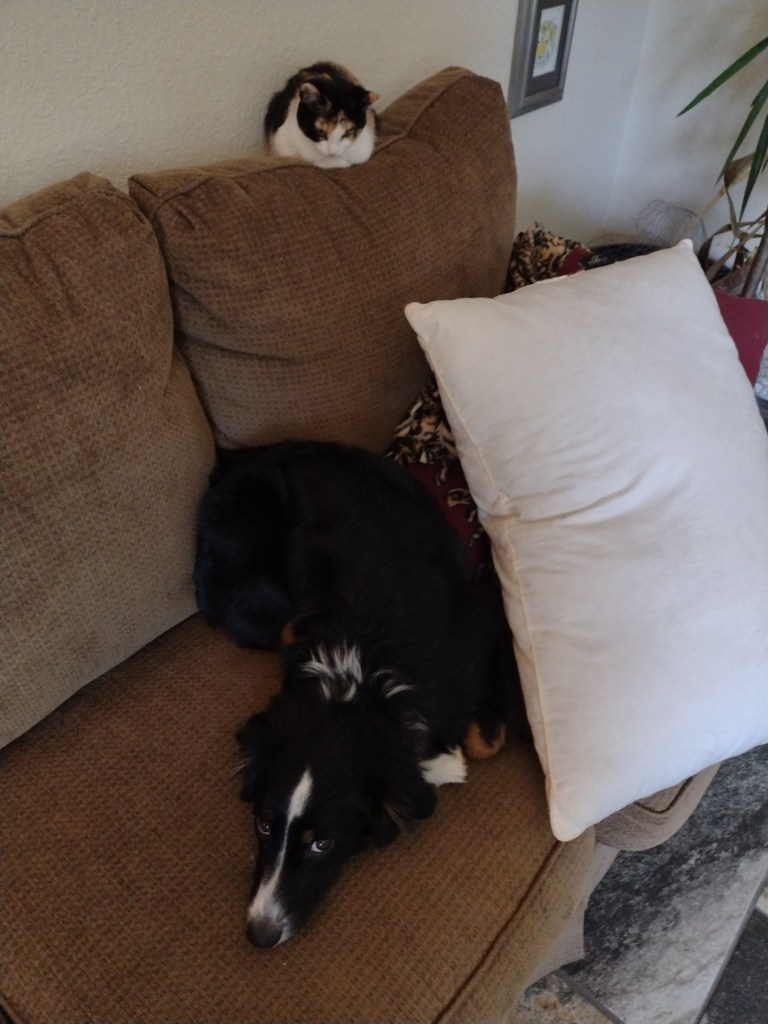
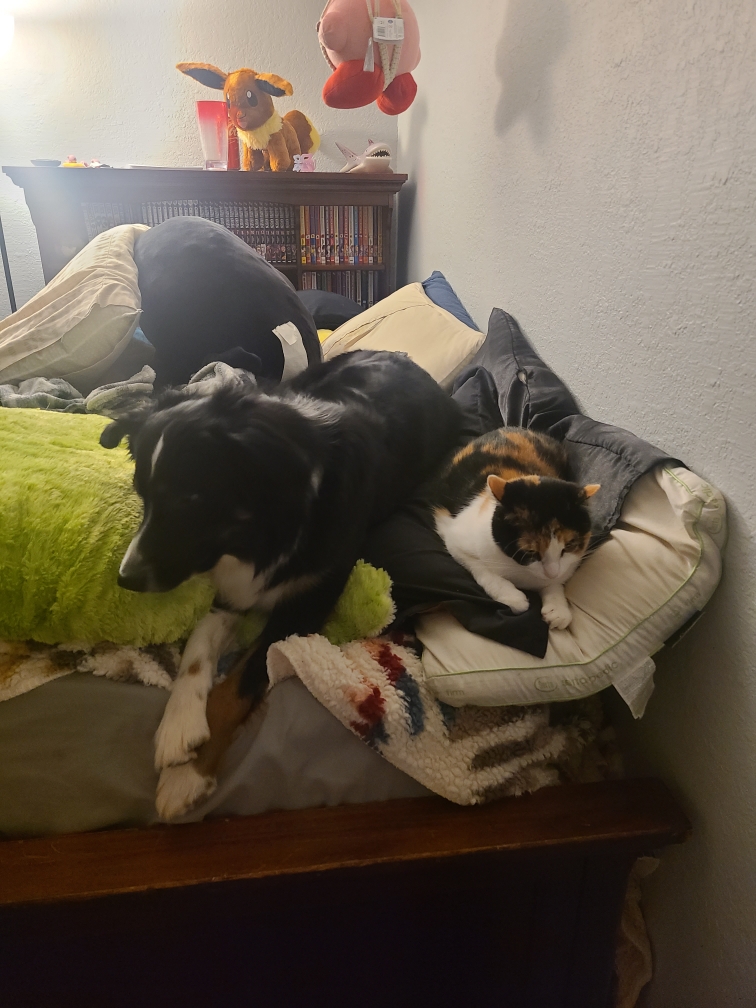
Sophie and Itty are best friends.
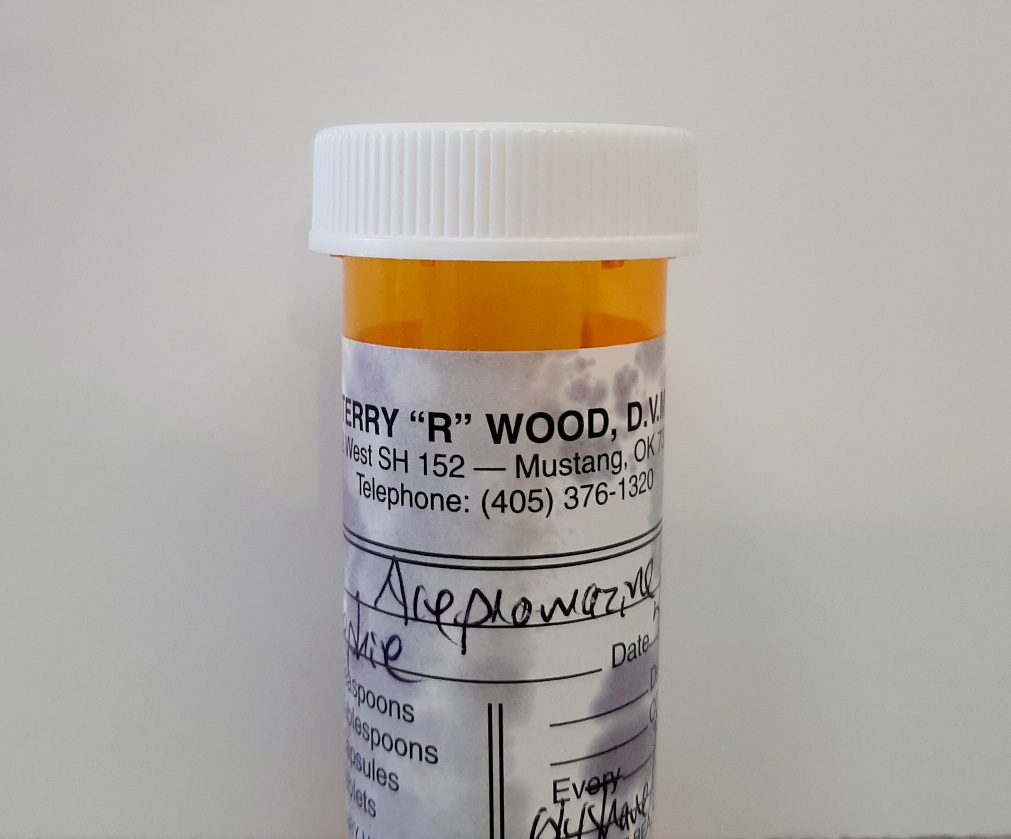
I’ve been concerned about both Sophie and Itty regarding our upcoming trip. Itty absolutely does not like the car, crate, or her backpack, I think, because she associates all with the vet. But both Sophie and Itty were abandoned before they came to us. So, our vet prescribed Acepromazine, which is the most commonly prescribed pet sedative. I gave them each their appropriate dose a couple of weeks ago.
I wanted to make sure it wasn’t going to make Sophie even more hyper than she already is. But it wasn’t until everyone else left the house that they both started showing the effects of sedation. And it didn’t knock them out. It just made them a little wobbly. However, after a few hours, Itty ate some cat-grass to make herself throw up. She definitely didn’t like being drugged. Additionally, the days following that, she didn’t trust that I wouldn’t drug her food again.
For our trip, I’ve invested a ton on just Sophie and Itty. I’m trying to make sure they’ll both be comfortable and stress-free. We have their prescriptions as the absolute last option. But I also have Rescue Remedy, ThunderShirts for both of them, their toys, so many treats, pet pheromones, etc. Something is bound to work, right? I’ll keep you guys updated.
Thanks for stopping by! Do your pets get anxious when traveling? What are your go-to methods? Please post a comment and share. And if you don’t already, please don’t forget to follow!
After caring for backyard chickens for several years, you see many strange behaviors. While some are funny, others are relatable. For example, if your coop is like ours, every bird has its own space. So, why do chickens huddle together?
Sometimes things like that, I mark off to them being weird. For example, hens notoriously prefer to all lay eggs in the same nest. As I said, weird. However, in the case of huddling, there are actual reasons for this behavior. Thus, keep reading below to find out why they huddle.
Reasons Why Chickens Huddle
Digital Art, Courtesy of Sarah Smith
Cold weather
Just as people huddle close to others when cold, chickens also do the same. It’s instinctual for self preservation.
Predator attacks
Another time your backyard birds will huddle together is when they’re under attack. Be it a dog that got loose, or an overhead aerial attack, they’ll likely flock to the coop and huddle together.
Roosting issues
Not having enough roosts will cause your chickens to huddle. Additionally, either having roosts that are too high or uncomfortable will also result in birds huddling together. But it won’t be because they want to; it’s due to having no other choice.
Chicks or juveniles
If you have chicks, and they’re huddling, it’s possibly due to low temperatures. And they are cold. Juvenile chickens will huddle in the coop if they can’t reach the roost yet. Although, they also could be cold.
and Illness and parasites
Furthermore, illness and parasites can cause chickens to huddle as well. For instance, coccidiosis is a protozoan parasite that can affect many animals. Though, in chickens, one of the signs is ruffled feathers or huddling. And Pullorum disease in chickens usually affects younger birds, ie chicks. But huddling is also one of the symptoms.
Can Chickens Suffocate
Both adults and chicks can suffocate if and when conditions are right: a lot of birds piling on top of each other. However, in chicks, disease and low temperatures still tend to be the number one reasons for early chick mortality, even if they aren’t piling on top of each other.
Below you’ll find advice for each chick and chicken huddling situation.
If it’s cold out, be sure to have the coop insulated. And use the deep litter method for natural heat in the coop. Also, provide plenty of feed. Plus, give your birds scratch grains to warm them from the inside as well.
Check on your chickens
Pasture-raised birds will huddle together in fear. Thus, if your biddies are in the coop huddling, then either a predator scared them. Or a flock member was attacked. So, examine your chickens. Plus, do a head count. If all are well and accounted for, then look for their source of fear. Again, it could be a neighbor’s dog, a hawk, or a snake. Those are the predators where I live. Where you live, they could be different.
Provide roosts
In case your chooks are huddling due to roosting problems, then supply enough perches for them. Additionally, make sure the perches are comfortable. For example, wood is the best material for a roost. However, material isn’t the only concern. Height is one as well. How high and low the roosts are also need to be considered. Check this site out for more details.
Adjust brooder temperature
When raising chicks, you can easily tell whether they are hot or cold. If they’re hot, they will pant and hold their wings out. And they’ll get as far from the heat source as they can. But if they’re cold, chicks will huddle together under the light for warmth. Thus, you can adjust the height and position of the light, depending on their needs.
For juvenile birds who can’t reach the perch, try lowering it.
Practice good biosecurity
Digital Sketch, Courtesy of Sarah Smith
So, if you have chicks that are sick and huddling due to the parasite coccidia, give them Corid. And as the chicks are exposed to the flock, by the time they reach maturity, they will have developed immunity. Though, if you aren’t practicing good biosecurity, you can bring coccidia from another flock to your own. Therefore, your birds can get sick and vice versa. Also, don’t leave food on the ground for your birds.
There is no known treatment for pullorum besides euthanasia. Thus, purchase chicks and birds from NPIP certified hatcheries to be on the safe side.
Why Chickens Huddle Together
We learned that chickens huddle together for several reasons. And none of them should we ignore. Or at the very least, we should check on our birds, to make sure they’re ok. Because a predator could’ve scared them. Or they could be cold. Although, they could also be dealing with a sickness as well. But, the main point is, huddling is definitely something to watch until you know the cause. Do your chickens huddle? What was the reason? And what did you do to help them?
Thank you for reading this post. Please share and post a comment. And please don’t forget to follow, if you don’t already do so.
About 6 months ago I wrote a post regarding signs of elderly chickens. And in it I explained, on average, how long chickens can live. In addition, I described the physical features and habits of aging birds, including egg laying changes. However, what do you do when chickens stop laying eggs?
Well, there are many reasons chickens stop laying eggs besides old age. Moreover, you can prevent a lack of eggs from occurring in some of the cases. Though, in cases like aging, you simply cannot. Continue reading to find out both why chickens stop laying eggs, and what to do about it.
Hens begin laying when the amount of daylight reaches ~ 14 hours a day in early spring. And maximum egg output occurs when the day length reaches ~ 16 hours a day. Thus, when there’s less sunlight, egg laying will drop off.
Egg eating or cannibalism isn’t when a chicken will stop laying eggs. However, it is a terrible habit where a chicken, or many chooks will eat the eggs themselves. Thus, you’ll go to collect eggs, and there will be one or none.
extreme temperatures, hot or cold
Either extreme heat or extreme cold will halt egg production. That’s because chickens will need to conserve their energy in either case.
health issues
Many health issues, including being egg bound, pests, and parasites can cause hens to stop egg production.
inadequate nutrition
If chickens aren’t fed a proper diet, or if they don’t have access to clean, fresh water daily, then egg production will decrease. Likewise, if they are given too many treats or supplements, egg production can be negatively affected.
Sometimes pasture-raised birds lay their eggs elsewhere, other than the coop. However, there are also breeds that are known for hiding their eggs, such as the Ameraucana.
Another major reason hens will stop laying eggs is stress. And that includes stress of any kind: a barking dog or a bullying hen. But adding too many members to the flock suddenly can be just as stressful to your hens.
And the last reason hens will stop laying for a season is predators. If one of your birds is attacked, that particular hen will stop egg output for a season. But if you’re missing eggs in a nest, another predator could be a chicken snake stealing eggs from the nests.
and of course, age
Production birds only lay eggs for about 3 years. However, heritage breeds and others can lay a lot longer. Most of my flock are Ameraucana, and the older ones are over 6 years old. And they still lay eggs. Though, they don’t lay every day like they used to.
If you have hens that stopped laying eggs, you can try
adding artificial light
Some poultry farmers use artificial light when there’s less than 16 hours available for their hens to lay eggs. But some, like me, don’t. Because we use this period as a time when our birds can recuperate.
switching to a high-protein feed during their molt
This will help your birds convert their energy into regrowing their feathers.
breaking the brood
If you don’t want any chicks or a broody hen, break her brood. Either make a broody box or purchase one. But all you do is put the hen in one, in full light, away from the flock for several days. And this should effectively break her broodiness.
There are many tricks offered to stop egg eating. But the only one that truly stopped cannibalism in my flock, without having to kill every bird, was pinless peepers. They’re blinders so the birds can’t see what they’re doing. We left them on for 2 weeks. The birds hated them, but they certainly were reformed!
keeping your hens comfortable in extreme temps
If the weather is very hot, keep your birds cool by adding ice to their waterers. Plus, you can make them frozen treats, like the one here. And if it’s very cold, make sure to winterize the coop. If you need instructions, see here.
Other than an egg-bound hen, most health issues that your flock might encounter can be prevented by good biosecurity and a clean coop. However, if you should have an ill hen, quarantine her and take her to the vet. But if you don’t have one where you live, try to find out what’s ailing your bird. And take appropriate steps to help her and the rest of your flock. One of my favorite sites is backyardchickens. Whenever one of my chooks is ill, I check them out.
feeding aminimum of 16% protein for laying hens
When hens are ~18 weeks old, they need at least 16% protein layer pellets with increased calcium for shell development. And have a dish of oyster shell available for them as well. In addition, limit treats to only ~ 2 tbsp per day to a hen’s 1/2 cup nutritional requirements. Plus, make sure your birds have access to plenty of clean, fresh water daily.
keeping hens cooped until done laying
If your birds are pasture-raised, and they hide eggs or lay different places, you could keep them cooped up till they were done laying. Otherwise, look under trees, bushes, in barns, and every out of the way place you can think of. Chickens are good at hiding eggs, so you might get kids to help look.
taking care of the stressor
Having chickens can be like having children. You wear a lot of hats, which means you do a lot of work. You’re a vet, or at least a vet tech, if you live in the country. And sometimes you are animal control. But you’re also a teacher and a student. So, depending on what stress is disrupting egg production, that will determine how you proceed. You won’t use the same solution for a bullying hen as you would a barking dog. That said, separate a bully from the flock for a few days to knock her down a few pegs from the pecking order. Also, proceed with caution when adding flock members; add them gradually. And see how your flock does.
making sure your coop and pen are predator proof
The best protection you can offer your flock is by making sure the coop and run are predator proof. That means that no predators of any size can get in anywhere. However, if your birds are pasture raised, the only predators that you still have to contend with are aerial ones.
and finally, just try loving them until it’s their time to go
A female chick is hatched with thousands of tiny ova, which are undeveloped yolks. So, chicks are hatched with all the eggs they’ll ever have. And the majority of hens slow down with egg laying around 6 or 7 years old. There’s nothing you can do to magically get an old hen to start laying eggs again.
But that doesn’t mean she’s useless. Far from it. If you only have older hens, invest in a couple of younger ones. And the senior hens will pass on much wisdom to the younger hens. Plus, older gals are great at weed eating and bug patrol. Furthermore, if you want chicks, and one goes broody, they can be great mothers. That’s because broody hens do a better job than we do at raising chicks.
Aside from keeping senior birds, you can slaughter them. Or you can try to find another farmer or homesteader who will take them from you.
What We do when Chickens Stop Laying Eggs
Superimposed Digital Art, Courtesy of Sarah Smith
We saw that chickens can stop laying eggs due to stress, old age, heat and cold, and malnutrition. But illness, broodiness, molting, winter, and predator attacks can also cause hens to stop laying eggs. And cannibalism and snakes can cause eggs to disappear. In addition, there are many different solutions to keep your chickens producing eggs year-long.
We’ve got about 14 or 15 hens who are just over 6 years old. And the boss, Megatron, is ~ 6 years old. He’s the only one who walks with a limp, and has a hard time keeping up with his girls. But that has more to do with his fights with Baby Nay than actual old age. However, I guess those fights did age him.
We keep our birds even when they stop laying eggs at our place. Because they’ve all earned their position just simply by being there. So I guess it’s simply grace and love.
Thank you for taking the time to read this post. Please post a comment and share. And if you don’t already follow, please do so now.
Six weeks ago I started working full-time to help out my office. But it will only be about 2 more weeks. Plus, my husband and I made a big decision somewhat recently. It’s something he’s brought up almost yearly. However, it was never the right time. So, due to various reasons, we put our house on the market. Therefore, soon we’re moving to East Texas. Thus, in the midst of all these changes, I wondered, can cats have anxiety and depression.
Our house for sale
Once we put our house on the market, we had to clean our house on a daily basis, in case the realtor wanted to show it. I don’t think our house has ever been as immaculate as it is. Furthermore, there couldn’t be any signs of pets: no toys, no food or water bowls, and no pet toilets, aka litter boxes. And there could be absolutely no pet smells.
In addition to all of these daily adjustments to the pet accoutrements, my schedule altered from part-time to full-time. Whereas I once was home every afternoon, now I work everyday, all day long. And there was no slow transition. One day was normal, like any other. The next was something quite different; and it stayed different. Moreover, I haven’t had enough energy to give all of my time and attention to my fur baby.
The majority of animals, including cats, most certainly can suffer from anxiety and depression. Though, they don’t always present exactly the same way. You might have an anxious cat if they are
More aggressive than usual
Hissing more
More vocal, ie meowing more
Pacing
Have excessive mood changes
Perhaps fearful of leaving your side
Trembling or shaking
Failing to use the litter box
Hiding
Trying to escape
Lethargic
Experiencing a change in appetite and possibly weight as well
Having digestive issues like diarrhea
Over-grooming, which would end up in bald spots or sores
Depression in cats isn’t due to a chemical change in their brains. But it’s usually a sign of a deeper problem. And some of the signs of depression in cats are similar to anxiety, as you’ll see. Signs of depression in cats include
Decreased appetite and no interest in treats
Loss of interest in playing with toys
Less interest in interacting with housemates or family members
Meowing more
Less interest in going outdoors, if allowed outside
Grooming less
Urinating more
Failure to use litter box
Excessive scratching
Crouched position with tail tucked and ears back
and Withdrawn: no head butting or kneading your lap
There are a variety of things that can cause anxiety in cats, just as with people. In addition, some cats are more likely to have anxiety than others. For example, cats that weren’t socialized much are more likely to have anxiety as are traumatized kitties. Other possible causes of anxiety in cats include
Sickness or trauma
Separation anxiety
A traumatic experience, such as history of abuse, abandonment and natural disaster
Loud noises
Changes in the household, ie new members or change in a member of the household’s schedule
Most of the causes of depression in cats are physical. Although, there are also some causes similar to anxiety in cats. And they deal with environmental stressors. Possible causes of depression in cats include
Environmental Stress
For example, grieving the loss of a loved one, either animal or human is an environmental stress. Or a change in the home environment, like being bullied by other cats or another pet is another instance of environmental stressors.
Moving is another example of environmental stress.
And change in the family’s schedule is also an example of environmental stress.
Change in Physical Health
Pain is an example of change in physical health. And many of the signs of pain in cats are similar to signs of depression and anxiety.
Another example of change in physical health is old age. Plus, it can go along with pain, because older cats tend to groom less.
Chronic illness is my last example of change in physical health. Just as with people, cats get depressed with chronic illness and pain. Just some of the chronic issues cats can get are asthma, cancer, IBD, diabetes, and kidney disease.
and Inadequate Nutrition
Both cats who are underweight and overweight are at risk for sickness and pain. And we already saw that chronic illness and pain lead to depression. So a nutritious diet is essential for a happy, healthy cat.
If your cat is showing symptoms of anxiety, they need to feel safe. So, it’s essential that you
don’t punish your kittyfor being aggressive, or for any other unwanted actions.
All punishing your fur baby will do is exacerbate their anxiety and the undesirable behavior. In addition, you should think of your kitty as a baby.
talk baby-talk to your feline friend
Studies have demonstrated that cats like it when their owners use pet-directed speech, or what we would call baby-talk. Plus, utilizing pet-directed speech with your kitty nurtures your special bond with them.
keep a routinewith feeding and playtime
Because cats are very prone to routine, any change on our end regarding their care could make them sick. A different study, published in the AVMA Journals, revealed that healthy cats exhibited ill health after familiar habits were altered. If you’re interested, you can find the study here.
include plenty of mental stimulation
Indoor cats can get bored easily. Thus, if they don’t have much mental stimulation, they’re susceptible to boredom-related and stress-relieving behaviors. But to avoid those unwanted actions, have lots of toys, perches, and cat scratching posts for your kitty. And don’t forget to make time to play with your cat.
clean the litter box daily
Most cats like a clean toilet, aka litter box. So, it’s ideal to clean it at least once a day. Additionally, refrain from moving your cat’s litter box, which would put added stress on your cat!
try calming cat pheromone products
I’ve tried the diffusers in the past when we got Cake, and I never noticed a difference. Meow Meow and Cake still didn’t like each other; and the diffusers didn’t seem to chill them out. But when Itty started displaying anxious and depressed symptoms, I decided to give the collars a try. And they work very well. However, that’s in addition to all of the other things I’m doing.
and reduce competition if you have multiple cats
The main ways to lessen competition between cats is to have multiple feeding and drinking stations, extra litter trays, extra hiding places, and plenty of toys. And be sure to space all of these items throughout your house.
First of all, I just want to say, this isn’t meant to take the place of veterinary advice. If you know your fur baby has a medical condition, if you suspect one, or have seen evidence of one, call the veterinarian. The following things are what I tried, since I know Itty’s symptoms were environmental–they began after I started working full-time and we put the house on the market. In addition, after a lot of effort on my part, she’s doing much better. Therefore, if your cat is depressed due to a change in his or her environment, you can
spend time with them
Research has shown that cats would much rather spend time with their owners than get treats or play alone with a toy.
When Itty first presented with symptoms, I still tried to play with her. Sometimes she was receptive. But it never lasted for long.
get a new toy
If your cat’s depression is due to boredom, getting a new interactive toy could be just the trick.
Again, I got Itty some new toys, a cat tree and scratching post, and more fuzz balls. While she loves a couple of the things I got her, she has yet to even approach the other.
offer new types of food
Sometimes even changing your cat’s food or litter could make them depressed. And if they aren’t eating as much, or no longer eating, try offering them wet food in tuna flavor. It has added moisture, and is generally better than kibble. I advise tuna simply because our cats love tuna flavor. But even the above mentioned research included food. And tuna was the favorite among felines.
Not too long ago classical music was the go-to choice when playing music for your pets. However, now, as more studies have been done, it makes sense that cats respond better to cat vocalizations.
I admit I hadn’t tried the music until a few weeks ago. When Itty and I started playing, it was how it’s been when she first had symptoms of anxiety and depression. She wasn’t all into it. But she amused me, because she loves me. However, when I put the cat-specific music on, it’s like she woke up. At first, she ran to my phone and sniffed it. She was clearly checking it out. And then she played with more energy than I’ve seen her play in a long time.
and offer calming pheromones
There are different ways the pheromones can be delivered: diffuser, spray, chews, or collars. I got the collar and the chews. Though, I waited until a couple weeks ago to try the chews. Itty was not impressed with the smell. At least she’s no longer wanting to eat anything and everything. So, we’ll most likely forego the chews, since she won’t touch them.
Obviously any time our fur babies are acting out of the ordinary is a cause for concern. And it’s recommended that you call your vet. You absolutely want to rule out any physical causes for anxiety and depression.
Itty had her check-up a couple of weeks ago for vaccinations. Plus, I asked him about her panting when running across the room; not doing heavy play or exercise. Furthermore, I discussed the 13 hour trip we’re making to South Dakota with both her and Sophie in May. On our last vacation, we decided they were going with us on our next trip, since Itty got locked in a bedroom for 3 days. May will be busy. After about 5 or 6 weeks of all that I tried and suggested, Itty was back to herself. Though, not necessarily weight-wise.
Can Other Pets Get Anxiety and Depression
Yes, absolutely, other pets can get anxiety and depression. In fact, dogs get anxiety and depression for similar reasons as cats. Also, some breeds are more prone to anxiety, such as Australian Shepherds. Additionally, some signs are alike as well. Plus, chickens get anxious too. But for different reasons, like predators or overcrowding.
It seems like Itty and Sophie are a pet-match made in heaven. I’m so cued into Itty’s moods, because she’s my baby. Although, during Itty’s funk, I noticed Sophie seemed out of sorts. I’ve been at work most of the time the house was shown. Therefore, the pets had to be vacated as well as the people from our comfy abode. Hence, none of the pets enjoyed the days the house had to be shown to potential buyers. But especially Itty and Sophie. Whereas Itty showed symptoms of both anxiety and depression, I only saw symptoms of anxiety in Sophie. Though, Sophie would still play and eat. They just express themselves differently. While one is an introvert, the other is an extrovert.
I’m happy to say that our house got sold in only 2 weeks. Therefore, our babies didn’t have to deal with the craziness for too long. However, I’m still working full-time until May 1st. Then we go on a 5 or 6 day vacation before packing and moving. And the chickens have absolutely no idea what’s going on.
We saw that cats can have anxiety and depression. Additionally, we learned that many things can trigger anxiety in cats, from moving their litter boxes to changing schedules. Plus, depression in cats has similar causes to anxiety in cats. However, it can also be caused by illness and pain. Besides ruling out a physical cause for anxiety and depression, there are many ways of helping our fur babies. The main one being spending time with them.
I appreciate you taking the time to read this post. Please comment and share. If you don’t already follow, please do so now.
Easter is a time when people celebrate the resurrection. But it’s a time to enjoy sunshine, family, and good friends as well. Also, a lot of children color eggs. And then parents hide the eggs for an egg hunt. Though, if you have the kinds of chickens we have, they might colorand hide the eggs from you.
Furthermore, it’s a great time to break bread and have a meal together.But don’t forget to grab some dessert. While some people like to stick to what’s healthy, others go for more decadent desserts.
However, don’t worry if you’re different from your neighbors. Just smile and be your beautiful self. We sincerely hope you have a great weekend, no matter your background. We wish you a happy easter from our flock.






































 Chicken Girl