Providing helpful information regarding our feathered, feline, and canine friends while also sharing fun stories. And locally we provide pet sitting services.
Author:KS
I breed Black Ameraucana chickens and Easter Eggers that are Black Ameraucana mixed with either Cuckoo Maran or Barred Rock. And I donate eggs to people or organizations in need. Further, I've started chicken and other pet sitting in my area. Details are on my About page.
I use affiliate links to support my content at no extra cost to you.
When it comes to our furry companions, keeping them well-groomed is not just about appearances; it’s about their health and happiness. Welcome to the ultimate guide to dog grooming, where we’ll delve deep into the art and science of pampering your pooch. From bath time to brushing, we’ve got you covered.
Before we dive into the nitty-gritty of dog grooming, it’s essential to understand that not all dogs are the same. Different breeds have different coat types, and each requires a tailored grooming approach. Whether your furry friend sports a short, smooth coat or long, luxurious fur, knowing their specific needs is crucial.
1. Short Coats: Sleek and Low Maintenance
Dogs with short coats, like Dachshunds or Beagles, are relatively low-maintenance in the grooming department. A weekly brush to remove loose hair and an occasional bath are usually sufficient. This coat type is perfect for those who want a clean, fuss-free companion.
2. Medium Coats: Striking a Balance
Breeds like Bulldogs and Labradors have medium-length coats that require a bit more attention. Regular brushing helps keep their fur in good condition, and a monthly bath keeps them smelling fresh.
3. Long Coats: The Fluffiest of Them All
Long-coated breeds, such as the Maltese or Shih Tzu, are the epitome of elegance. However, they demand a higher level of care. Daily brushing is essential to prevent matting, and regular trims are a must to keep their fur manageable.
Bathing your dog is a crucial aspect of grooming, but it’s not as simple as filling up the tub and tossing them in. Here are some tips to ensure a successful bath time:
1. Gather Your Supplies
Before you start, make sure you have everything you need within arm’s reach. This includes dog-friendly shampoo, a towel, a brush, and treats for positive reinforcement.
2. Brush Before Bathing
Brushing your dog before the bath helps remove tangles and mats, making the bathing process more effective.
3. Use Lukewarm Water
Ensure the water temperature is comfortable for your pup, neither too hot nor too cold. Wet their fur thoroughly, avoiding their eyes and ears.
4. Shampoo Sparingly
Use a dog-specific shampoo, and lather it up gently. Be cautious around the face and ears, as dogs are sensitive in these areas.
5. Rinse Thoroughly
Rinse until the water runs clear, ensuring no shampoo residue remains. Incomplete rinsing can lead to skin irritation.
6. Dry and Reward
Use a towel to gently dry your dog. And if they tolerate it, you can finish with a low-heat blow dryer. Don’t forget to reward them for their patience and good behavior!
Depending on your dog’s breed, regular trimming might be necessary to keep them comfortable and healthy. While some breeds require professional grooming, you can tackle basic trims at home with the right tools and techniques.
1. Nail Care
Trimming your dog’s nails is crucial to prevent overgrowth and discomfort. If you’re unsure how to do this safely, consult your veterinarian or a professional groomer.
2. Ear Maintenance
Check your dog’s ears regularly for signs of infection. And gently clean them as needed with a veterinarian-recommended solution.
3. Professional Grooming
For breeds with complex grooming needs, seeking the services of a professional groomer is a wise choice. They have the expertise and equipment to ensure your dog looks their best.
Maintaining Dental Hygiene: Don’t Forget the Pearly Whites
Just like us, dogs need dental care too. Neglecting oral hygiene can lead to dental disease, which can impact your dog’s overall health. Here’s how to keep those teeth in top shape:
1. Brushing Teeth
Yes, you can brush your dog’s teeth! Use a dog-specific toothbrush and toothpaste, and make it a part of your weekly routine.
2. Dental Chews and Toys
Provide dental chews and toys that promote teeth cleaning and gum health. They’re a tasty way to maintain oral hygiene.
3. Regular Vet Check-ups
Regular veterinary check-ups should include a dental examination. Your vet can advise on any necessary dental procedures.
Final Thoughts: A Happy, Healthy Dog
In this ultimate guide to dog grooming, we’ve covered the essentials of keeping your canine companion clean and healthy. Remember, grooming isn’t just about aesthetics; it’s about your dog’s well-being and comfort. Tailor your grooming routine to your dog’s specific needs, and you’ll have a happy, healthy pup by your side for years to come.
Now, go ahead and put this knowledge to use. Treat your furry friend to a spa day they’ll wag their tails about!
Author Bio
Emma Anderson from Shernbao USA has been involved with dog grooming for the past 15 years and now wants to share her experience and knowledge with others.
I use affiliate links to support my content at no extra cost to you.
Watching cats be themselves can be relaxing, comical, and educational for pet parents. And though cats don’t appear as expressive as dogs, since their facial features don’t change much, in truth they really are. You just have to know what to look for. As with dogs, you can learn a lot about what’s going on with a cat just by observing their tail. Therefore, today we’ll look at why cats have a tail.
Reasons Why Cats Have a Tail
Pickles is fishing!
Yes, you probably realized already that one of the reasons cats have tails is for communication. One tail movement does not satisfy for all communication or for all cats. Thus, cats communicate with each other and us about how they feel.
But that isn’t the sole reason or even the main reason cats have tails. Tails act as a counterbalance for landing. And for cats, tails increase their agility. Plus, their tails help them jump, climb, and hunt.
Cats also use their tails as a sign for affection or irritation. Though, I suppose that would be a form of communication as well. When cats are feeling affectionate, they wrap their tails around their humans or other pets. But if they’re irritated, sometimes they use their tails to swat at their humans or other pets.
What about cats without tails? Or short-tailed cats?
Different Lengths of Tails
The length of a typical domestic cat tail is about 12 inches long. However, there are some cat breeds that are rumpy, stubby or stumpy. And those words are somewhat similar. While stubby and stumpy mean a cat with a stub for a tail, rumpy means tail-less.
Cats with the Shortest Tails
This is our neighbor’s cat, a Japanese bobtail. But you can’t see the tail, because the picture cut it off.
The Manx cat has a short tail. But it can be tailless as well. Moreover, all breeds of bob tails have the shortest tails. On the other hand, the cat with the longest tail is a Maine Coon from Michigan. Having a long tail doesn’t seem to cause cats any issues. Though having short or no tails can cause health problems. However, the cats don’t seem to have issues with their balance.
But what about lions, tigers, and the rest? Why do they have tails? Well, unsurprisingly, lions, tigers, and leopards, all have tails for the same reasons as domestic cats: balance and communication.
Conversely, cheetahs and cougars mainly use their tails for balance. I could only find one site that stated cheetahs might use their tails to communicate as well. And then cougars are solitary cats. So, I’m not sure if that means no one really knows or what.
Big cats and domestic cats have tails primarily for balance and agility. However, they also use their tails to communicate. But, for domestic cats at least, tails have a wide range of communication. Moreover, even though most cats have a typical 12 inch length tail, there are also tailless, stumpy, and long-tailed cats.
By the descriptions of tail communication above, what does your cat’s tail say about them? Or about what they’re communicating? All of our cats are mostly confident most of the time. However, when we go outside and Itty and Pickles play with each other, they can get bushy tails. But they’re still definitely playing with each other. And sometimes Itty will have her tail down, flicking while walking around and hunting bugs.
Thank you for stopping by! Please share, and if you don’t already follow me, please do so now!
Digital art on a picture of one of our hens, courtesy of Sarah Smith.
Some links here earn me a small commission at no extra cost to you.
Warning: This post contains graphic images.
For eons in the wild, animals have masked any sign of weakness to avoid being eaten. This is instinctual behavior to hide from predators. And backyard chickens are not immune to this tendency. Therefore, chickens are hardwired to lie low when sick. Or they might even pretend that all is well. So, how do you know if one of your birds is ill or hurt before it’s too late? Today I’ll go over how to tell if a chicken is sick. Moreover, I’ll address the best ways to prevent sickness. And then cover treating the most common chicken illnesses.
When you have backyard chickens for a certain length of time, you definitely get to know them. You know your birds’ personalities and tendencies. And you know what they’ll do first thing when you open the coop door in the morning. However, you can also get so busy that you overlook those same things. It happens. I know, because I’ve done it. It’s easy to get into the rhythm of busy life and slack off on observing them. I’m not going to insult anyone by assuming you don’t know your birds. But I know people are human, with human tendencies, just like me. And when we get busy, we forget, sometimes even fundamental information.
The illnesses I list below aren’t the big ones that wipe out entire flocks. In fact, they’re not even ones you hear about on the news. Though, if ignored long enough, they can certainly be deadly. Because sometimes it’s the little things that trip us up more. And, as I said, they are way more common if we let things go for just long enough.
Disclaimer: Consult with a veterinarian before using the information provided in this post. I am not a veterinarian and the info contained in this post should not be seen as professional veterinary advice. If you use or rely on the information in this blog post, you do so at your own risk.
When I think of the most common chicken ailments, I automatically think of the most common human illnesses, like the common cold. Although not fun, people don’t necessarily die from them, unless there’s an underlying condition or weakness. However, you still don’t want to ignore the symptoms, which is why we manage them. And it’s the same with chickens. Some of these aren’t necessarily deadly when chickens first have symptoms. But, the problem is, chickens are excellent at hiding symptoms. Consequently, once you become aware that something’s going on, they’re worse than you think. Therefore, the most basic afflictions chickens will encounter include
parasites, such as mites, including leg mites, lice, ticks, and worms
All of these parasites can cause listlessness, decreased egg production, and a pale comb. And you can visually see them upon inspection. Also, if one bird has a parasite issue, you can bet you have other birds with them as well.
respiratory issues
Nasal discharge, coughing, wheezing, and difficulty breathing are all symptoms of respiratory issues. But that doesn’t necessarily mean they have Bird flu. There are plenty of colds and viruses that go around for chickens just as they do for people. If you have a bird that presents with respiratory issues, examine the rest of the flock for similar issues. They may or may not have a communicable disease.
When we had our Wyandotte boss, Fives, it seemed like she inherently always had something she was dealing with. However, none of the other chickens caught anything she had. But we isolated her just in case and until she sounded and was doing better.
diarrhea
Runny poo or a dirty bottom indicate GI issues. Moreover, this can be a contagious illness that you might see in some of your other hens.
crop issues, like sour crop and/or impacted crop
Sour crop is smelly, and when you press on the crop, liquid pours from the hen’s beak. However, an impacted crop is where the crop is very hard and won’t empty, because something indigestible is stuck in the crop. Plus, it’s a serious issue if not dealt with immediately. With either issue, the bird won’t eat.
egg binding
Signs of egg binding includes distended abdomen, straining, decreased activity, swollen vent, restlessness, and frequent sitting. Plus, your hen will waddle like a penguin. And upon inspection of the oviduct, there should be an egg.
injury from predator or from rooster during mating
Not only do you have to watch for predators from the land and air, but you have to watch your rooster too. If your hens are a lot smaller than your roo, or he’s just ungainly during mating, he can injure them. And the hen will hide her injury and be less likely to compete for food. Thus, she’ll get weaker, and invite more trouble to herself. She may not have any visible injuries, other than limp or hold a wing a certain way.
Therefore, when you let your birds out each morning, just watch them for a few minutes. And mentally go through a quick checklist of the above symptoms. I’ll narrow them down for you. Ask yourself if any of them
appear tired
have pale combs and wattles
have any visible parasites
are coughing or sneezing
have watery or bubbly eyes
have abnormal droppings
are not eating
have full cropsin the AM
can stand on their own
have NOTlaid an egg recently
are injuredor holding a wing a certain way
or have any strange lesions on the comb or wattles
If you discover that you have birds that are indeed ill, then isolate any from the main flock. And call your vet if they see chickens. However, don’t worry if you don’t have a vet that sees chickens or you can’t find one. Unless you are a big operation and are seeing widespread illness in your flock, this is likely an isolated incident. Thus, with a little TLC, your bird or birds will be back to normal in no time.
Alternatively, if you rarely clean your chicken coop or waterers, or don’t regularly change the feed, then this might not be an isolated event. Therefore, the single most important thing you can do to prevent your chickens from getting sick is keeping your coop clean.
Since my husband medically retired 4 years ago, he no longer super duper cleans the cooponly twice a year. Now he has the cleaning scheduled every 2 weeks. (Yes, you read that correctly.) Although, he still empties out the boxes on a daily basis. Due to his efforts, our chickens have been parasite free with absolutely no need to treat. And keeping the coop clean seems to keep most germs away. But, unfortunately, it doesn’t prevent crop issues, an egg-bound or an injured hen. Still, the only issues we’ve had have been from predators or roosters.
How to Care for a Sick Chicken
So, what do you do for an unwell chicken? How do you take care of them? For starters, if you know a poultry vet, call them. But again, if not, it isn’t the end of the world. Many backyard chicken enthusiasts don’t have access to a poultry veterinarian but still keep chickens. Other steps to take include
quarantine ill birds ASAP
Even if they aren’t contagious, depending on the symptoms and recommended treatment, you may still want to isolate your sick bird(s). Recall that chickens are notorious for bullying if and when they sense weakness. Hence, another reason to separate sick birds from the flock is to protect them from bullying and possibly cannibalism. Being harassed would only further aggravate their issue.
hydrate your ill birds
Make sure your sick bird or birds are drinking even if you have to use a dropper. Additionally, adding some electrolytes can be very beneficial to an ill bird, particularly if they were dehydrated.
offer food
In the beginning of treatment it isn’t as necessary as water. That said, if your unwell hen will eat, by all means, offer some food.
How to Treat an Ill Bird
Digital art on a picture of our hen, courtesy of Sarah Smith.
If your sick bird is showing signs from the most basic chickenafflictions above, and other than parasites, no other birds are affected, then continue reading for specific instructions.
Parasites
If your ill bird is infested with mites or lice, the best treatment is to
clean the coop thoroughly.
and spray the coop and chickens with Elector PSP. There’s no egg withdrawal for this treatment.
But if your bird is infested with worms, then you need to
find out what kind of worms they’re infested with
Some are rare, while others are more common. Also, there are different types of de-wormers. With that in mind, avoid the natural de-wormers, because you’ll waste your time and your bird’s health. They don’t work whatever they promise. Trust me, you need something that really works. Not garlic, not apple cider vinegar, and no, not diatomaceous earth either. Check out The Chicken Chick for more info on specific worms and de-wormers. And once you’ve got your girls back to normal, follow the list below to keep them that way.
To prevent any more worm infestations, you need to
keep the coop clean
keep food in pest proof containers like a galvanized metal trash can
provide fresh, clean water daily, and clean waterers daily
don’t throw food or treats on the ground
and practice good biosecurity: don’t let wild birds in your yard
Respiratory Issues
Chickens with respiratory issues can be quite stressful for you, the chicken keeper. For one, you don’t know if it’s serious. And two, you’re not sure if it’s contagious, since you hear annual reports of contagious chicken diseases. But it’s essential you don’t freak out. The best things you can do for your bird with a respiratory issue are already listed for you under how to care for a sick bird above. Other than that, watch your remaining birds to see whether they start developing any similar symptoms. Plus, continue to monitor your ill bird for changing symptoms. Are they getting worse, improving, or do they have any sores or spots on their combs or wattles? How about bubbly eyes?
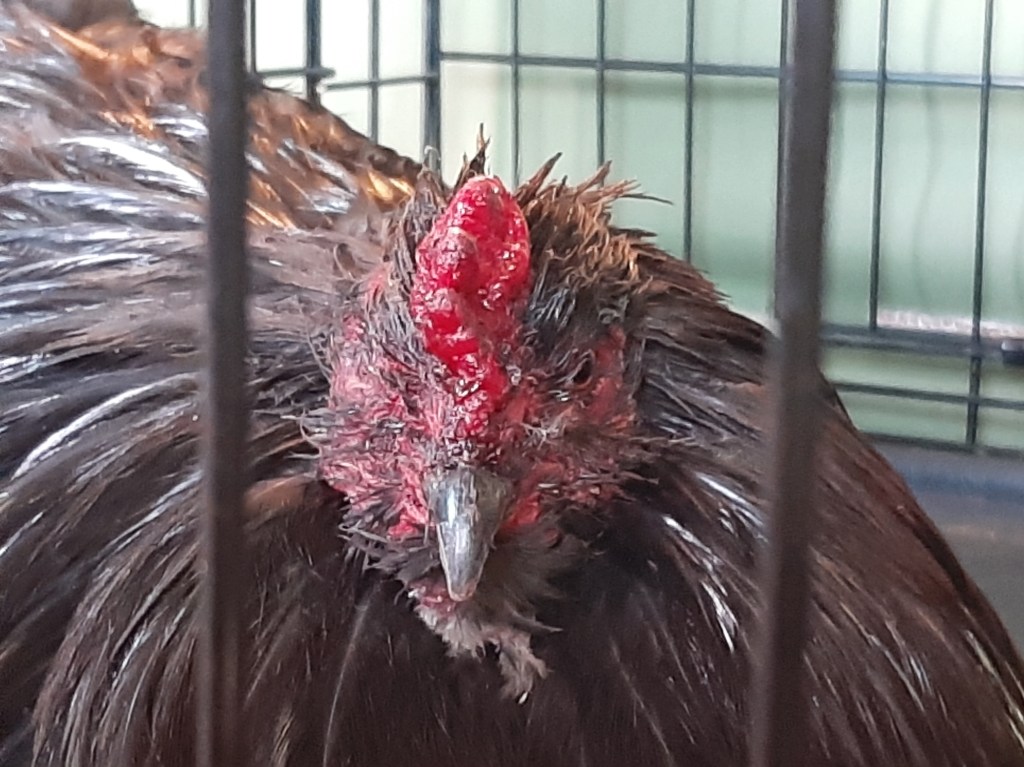
If yes to the spots or lesions on combs and wattles then it could be fowl pox. And you would need to keep your birds quarantined for 2 to 3 weeks. Plus, there are 2 types of fowl pox: wet pox or dry pox. Wet pox is more serious as it’s internal and can cause breathing issues. There’s no treatment for fowl pox. However, if they only have bubbly eyes and not respiratory problems, then it’s some type of eye infection. And you can try gently rinsing the eye with saline. Then apply Neosporin. Although, that might not do much, since chickens dust-bathe. So you might need a chicken vet after all. We struggled with this issue in a juvenile rooster.
There can be several reasons why a chicken would have loose, runny stools, such as
coccidiosis
Your chickens and my chickens have coccidiosis. However, they don’t suffer the effects, because they’ve built up an immunity to it. Though, if you don’t practice good biosecurity, then someone who also owns chickens can pass their chickens’ coccidia to your chickens. And vice versa. Other symptoms of severe coccidiosis is weight loss and blood in the stool. Go here for more info on how to treat or prevent diarrhea caused by coccidiosis.
Worms
Usually worms do not produce diarrhea. That is, until a high worm load irritates the gut. And then that can cause a secondary bacterial infection, according to Richard Jackson BVMs from Poultry Keeper.
Viruses (such as rotavirus and adenovirus)
Young birds are most susceptible to diarrhea caused by viruses. If your bird has a virus, the illness will have to run its course. However, sterilize and sanitize everything related to your chic kens. And keep your ill bird separated from the flock.
Bacterial diarrhea
This could occur due to coccidiosis, worms, or any time the gut is damaged. Think of it as the chicken’s gut bacteria is out of balance. Fix the culprit, and then offer probiotics.
And a feed too high in protein
If you don’t feed your chickens the appropriate commercial feed, the result can be too wet droppings. And that will cause the litter to be too wet, which can further cause issues. Or it can be a breeding ground for disease if the chicken is untreated.
Now if the bird is otherwise healthy, eating and drinking, then just offer supportive care, making sure they don’t get dehydrated. Plus, you can collect a stool sample. And send it to your veterinarian for a worm sample. See here for detailed pictures and descriptions in case you aren’t certain about your own birds and their diarrhea.
Crop Issues
Photo by Anastasia Lafazanidou Kwnstantinidou on Pexels.com
There are many different articles and thus, recommendations for these issues. And you’ll find that people use sour crop and impacted crop interchangeably. However, they are not the same at all. They are distinct conditions, requiring distinct treatments. If your bird has impacted crop, but you treat them with the advice for sour crop, you will delay the proper treatment. And your bird might die.
Therefore, if you notice a sour smell from your bird, and they leak liquid when you press on their full crop, they have sour crop. So, you want to
flush the crop with 1 tsp Epson salt and 1/2 c water. Use a syringe, careful not to get water in the bird’s airway.
and treat the fungus: mix 4 oz of powdered bluestone copper sulfate with 1/4 c ACV(apple cider vinegar) and 32 oz of water. Then to each gallon of the sick bird’s water, add 1 tbsp of this solution. Do NOT put the solution in metal.
An impacted crop is where the crop is almost rock hard, because something indigestible is stuck. Again, there are many suggestions. But I don’t know if the people who offered those suggestions actually had any real-world experience with a chicken suffering from impacted crop. They recommend to lubricate the crop with olive oil or similar. How is that supposed to help? I guess I can see in theory, but in practice? You can try those wonky methods if you want. But, as I said, impacted crop is a life and death situation. Time is not on your side.
Unfortunately, it was while I was trying all of the wonky methods, when I finally came to the conclusion that nothing was helping my bird. I had to take drastic measures. So, I found some videos on people performing surgery on their own chickens; the same exact one my bird needed. And I ordered the materials. Although, my bird didn’t make it. She died before my order ever arrived. Please don’t be me. If you don’t have a chicken vet, order supplies so you’ll have what you need in the event you have a bird with impacted crop. Check this site out for more info. There are plenty of sites out there from others, like me, who’ve actually had chickens with impacted crop. Surgery is the only answer, if you want to save your bird. But you have to know the difference between impacted, pendulous, and sour crop.
Egg Binding
If you have a hen walking like a penguin, the number one condition that comes up on the internet is egg binding. However, there definitely can be other things going on. That said, an egg-bound chicken is certainly an emergency, not to be taken lightly. Thus, if your ill bird has other signs of being egg-bound, you can
offer her electrolytes in her water. But, if she won’t drink on her own, help by using a dropper.
Next, submerge her lower body, including vent, in a warm bath for 10-20 minutes. Gently towel her dry to prevent the egg from breaking.
Then apply Vaseline or KY jelly just inside and around the vent. This is to help her pass the egg.
Next, put her in a dark, separate place away from the flock.
If she is truly egg-bound (you know there’s an egg), and she hasn’t passed it yet, then absent veterinary help, most sites recommend removing the egg manually. However, it is extremely dangerous and difficult. So, caution is also advised.
As long as your hen appears well and not in shock, gentlypalpate her abdomen to locate the egg.
Then carefully shift the egg, trying to move it, so the hen can hopefully pass it.
Should this prove to fail too, the last option would be aspiration, implosion, and then removing it manually.
Check out Tim Daniels from Poultry Keeper for his advice.
And the best way to prevent egg binding is to feed your birds the appropriate commercial feed. And provide oyster shell. Plus, limit the treats to keep your birds from getting obese.
In the event you have a chicken with all of the signs of egg binding, except the presence of an actual egg, what then? As I mentioned, something else could be going on. So, if you do NOT see an egg on examination of your bird, then you know for sure they aren’t egg-bound. On the other hand, they may have
Most of the above are as serious as an egg-bound hen. Further, some of the issues require antibiotics, hormones, or surgery. However, in the case of heart disease, other medications would also be involved.
Injury
This was Megs after being beaten up by Baby Nay.
Unfortunately this is the most prevalent issue we personally have to deal with on our acre. And mostly it’s due to dogs. Neighbors’ dogs. But we have our chicken first aid kit, which I highly recommend you start putting together. See here for instructions. So far we’ve not had to take any of our birds to the vet due to any predators. We have had to call once for an antibiotic. And that was due to a hawk attack. Thankfully, the hen lived, because of that antibiotic. Although, we have also lost one duck and one guinea when we went on vacation this past spring. Therefore, I want to encourage you that if you’re around and one of your birds gets attacked, your presence alone will likely save that bird. My husband and I usually work together on these issues. He’ll find the bird since he’s outside usually working. Then he’ll get me, and I’ll grab the kit. So, if you find an injured bird,
First, assess the injured bird.
They will be frightened and in pain. Though, hopefully, nothing will be broken, other than skin and feathers.
Next, clean the wound with Vetericyn wound care spray.
Then liberally apply Gentian violet .5% over the wound(s).
Gentian violet is an antiseptic dye used to treat fungal infections of the skin (such as ringworm & athlete’s foot). But it also has some antibacterial effects. For all of our birds who’ve been attacked, this is our first line of defense. And our birds don’t start going crazy, pecking the heck out of those birds with the purple stuff on their wounds. I believe Blu Kote is made of the same thing.
Depending on the injury, you may keep the injured bird isolated from the flock for a couple of days. Or not. It’s entirely up to you.
Most sites would probably recommend isolating the injured bird. However, the only bird we’ve ever isolated was Megatron, when he got his tail feathers kicked by Baby Nay and would’ve died had I not intervened. All of our other injured birds, including Rex (hawk bait), were allowed with the flock. One was going broody anyway, so she secluded herself. We didn’t have to do anything.
Provide fresh feed and fresh, clean water daily. Check their wounds that they’re not getting septic or angry looking; that they’re indeed getting better.
You may need to re-apply the Gentian violet. And if you did isolate your bird, like I did with Megs, then let them back in with the flock. He was and is the boss, so I didn’t have to do anything special. But I let him back in with the flock after a week. Birds have phenomenal memory even with their pecking order. I don’t re-introduce my birds a special way once I’ve taken them out of the group; they know each other already. And they simply don’t care, except for the one who wants to rejoin the group.
In addition, we’ve had birds that have had only feathers out during an attack. But we’ve also had birds that have had skin missing. Though, we haven’t had to deal with bleeding with any of them or their wounds.
So, How do You Tell if a Chicken is Sick
Just like other prey animals that get sick or hurt, chickens will act like everything is ok. And they may hide when ill or in pain. Therefore, it’s vital that you know what your chickens are like, including their mannerisms. Thankfully, though, there are universal signs. Not eating, being tired, lethargic, losing weight, not congregating, coughing, and sneezing are all signs someone, including birds, aren’t feeling too well. And the best prevention for keeping chickens healthy is keeping the coop clean and practicing good biosecurity.
How would you say your birds fare when it comes to illness or health? If they’re pretty healthy, what do you attribute it to? Thank you for visiting. Please share, and if you don’t follow already, you may do so now.
Rather than using heavy cream for linguini Alfredo, my mom used to make it with milk. She didn’t like the sauce being too thick. Thus, I grew up with this preference for a thinner sauce as well. Alternatively, now that I’m an adult, generally I use half-n-half when cooking white sauces. To me, it’s the best of both worlds. Although, the following shrimp and linguini recipe can’t technically be called linguini Alfredo, since I’ve made entirely too many adjustments to it.
While my mom adds scallops and shrimp to her recipe, I only add shrimp. Besides shrimp, seasonings, and cream, for a long time I never tried adding anything else to my recipe. But, eventually, I started to change things up, like tossing in fresh tomatoes. Then I tried spinach. However, kale would work just as well. With the recipe below, I added canned mushrooms and some cooking wine. And my family loved it. Therefore, after many such alterations, this is an entirely new recipe for us.
Additionally, most of the time, I cut up the shrimp. However, you don’t have to. Mixing 3 kids and seafood always prompted them to compete for the most amount of shrimp between them. And count how many each had, to be sure they received a fair amount. Consequently, I had to improvise. Even though my oldest no longer lives at home, for some reason, I kept the habit of cutting up the shrimp. Please enjoy the recipe.
4 sprigs each fresh oregano and basil (I used purple basil), chopped
1 (4oz) can sliced mushrooms
6 oz spinach, fresh or frozen (I used frozen, but heated according to package instructions)
and 1 lb linguini
Shrimp and linguini recipe instructions
First, melt butter in a medium saucepan over medium heat. Add garlic and shrimp, and cook until shrimp is cooked through. With Argentine shrimp, it starts out more translucent, like most shrimp, and as it cooks, it will get opaque.
Next, add the following 2 ingredients at the same time, but in 2 separate measuring cups; stir.
Then add the next 6 ingredients, stirring occasionally. Adjust temperature to medium low.
Cook linguini according to package instructions.
So the shrimp doesn’t over-cook, remove sauce from heat. Then when linguini is finished cooking, drain noodles. Put the noodles back in the pot you cooked them in and pour sauce over pasta. Mix well.
Finally, serve and eat immediately.
Do you prefer a thicker sauce to a thin one with linguini? And do you make your own sauce? Moreover, do you get creative with your sauces?
Thank you for visiting my blog. Please share, and if you don’t follow me already, you can do so now. Also, for my followers who are local to the OKC metroplex, if you have plans to go out of town and need a chicken, duck, or other pet sitter, look no further. I know how it is to be homebound, because you can’t find anyone trustworthy enough, or just plain can’t find anyone who can watch ALL of your pets. If that describes you, go to my about page for more information. Or just go to my contact page to reach me.
Photo by hazan aku00f6z u0131u015fu0131k on Pexels.com
Was there ever a time when you were holding your cat and suddenly noticed fur everywhere? That’s happened to me with Itty a few times. Therefore, at those specific times, I wanted to know, why is my cat suddenly shedding so much? I had a guess to Itty’s shedding. But there can be many causes.
Shedding is a normal process for cats, just as molting is for chickens and snakes. Plus, your cat will always leave behind errant hairs. However, at times, it can seem to be too much fur. Or, as I pointed out before, it seems like it comes out of nowhere. So, what’s considered a normal amount of shedding? In addition, what’s causing all the shedding? And should you be worried? We’ll answer those questions. Then go over tips to help you with your shedding cat.
What’s Considered a Normal Amount of Shedding
Cake is a free spirit.
We didn’t have cats till moving to Oklahoma, but we did have a dog. So I already knew about dogs shedding. However, when our last dog passed away, the fur was almost non-existent in the house. That is until we got a bunny. Then, not long after, we got Sophie, our Aussie. That’s not to say Itty won’t shed; she just doesn’t as much as Cake, who has a fluffy coat. And Pickles might not have as much fur, though she’s a kitten. Thus, she’s transitioning to her adult coat. Consequently, she seems to shed as much as Sophie.
Cats can shed twice annually. In the spring they shed their winter coat. And in the fall, they shed to replace their fur in order to get their winter coat. Although, if you have an indoor cat, like me, you might not notice the shedding as much all at once. On the other hand, if you have long-haired cats or cats who have a lot of fluff, they tend to shed more than short-haired breeds.
Why do Cats Shed
Pickles when she was a little younger.
Similar to us shedding hair, cats primarily shed their fur to make room for new fur. It’s based on a cycle and daylight exposure. And many things can influence this cycle, including whether your cat is inside or out. Though, usually indoor cats will shed some throughout the year. Other reasons cats will shed their fur include
allergies
If your cat is suffering with allergies, excessive or abnormal shedding is one of the signs.
parasites
Fleas, ticks, and mites cause itchiness and inflammation, which then spurs your cat to scratch and scratch. And a lot of scratching will lead to shedding.
ringworm
Rather than an actual worm, this is a fungal infection that affects the hair and hair follicles. In addition, one of the first symptoms can be a bald spot on your cat’s body.
pregnancy
Both pregnancy and lactation can deprive cats of calcium and minerals necessary for their coat. And that can lead to shedding.
metabolic disorders
Damage to the thyroid or hypothyroidism can bring about a decline in hair follicles. Plus, kidney failure leads to hair loss, while diabetes causes dandruff, flaking, and unkempt fur.
poor diet
Lack of sufficient protein or inadequate food can cause shedding. If you’re a first time cat owner, ask your veterinarian what brand they recommend you feed your fur baby.
age
When a kitten is reaching adolescence, ~ 6 to 12 months old, they start to shed their baby fur. Moreover, coat quality changes as animals and people age. Fur and hair get thinner. Thus, for cats, shedding is likely the culprit.
and lastly stress
When cats experience a sudden fear response, like going to the veterinarian, quick shedding is a normal biological response. On the other hand, longterm or chronic stress can cause behavioral issues, such as over-grooming. And that leads to hair loss, such as bald spots.
As you can see, some of these causes of shedding are quite normal and nothing to be concerned about. However, some of them definitely merit a visit to the vet. Next, we’ll look at ways you can help your kitty when they’re shedding or to prevent it before it starts.
If the shedding is due to seasonal change (spring or fall) or their age, then try the following:
Get the appropriate tools
Short-haired cats need a fine-toothed flea comb, soft brush, grooming mittens, and a shedding tool. Long and medium-haired cats need a wide-toothed flea comb, longer brushes, and a shedding tool.
Use those tools regularly
Combing and brushing your cat several times per week and daily during seasonal changes will help in the long run. In fact, this is the #1 piece of advice anywhere. Also, this is best to start when cats are young. But, if you didn’t, it’s ok. Just offer positive reinforcement, and go slow. Also, definitely go slow when using the shedding tool. And don’t over-use!
Get your kitty professionally groomed
Some brave souls opt to bathe their own cats when shedding is at its worst. After a warm bath with cat-safe shampoo, comb and brush your fur baby till they’re dry. You’ll be surprised by all the fur!
Boost hydration
It’s not that your cat is to the point of dehydration. But cats are known to be picky when it comes to water and where it comes from. Thus, if you don’t change their water daily, have an automatic water dispenser, or a fountain, that could be contributing to their shedding.
Improve mealtime
Adding wet food containing seafood will do so much for your cat’s coat. I personally can vouch for that. When Itty came to us she had a dull, dry coat. However, it wasn’t until I started adding wet food to her diet that her coat got bright, shiny, and silky. Now that she’s an adult, she also spends the majority of her waking time grooming herself. And, as I mentioned, she rarely ever sheds, unless she’s stressed.
However, if shedding isn’t due to seasonal change or age, or if your cat is pregnant or has any bald spots, call your veterinarian. Your vet is better equipped to give you advice on what’s going on with your kitty. Anything from fleas and stress to age-related disorders or allergies can also cause shedding.
To Summarize
This is Itty.
Shedding is normal for cats, just as it is for dogs. However, parasites, ringworm, allergies, old-age, stress, and disease can also affect cats and ultimately their coats. Any time your cat is shedding excessively and you’re unsure of the reason, or if they have bald spots, it’s best to let their vet check them out.
Other than seasonal change, do you know why your cat sheds? How do you handle it? As I said, Itty is our only cat that doesn’t shed a lot, unless she’s stressed. And as far as stress, she’s been doing much better. Thank you for stopping by. Please share, and if you don’t already do so, you can follow me now.
There are two ways you can make this easy flank steak stir fry. Obviously the easiest way would be using only one pan. However, when I made this, it was still triple digits out. So, I didn’t want the house to get unbearable if I used the stove. Thus, I used our NuWave infrared oven to cook the steak, which is similar to an air fryer. That way my house wouldn’t get too hot. Then, when it was done, I heated the vegetables for a few minutes before adding the steak to the pan. Consequently, my stove was on for only ~ 5 minutes.
But, weather permitting, you want to save dishes, or your air fryer isn’t big enough for your steak, just cook it (steak) in ~ 2 tbsp of oil in a wok. And the rest of the steps are the same. Otherwise, just follow the recipe below.
Ingredients for Flank Steak Stir Fry
2 lb flank steak
32 oz package of stir fry vegetables (from refrigerated section of grocery store)
4 oz bottled teriyaki sauce (I used PF Chang’s Teriyaki sauce)
1 – 2 tbsp cooking oil
1/2 tsp salt
and 4 c cooked rice or noodles
Instructions for Stir Fry
First, spray nonstick cooking spray on grill pan.
Next, season meat evenly on both sides with salt.
Then cut steak in ~ 1 inch slices against the grain; and again, cut those slices into 1 x 3 inch slices.
Further, cook according to your air fryer’s instructions based on how well you want your meat done. For instance, for NuWave infrared oven, I cooked our steak 4 minutes per side for medium rare.
At halfway mark, flip steak over and cook additional time.
Next, add 1 – 2 tbsp oil in a wok or pan large enough for meat and vegetables. Heat to medium high.
Then add stir fry vegetables and cook ~ 4 minutes, tossing gently with tongs.
Incorporate meat and 4 oz of teriyaki sauce, and toss with tongs.
Finally, serve with cooked rice or noodles.
We love Asian food at our home. It’s healthy and full of flavor. Even though I enjoy authentic recipes, I appreciate the ease and convenience of modern cooking. Do you have a favorite Asian recipe?
Thank you for stopping by. Please share, and if you don’t follow me already, you can do so now.
We’re about to head into the season where the days get shorter. Yes, it’s hard to believe it’s almost autumn. But hopefully the weather will cool off. So, this prompts the question, “Do chickens need light in the coop?” This is different from heat and adding a heat source. Strictly speaking, we’re only discussing light. Therefore, we’ll define the roles light serves in the brooder and coop. Plus, go over the pros and cons of adding light to the coop.
According to the University of Maine, the main function of having light in the brooder is for chicks to locate food and water. So, any time you raise chicks, you absolutely need light. Some people choose a 250-watt infrared bulb that will supply both heat and light, while others will provide a heat plate. Thus, if you’re of the latter group, just make sure you have plenty of either natural or artificial light for your chicks. Poultry Extensionrecommends chicks be provided with 48 hours of light post hatch, because it will take that long for them to reach peak sensitivity to spatial details.
Another result of adding artificial light directly to the brooder is exponential growth rate. Try this some time at home when you have a broody hen or hens. Once the hens hatch their chicks, go pick up a couple of day-old chicks, from a breeder or hatchery, and compare their sizes to the ones hatched by the broody hens. Trust me, you’ll be astonished at the difference. You’ll think the ones hatched at home are malnourished. But they’re not. Light, including wavelength, duration, and intensity also affects behavior.
Conversely, the purpose of a light in the coop for adult birds is to keep hens laying for as long as possible. Chickens absorb light through their retinas. However they also sense light through the pineal gland and hypothalamus. The pineal gland is accountable for regulating the circadian rhythm through melatonin. Also, both the hypothalamus and pituitary gland in chickens are responsible for reproduction. In addition, chickens can see more UV light than us. And studies involving light found that different wavelengths affect poultry reproduction.
According to NIH, light stimulus is emitted to the hypothalamus through the back of the eyes. Then it causes the release of GnRH, an important hormone for reproduction. Further, light prompts the production of follicle-stimulating hormone (FSH) and luteinizing hormone (LH), which are responsible for egg production. As a result, adding light not only increases egg production, it sexually matures hens faster.
Given that chicks need light in order to find food and water, and that it takes ~ 48 hours for sensitivity to spatial detail to peak, we won’t go over pros and cons with them. It’s well established that chicks need light.
The main advantage of adding light to your coop is that your hens will lay eggs longer. Chickens require ~ 14 – 16 hours of daylight in order to lay eggs. It’s part of their circadian rhythm. Thus, when the days get shorter, a hen’s retina, pineal gland, and hypothalamus registers the change, causing a decrease in egg production. Other benefits to having a light in the coop include
you can also see in less daylight
Adding light to the chicken coop, when daylight gets below 9 hours daily, gives you the ability to see while doing your chicken chores.
and different wavelengths have distinct positive effects on the birds
For instance, blue light has been noted to improve the health of pullets. Additionally, blue and green lights calm chickens more than red light. Moreover, lights with a sufficient red spectrum (2700K–3000K) are recommended for laying hens.
Reasons not to add a light to the chicken coop mostly involve wavelength, intensity of the light, and duration. For example,
lower spleen percentages were noted in hens exposed to red-LED compared to normal and blue-LED
It was thought that hens exposed to red-LED had a weaker immune system, because they had decreased spleen sizes compared to normal-LED. However, research from Journal of Applied Poultry Research cautions that something else other than red-LED may have manipulated the results.
and Too bright and duration of light can cause stress to the hens
Time and again we’ve discussed that stress of any type affects egg production. And high intensity light makes laying hens more aggressive and nervous. Plus, it induces pecking and cannibalism as does having a constant supply of light. Therefore, there’s no reason to keep a light on for longer than necessary. Your chickens won’t lay more eggs or continue even if you do.
Best Light for the Chicken Coop
You can either place compact fluorescent light bulbs (CFL) or light emitting diodes (LEDs) in your chicken coop. And there are pros and cons to both. However, most sites recommend using LEDs based on cost, carbon footprint, and ease of cleaning. When your coop gets dusty and dirty, just be sure to dust down your LED lights. Read this article for a breakdown of each light bulb.
Best Wavelength, Intensity, and Duration for the Chicken Coop
By Hadis Avidor Goldin
Since you want to simulate daylight in order to continue getting eggs, then the best wavelength is white light. And I’ve read suggested intensity ranges from 15 lux to 30 lux. However, lux are used in countries where the metric system is common, whereas foot-candles are standard in the US. Foot-candles measure lumens at bird level per square foot, while lux is lumens per square meter. So one foot-candle is roughly 10.76 lux. Moreover, according to Poultry Extension, brooder intensity is advised at 2 foot-candles while only 1/2 a foot-candle afterward.
Continue reading to find out how to add light to the chicken coop.
How to Add Light to the Chicken Coop
Provide 1 foot-candle of light (10 lux or 60 watt) per 100 square feet where it will shine on feeders and waterers
You can hang a bulb ~ 7 feet above. However, depending on the size of your coop, a single bulb can create shadows. Thus, an LED strip might be better.
Use a timer
By doing this, you won’t have to get up early to turn the lights on. And if you forget one day, it’ll still be ok, because of the timer.
Start adding artificial light when day length lessens to about 15 hours
And keep lighting your coop through the winter and spring, until daylight is back up to 15 hours a day.
Adding a light to the chicken coop is a question every chicken keeper has to answer for themselves. And it depends on what your purpose is for having chickens. Are they your pets, like a dog and a cat? Or are they a source of income? If they fall into the latter, then you most likely want to add lights. We’ve seen that having a light in the coop doesn’t harm chickens, especially if the intensity and duration is just right.
Do you have a light for your chickens? Other than getting eggs, have you noticed any other changes with the lights? Thanks for stopping by! Please share, and if you don’t already follow me, you can do so now.
In July I wrote an article on how to tell if a chicken egg was fertile. That’s assuming you have a rooster. But what do you do if you have a roo, and all your eggs are unfertilized? What does that mean? Well, it could mean a number of things. Since reproduction depends on both the hen and the rooster, we’ll look at fertility issues in both. After that we’ll explore how to increase fertility in chickens.
Did you know that rooster sperm can be viable inside the hen for 2 to 3 weeks depending on the breed? And the hen can store multiple roosters’ sperm in something called sperm storage tubules (SSTs). Additionally, it’s been said that roosters can mate 10 to 30 times per day. But I think that’s also breed dependent, simply because some breeds can be more aggressive, even romantically.
Reasons for Low Fertility in Roosters: Physical
These types of fertility issues have nothing to do with the chicken farmer or keeper. On the other hand, they’re inherent to the rooster, with him physically or with his mannerisms, such as
roosters with single combs are more fertile in contrast to rose comb and walnut comb roosters. Though pea comb roos have better fertility as well. However they’re still not as fertile as single comb roosters.
Age also affects fertility. According to several articles, the quality of sperm and mating itself declines as roosters age. So the older the rooster, the less fertile he’s going to be. In contrast, the more dominant rooster is also less likely to be as fertile. But he’s the one the gals want to be with. It’s quite the conundrum.
In addition, hens choose the rooster that has the largest comb. Although I’m not sure if that means he’s more fertile or less, since you can find articles supporting both theories.
Roosters that are too docile might have issues getting the deed done. Personally I have some roosters that are docile with us, but they don’t have any problems doing their business with their ladies, especially the young guys.
Additionally, roosters that are too small to mount the hen or hens will have problems copulating.
Molting causes roosters to slow down and rest. But did you know it also reduces sperm production, according NCBI?
Lack of sperm competition and agglutination. For fertilization to occur in many species, sperm need to be moving unhindered. Although sperm agglutination is the opposite of that, because the sperm are literally stuck to each other. Thus, it restrains sperm mobility. However, sperm agglutination in chickens helps fertilization rather than hindering it. You can read the full article in Nature Briefing here.
and If a roo plays favorites with the hens, not all the gals will be serviced. Therefore, that will inevitably lead to fertility issues, just because he’s neglecting some hens.
What Causes Low Fertility in Hens: Functional
Next, we’ll look at low fertility involving hens. And these deal with functional issues just as the previous ones did with the roosters.
Blocked cloaca
Unlike ducks, chickens don’t have appendages. They only have cloacas that briefly touch, often called the cloacal kiss. Thus, if there are too many feathers in the way or the hens have dirty bottoms, sperm will not make it to the egg. Or the cloacas won’t even touch. Therefore, if you have some fluffy butted or dirty bottomed hens, just trim their feathers around the vent area.
Age
In both hens and roosters, age plays a factor in fertility. So, the younger they both are, the more fertile. And the opposite is also true. I told my husband, that if we’re going to keep incubating, we have to do something about our aging flock. Megs is the dominant roo, and his girls are also getting older. Thus, their eggs have very recently been mostly infertile.
Molting
Again, both hens and roosters molt. And it’s a time for the feathers to re-grow and for the birds to rest, which means egg laying will stop for a time.
Sperm storage tubules (SSTs)
There have been multiple studies on hens, how long sperm is stored, and the SSTs. In 2020 it was discovered that too many fatty acids had a negative effect on sperm storage in the female reproductive tract and fertility in general. Another study, mentioned in Nature Briefing, showed that when hens were artificially inseminated with either high or low sperm mobility from various roosters, the sperm from the first roosters ended up fertilizing most of the eggs. Therefore, low mobility sperm can reach the SSTs and still fertilize some eggs. However, as of yet, there are no solid suggestions on how to overturn these issues.
and Cryptic female choice
Hens have the final say in who fathers their offspring. Consequently, to prevent inbreeding where multiple roosters are involved, hens will select the rooster that is not related to them. Also, exosomes are produced in the mucosal tissue of the hen’s vagina which significantly reduce sperm viability if mating is forced. As a result, if the hen doesn’t like the rooster, she has a lot to say about how well things will turn out. And if you’re getting infertile eggs, it could be due to the hen’s preferences.
Reasons for Low Fertility in Both Roosters and Hens: Animal Husbandry
Since these causes of low fertility are the same for both hens and roos, I’m combining them under the same heading. Additionally, most of these issues can be prevented, because they’re management issues and under our direct control.
Breeding for genetic selection
Altering some traits decreases libido and thus, lowers fertility.
Diet
Too much, not enough, starving your birds with a particular diet, or just plain feeding the wrong kind of feed will all cause fertility issues for your chickens.
Not enough daylight
During shorter daylight seasons your birds will not mate as much or be as fertile. For example, hens will lay less eggs during the shorter days of fall and winter.
Chronic illness or injury
Any disease or injury not soon addressed will take its toll on any bird. And if it’s a disease and not taken care of, it can spread to other members of the flock, greatly upsetting fertility.
Crowdingor lack of perching or nesting sites
Space issues could also fall under any kind of stress. Plus, these problems are more evident in commercial flocks than in backyard birds. However, if your birds are crowded, it creates stress and could result in disease, which affects fertility.
Vaccinations
In British Poultry Science, Volume 48, 2007, it was revealed that cockerels vaccinated for infectious bronchitis had reduced fertility.
For the purpose of maintaining a flock, it’s typically 1 rooster per 10 to 12 hens. But for breeders and depending on the breed, you need young, virile roosters. So in some cases it’s recommended 2 roos per 10 to 12 hens. But watch out for the hens’ backs.
Not enough water
Because water is used in most bodily processes, chickens included, it’s essential to all life. Although, if it’s hot out, chickens won’t drink water unless it’s cool and fresh. Therefore, they can quickly get dehydrated, which can affect their health and thus, fertility.
and Stress of any kind
Predators, loud noises, pollution, heat stress and cold stress would all fall under stress of any kind. And they all can affect fertility in one way or another, whether with egg issues in the hen or actual fertilization problems with the rooster.
How to Increase Fertility in Chickens
Given that chicken is a popular food, I wouldn’t be surprised if my lists weren’t exhaustive. It just means that scientists are still trying to crack the code on chicken fertility. But now that I’ve covered some issues both hens and roosters might face regarding infertility, ways to increase fertility include
don’t get rid of your rooster just yet
If your rooster doesn’t happen to have one of the high fertility combs, like single or pea, what do you do? Well, the next question is, how old is he?
add new roosters
Since under 1 year old is viewed as the most fertile age, if your roo is over a year old and doesn’t sport the most fertile style comb, consider getting new roos. Maybe even get one with a single comb. In addition, having different, younger roosters will inspire sperm competition during mating and help with fertility. See sperm competition under roosters.
keep vent areas clean
Make sure hens vent areas aren’t blocked by poo or feathery bottoms.
how old are your hens
Invest in more layers if your hens aren’t laying any more or as much. Don’t just incubate; actually purchase some from a reputable breeder to bring in new genes.
provide commercial breeder feed with essential vitamins, proteins, and minerals
Breeder feed contains slightly more protein than standard layer feed, which improves development and fertility.
add artificial light to your coop during seasonal daylight changes
This is entirely up to you whether you add light to your coop or not. But, when your birds molt, it’s a time for them to rest, recharge, and regrow feathers. Just be sure to feed them appropriately.
practice good biosecurity
Inspect your flock for illness and injury on a regular basis. Moreover, examine the coop for damage and necessary repairs. These are quick assessments, designed to note any possible danger to the flock. Also, don’t allow anyone in the coop, run, or in the flock’s yard who has their own separate flock, or who works with poultry.
make sure each bird has enough space
Whether your chickens are pasture-raised or not determines the amount of space they require. Though most people agree that each bird should have 3 – 4 sq ft in the coop, including plenty of perches and nesting boxes. And the birds need 5 – 10 sq ft each in the run, depending on if they are ever let out to roam. If the chickens are pasture-raised, then at least 108 sq ft per bird is needed for roaming.
provide fresh, clean water daily
Have multiple water stations for your birds. And in the summer heat, fill them with ice to prevent your birds from getting dehydrated.
and lastly, be aware that stress affects fertility
There’s not much you can do about noises or the weather affecting your birds. However pollution that could affect backyard chickens is ammonia from their droppings. Plus, if you can smell it in your coop, then it either indicates a ventilation issue, or it’s past time to clean the coop. Furthermore, in the event you’re taking care of your birds, but there’s extreme heat outside, you’re just not likely to get as many fertilized eggs.
In Conclusion
We know that both hens and roosters share responsibility for fertility. In addition, fertility in both continues to be studied, given that chicken is popular and economical worldwide. Even though chicken infertility has many causes, including functional and management, there are ways to combat it. Feeding your birds the correct feed, providing fresh, clean water daily, and checking them and their houses on a regular basis should be a given. Doing those minimal tasks goes a long way in helping your birds. Despite that, when fertility drops, add more roosters and hens, with the proper ratios.
Have you ever noticed fertility issues with your flock? How did you handle it? I mentioned earlier that Megatron is our dominant rooster. And I’ve also noticed that fertility has dropped. But I can’t help wondering if it’s the heat or a fertility issue. I know that before the younger boys were introduced, Megatron was slowing down with a lot of things. However, he got very busy once they took an interest in his business. Of the 3 adult roosters, Ravage would be considered the cat’s meow. He has the biggest, reddest comb. And he has been graciously accepted into Meg’s flock, whereas Mystogan, Ravage’s brother, has not. Megatron allows Ravage to handle most of the issues in the yard. I suspect most of the chicks we have thus far are Ravage’s offspring and not Meg’s.
Thank you for taking the time to read my post. Please share, and if you don’t already do so, you can follow me now.
When people consider animal intelligence, they probably imagine a dog, a chimpanzee, or a dolphin, but not usually cats. Cats are typically portrayed as uninterested, lazy, and snobby creatures. In medieval times they were even depicted as being associated with the devil. However they weren’t necessarily considered pea-brained. Though, who really knows, right? On the other hand, for fellow cat parents, you know something different. Your cat isn’t a dog, a chimp, or a dolphin, and certainly not demonic. Even if your cat is cunning, they’re still smart in your book. Join me as I attempt to answer the question, “How smart are domestic cats?”
Let’s look at the question for a minute. Who or what are we weighing cats against? Dogs? Humans? Stray cats or wild cats? It would be great to say definitively that domestic cats are smarter than dogs. Regardless, it’s just not that simple. Cats haven’t been studied as extensively as certain other species. At first, scientists spent all their time researching mice, rats, and pigeons. But then in the 1990s, dog cognition started to be studied. Some scientists attempted to study cats at the same time, though without much success. So it wasn’t until the past decade that any significant headway into feline research came about.
Before we can answer how smart cats are, it’s important to understand how intelligence is measured. Equally as relevant is how one defines cat intelligence. You’ll likely find different definitions. But basically they all amount to the same thing: Cat intelligence is a series of events that guide behavior, such as sensing, perceiving, recalling, and reasoning. Moreover, human intelligence can be measured by IQ tests, such as the Wechsler Adult Intelligence Scale, whereas most animal cognition tests involve
gauging an animal’s problem solving potential
An animal’s problem solving ability would be whether they can work with groups, use tools, etc.
measuring the size of an animal’s brain and complexity
Encephalization quotient (EQ) predicts cognition via comparing one animal’s brain to an animal of similar size.
evaluating the animal’s sense of self awareness
This type of test is called a mirror test. For instance, a spot or mark, like a red dot, is placed on the animal’s forehead. If the animal recognizes its own reflection, by touching its face, then the animal passes the test.
studying an animal’s self control and capability to act on new info
The self control or pointing test instructs an animal to anticipate food in a specific place. Then the location changes and the human points to a new spot. Domestic animals, like dogs, excel at these tests. And human babies pass these tests around age 1 year.
When writing this post, it became obvious that analyzing animal intelligence is ongoing and not simple to answer. As a result of being measured by human standards, those very studies are questioned by some people.
Comparing Cats to Humans
Digital Art, Courtesy of Sarah Smith
Believe it or not, cats have similarities to humans. If you’re a cat parent, you already sense this. And I’m not talking about character traits here. But seriously, humans and cats share 90% of the same DNA. With that in mind, the human brain contains ~86 billion neurons while a cat’s brain has ~ 1.2 billion. Also, the surface area of a cat’s cerebral cortex is 83 cm2️⃣ compared to 2400 cm2️⃣ in humans. And their cerebral cortices contain ~250 million nerve cells in contrast to our 16 billion. Since cats are smaller, it makes sense, right, because their brains are smaller than ours? However, intelligence isn’t all about brain size. In reality, it’s about number, size, and complexity of nerve cells.
Not only are cats 90% genetically similar to us, their smaller brains are also nearly90% identical to our own. A cat’s brain has a cerebrum, cerebellum, brainstem, 2 cerebral cortices, and surface folding, just like ours. Moreover, like a human brain, a cat’s is divided into areas. And each has a unique job to carry out. Plus, like ours, a cat’s brain is created to have good memory, both short-term and long-term. Though, a cat’s brain takes up only ~ 0.9% of their body mass in comparison to ~ 2% in the average human.
Traits of a Socially Smart Domestic Cat
Just a month ago before Itty and Pickles made friends.
Recently social intelligence has been the most common subgroup to be studied. Additionally, there are some basic features socially smart cats possess, including
Simply put, associative learning for animals is the process by which an animal connects (or associates) stimuli with certain behavior. For example, my cat, Itty, knows that if she scratches my mattress (the stimulus) every night, I’ll wake up to feed her (the behavior). She memorized her particular action produced my reaction of rewards. (And now I’m stuck waking up in the middle of the night each night.)
social referencing
Social referencing tests whether a cat will pick up on their owner’s emotional cues regarding certain things. Not long ago I wrote a post on Itty being stressed. However, now I believe she was reflecting what I was feeling about my new work schedule. Moreover, I think I contributed to her anxiety with Pickles, our new cat. And she doesn’t like being around certain people based on how I think she feels around them.
secure attachment style
Cats, like dogs and humans, have attachment styles. While humans have 4 attachment styles, cats only have 2, and dogs 3. Additionally, a cat will have either a secure or insecure attachment style. And a secure attachment style is associated with emotional intelligence. Plus, research has found that cats are more securely attached to their people than not.
staying responsive to human cues
These type of tests can involve pointing, following an owner’s gaze, and responding to their owner’s voice as well.
There are many examples of people who’ve trained their cats. Every cat has their own personality. While one may be a piece of cake to train, another might not be as easy.
Should We Compare Cat IQ
This was a few years ago, and they both wanted to be in the room with us.
When studying for this post, several websites claimed that many animal behaviorists thought cats had the same intelligence as a 2 year old human child. However, every single website failed to mention which study or animal behaviorist did the research substantiating those claims. On the contrary, the few verifiable sites and scientists who’ve actually studied cats never mentioned human ages. And very few compared cat intelligence to any other animal. In addition, it’s important not to compare a cat’s intelligence to that of really any other species, given that a cat is still a cat, rather than a dog, a human, or any other animal. Cats excel at hunting while dogs work great with groups. We all have our different strengths, what we were essentially built for. Thus, when evaluating a domestic cat’s intelligence, it should only be analyzed against another domestic cat.
At our house we have 3 different domestic cats: a 4 month old tuxedo kitten, an adult calico cat, and an adult Russian Blue cat. And they all have distinct levels of brainpower and energy. However, the cats with more energy appear smarter, at first glance, than the one with less energy. If we go by some of the tests found on the internet, the less energetic cat would hardly pass any of them. Though I’m hesitant to say the more relaxed cat is deficient in the brains category. She just might not care enough about that particular thing at any given moment. Or perhaps she’s not sufficiently motivated to give a crap.
Then take Sophie, our Aussie, who not only is known for her mega energy needs, but is also highly intelligent. Not every family or person out there is like us, I’m aware. Most people are in the great divide: dog people or cat people. Instead we have the benefit of observing several species of animals on our property. And I can tell you that both Sophie and Itty have my morning routine down to a T. While one of them is up my butt, barking to hurry me, the other one is quietly watching and anxiously waiting to see when I’ll be ready to take them outside. Both of them know just before I take them out, I put my shoes on, make my tea, and then I put my sunglasses on. Even though Itty and Sophie are completely different creatures, they share the same expectant look in their eyes.
How Smart are Domestic Cats: Through the Eyes of History
Photo by Miguel u00c1. Padriu00f1u00e1n on Pexels.com
If you Google how smart are domestic cats, your browser will inevitably display a contrast between dog and cat intelligence. Plus, ways dogs have joined humans in the workforce throughout history are usually listed as well. Conversely, the same cannot be said for felines. Alternatively, you just need to go about your search in a different manner. Despite people in the Middle Ages having both bad and very wrong associations about cats, the rest of history casts a favorable light on these cute furballs. Besides being excellent mousers, other jobs cats have held include
pest control for snakes, rats, mice, etc, and companions in Egypt thousands of years ago. And when cats died, their owners mummified their cats and dressed them in jewels to signify the owners’ status.
mascots and companions to Roman soldiers in 5th century BCE.
custodians of precious books and manuscripts in Buddhist temples starting around the mid 6th century CE. Then cats began to symbolize good luck and fortune dating back to the 17th century with the creation of Maneki-neko, “beckoning cat”.
war heroes, such as Crimean Tom during the Crimean War (1854). Plus, 500,000 cats were deployed during WWI (1914-1918). Also, Simon throughout the Chinese Civil War (1949).
and lastly therapists. Actually, it’s cat therapy, like pet therapy. So, whether for first responders, soldiers overseas, or patients, cats have proven to comfort those in need.
But How to Test Cat Smarts
Digital art, courtesy of Sarah Smith
If you have one or more cats, and you’re interested in assessing their brainpower, there are some simple tests you can try. However, you may have observed some giftedness in your pets before now. Some of the studies that Vitale and others have done with cats, I’ve observed with Itty. I’ve already mentioned Itty taking cues from my emotions (social referencing), memory, associative learning, pointing and following my gaze. But Itty also has distinct meows for different things she wants. And she makes sure I follow her to help her out with whatever she needs, like going outside or getting past the dog unmolested, which, to me, indicates problem solving. Although, I had no idea any of those things categorically had to do with smarts until researching cat intelligence.
I won’t include any cat intelligence tests on this post, because I feel there are too many factors involved. And the intelligence tests that I’ve seen aren’t really able to capture how intelligent one cat is. For instance, anything that has to do with toys, Itty isn’t interested in. Ever since she was spayed, her energy levels plummeted. So playtime isn’t her thing anymore. Also, she looks like she can’t imagine the toy being prey. She’ll look from the toy to the string up to the wand to my arm and hand. But, if we go outside, she’s a different cat. She’ll chase birds and bugs to her heart’s content. However I will post a link to a test. Don’t worry if your cat doesn’t do so well, especially if you’ve observed your cat being super brainy. Just remember, cats are really quite smart. It’s just tough to test them.
How Smart are Domestic Cats
Cake playing a board game.
The intelligence of domestic cats has been compared to dogs and human children countless times. But since intelligence for each species is unique, it isn’t something that really should be compared cross-species. Every species excels at something peculiar to them. Also, cats haven’t been studied as much, because they haven’t been bred for as long as dogs. That means they’ve retained their wild nature. Moreover, there are tests you can use to measure your pet’s intelligence. Though, observing their behavior is much easier, if you have the time. But no matter how their intelligence rates, remember to love your pets.
Do you have a super smart cat? How do you know they’re brainy? I’d love to hear your stories. Thank you for stopping by! Please like, share, and if you don’t already follow, please do so now.























 Chicken Girl