

I use affiliate links to support my content at no extra cost to you.
A couple weeks ago, my daughter Hannah told me that she heard calico cats tend to have spicy personalities. Not all, mind you. Apparently, there’s a spicy scale. So, that got me thinking whether there were different cat personalities based on color. Like coat color.
Human personality tests have been studied since at least the late 18th century. And according to the BBC, there are around 2500 personality tests in the US alone. Plus, there are even some personality tests for pets. However, our pets can’t answer for themselves. So, it isn’t quite the same. I guess the given personality would depend on the person answering for the pet, wouldn’t it? More on that later. First, let’s take a look at some of these stereotypes. And then see what science has to say.
How Many Cat Coat Colors are There

Even though there are ~ 73 recognized cat breeds internationally, with a variety of patterns and colors, there are actually only 2 base coat colors: black and orange. Naturally I was skeptical when I too found that out. Therefore, I examined my two indoor cats and discovered that Pickles has black skin under her pelt, while Itty is orange. So, according to Nature’s Advantage, all the different coat colors result from genes that basically dilute the OC colors. Further, as reported by Hawthorne Hills Veterinary Hospital, cat coat colors are connected to their sex chromosomes.
White cats tend to be the exception. There are albino white cats that have a disorder preventing their bodies from producing pigment. Thus, these cats can literally be any color combo or pattern. But, due to this disorder, nothing gets printed. Then there are non-albino white cats. These cats have white fur due to masking genes, that I won’t get into right now. However, the main way to tell the 2 types apart is that true albinos will have pink eyes and pink skin. Also, if a white cat has any type of spot on them, no matter how minuscule, even if on a toe bean, then they’re simply a white cat.
Now that you have an idea about coat colors, we’ll move onto stereotypical personalities.
What are the Different Cat Personalities Based on Color
Black cats
- historically associated with witches and evil
- but otherwise regarded as lucky worldwide
- and friendly per owners
When I was ~18/19 years old I had a black male cat named Mr Kitty. And he was a very good boy. The only thing I could say negatively is that he had genetic urinary issues since he was ~ 2 or 3 years old. I don’t know about having any good luck because of him. But I didn’t have any bad luck.
Orange cats
- thought to be more affectionate and riskier
- easy going and gentle temperament
- some stereotypes I’ve seen indicate that orange cats are crazy, like they do crazy things. Maybe the risky behavior?
Ok, I never had an orange cat. However, Mr Kitty had a sister named Cinnamon, who, just by her name, you can tell she was a ginger. And she lived in the same house with us. As a result, I was pretty familiar with her and her personality. She definitely was easy going and affectionate to her family.
On the other hand, I’ve seen videos of crazy orange cats. I don’t know if those are male cats or what. Consequently, maybe it’s just a case by case basis. And we shouldn’t take stereotypes so seriously.
Grey cats
- said to be calm
- shy
- and soft-spoken
Cake is our grey furred cat. Although she tends to be calm, she isn’t shy at all.
White cats
- aloof
- shy
- and lazy
I can’t say anything about white cats, because I have no personal experience with them.
Tabby cats
- playful
- and outgoing
When I was a young mother, we had a male tabby. He was a rescue, and I don’t know how old he was when we got him. Even though he wasn’t playful, he was outgoing, at least to me.
Tuxedo cats
- friendly
- playful
- and very affectionate
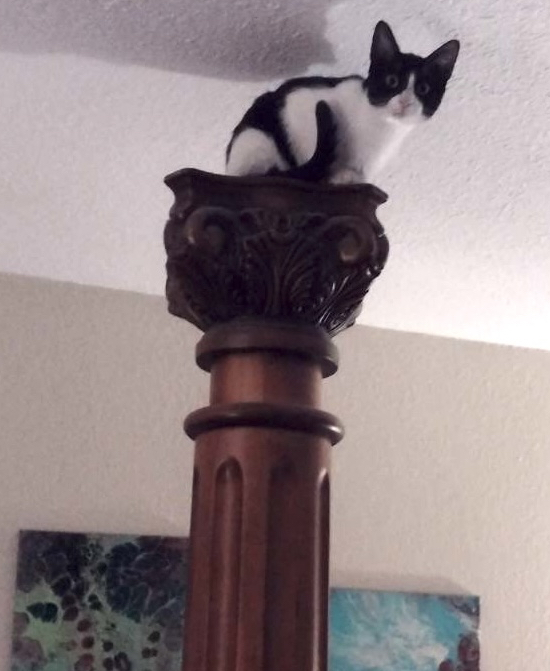
We currently have a tuxedo kitten, and she certainly fits the description well.
Tortoiseshell cats
- supposed to be divas
- and can get cattitude with owners
The only tortoiseshell cat I’m familiar with is Meow Meow. She was a middle-aged cat when we took her in. Hence, I’m not sure if that did or didn’t have anything to do with her attitude or lack thereof. She was a happy and loving cat; she even let us pet her belly.
It makes me sad to think that her original family let her go because they couldn’t handle a little bit of cattitude. Clearly some people aren’t meant to be cat people.
Calico cats
- considered to be divas like torties
- also, said to be more intolerant compared to other cat colors
I don’t know what people are talking about. Itty is a princess; I’ve told her since she began living with us. Of course she’s going to act the part. And I don’t think there’s anything wrong with her attitude. She doesn’t treat me bad or anything. In fact, she loves me. And maybe only me. But I’m fine with that.
What Does Science Say

Due to these stereotypical personalities, science stepped in to find out whether they were true. Because, just like human stereotypes, pet and animal stereotypes are harmful. Since potential owners have weird ideas about them, it prevents black cats from getting adopted. Therefore, how did science figure out if the stereotypes were true or not? Well, by asking cat owners, of course.
One study looked at cat surveys only from Mexico, while 2 others were from the University of California, Berkeley and the University of California, Davis, respectively. Further, the first 2 studies were relatively small samples; less than 211 in each. But the third sample involved almost 1300 surveys.
According to the first study, gray cats had the highest scores for timidity, independence, and intolerance. Orange cats were found to be more trainable, friendly, and calm, whereas tabbies were bolder and more active. Tricolor cats, like calicos, were more stubborn. And bicolor cats, such as tortoiseshell and tuxedo cats, were more tolerant.
Since the second study was reexamined by the University of California, Davis at a later date and by more participants, that’s the one we’ll concentrate on. In that study, the respondents were asked to rate their cats’ level of aggression at home, while being handled, and at the vet.
In those 3 backgrounds, the most aggressive cats were mostly female gray and white, black and white, orange, and calico cats. Also, gray and white cats were most aggressive during vet visits. And black and white cats were most likely to react negatively when handled, whereas calico cats were more likely to become discontented. Moreover, black, white, gray, and tabby cats had the lowest level of aggression.
Is Your Cat’s Personality Based on Coat Color

Remember when I hypothesized above that cat personalities would depend on which person was taking the test for the cat? Everyone in my house thinks my cat Itty is a bit of a prima donna, except me, of course. I readily admit, however, that she detests being handled. And, as such, I respect her boundaries, whereas no one else does. Thus, they feel her wrath on occasion. But I don’t. That doesn’t mean I don’t pet her; I certainly do. Although, as soon as I sense her irritation, I back off, while the rest of my family persists with the petting and picking her up, etc.
Therefore, if I were to take a cat personality test for Itty, she would not fit the standard profile. Though, if anyone else in my house took a cat personality test for her, they would answer based on how she treats them, and how they don’t respect her. And voila, you have a cat coat personality stereotype. I hope that makes sense.
As a result, it’s my opinion that it’s entirely how we view our cats that affects their personality. Consequently, if you know your cats very well, their likes and dislikes, you probably are very familiar with their personalities, regardless of any stereotypes. Kittens act like infants, while cats who’ve been hurt may act like a hurting human.
What do you think? Do you notice any cat coat color stereotypes in your cat or cats? Have you ever heard of these coat color stereotypes before? I hope they don’t discourage you from ever adopting a certain color cat in the future. Thank you for stopping by! Please like, share, and if you don’t already do so, you can follow me now.
https://chickcozy.com/kristinasmith


2 replies on “Different Cat Personalities Based on Color”
Once our tabby barncat (from unknown origins) got used to us, she is very playful and outgoing, so maybe?
LikeLiked by 1 person
I think I was only familiar with the black cat and orange cat stereotypes before my daughter said anything. But I never really put much stock in stuff like that. She thinks cattitude is true for calicos; however, some cats don’t mind being handled while others do.
LikeLiked by 1 person