
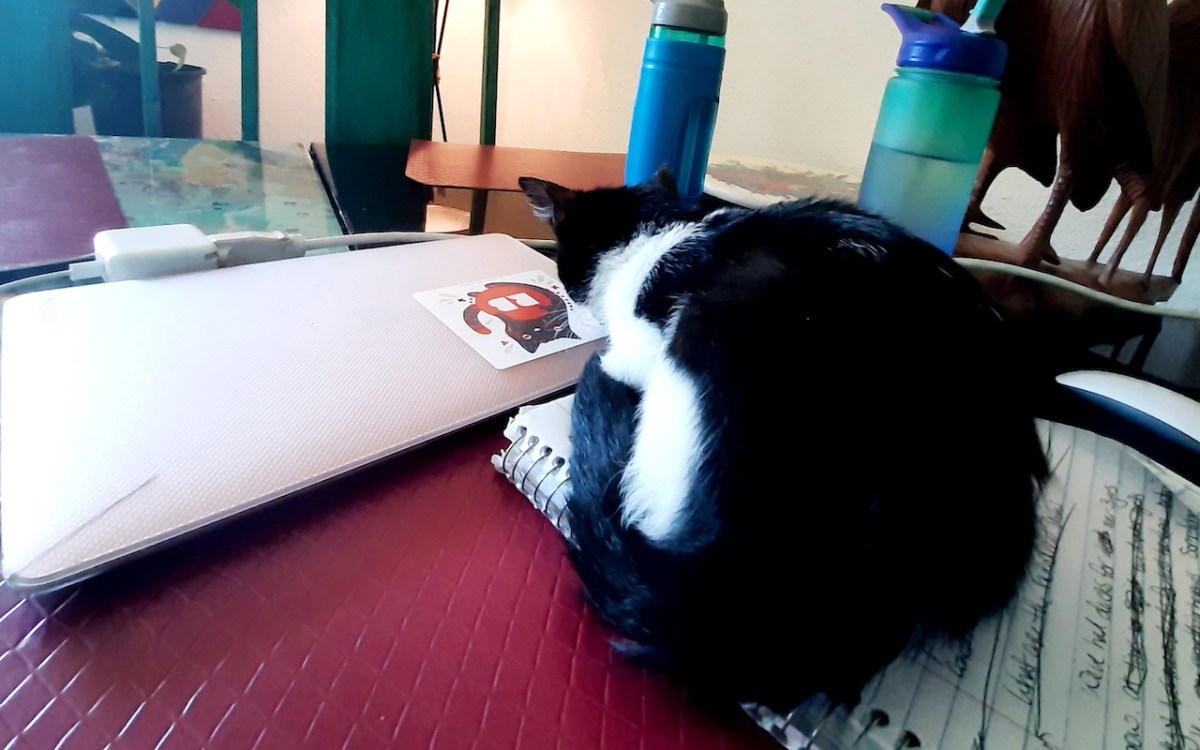
When people consider animal intelligence, they probably imagine a dog, a chimpanzee, or a dolphin, but not usually cats. Cats are typically portrayed as uninterested, lazy, and snobby creatures. In medieval times they were even depicted as being associated with the devil. However they weren’t necessarily considered pea-brained. Though, who really knows, right? On the other hand, for fellow cat parents, you know something different. Your cat isn’t a dog, a chimp, or a dolphin, and certainly not demonic. Even if your cat is cunning, they’re still smart in your book. Join me as I attempt to answer the question, “How smart are domestic cats?”
Let’s look at the question for a minute. Who or what are we weighing cats against? Dogs? Humans? Stray cats or wild cats? It would be great to say definitively that domestic cats are smarter than dogs. Regardless, it’s just not that simple. Cats haven’t been studied as extensively as certain other species. At first, scientists spent all their time researching mice, rats, and pigeons. But then in the 1990s, dog cognition started to be studied. Some scientists attempted to study cats at the same time, though without much success. So it wasn’t until the past decade that any significant headway into feline research came about.
How Intelligence is Measured

Before we can answer how smart cats are, it’s important to understand how intelligence is measured. Equally as relevant is how one defines cat intelligence. You’ll likely find different definitions. But basically they all amount to the same thing: Cat intelligence is a series of events that guide behavior, such as sensing, perceiving, recalling, and reasoning. Moreover, human intelligence can be measured by IQ tests, such as the Wechsler Adult Intelligence Scale, whereas most animal cognition tests involve
- gauging an animal’s problem solving potential
An animal’s problem solving ability would be whether they can work with groups, use tools, etc.
- measuring the size of an animal’s brain and complexity
Encephalization quotient (EQ) predicts cognition via comparing one animal’s brain to an animal of similar size.
- evaluating the animal’s sense of self awareness
This type of test is called a mirror test. For instance, a spot or mark, like a red dot, is placed on the animal’s forehead. If the animal recognizes its own reflection, by touching its face, then the animal passes the test.
- studying an animal’s self control and capability to act on new info
The self control or pointing test instructs an animal to anticipate food in a specific place. Then the location changes and the human points to a new spot. Domestic animals, like dogs, excel at these tests. And human babies pass these tests around age 1 year.
- and assessing memory
Usually memory tests include novel object recognition and a maze of some sort.
When writing this post, it became obvious that analyzing animal intelligence is ongoing and not simple to answer. As a result of being measured by human standards, those very studies are questioned by some people.
Comparing Cats to Humans

Believe it or not, cats have similarities to humans. If you’re a cat parent, you already sense this. And I’m not talking about character traits here. But seriously, humans and cats share 90% of the same DNA. With that in mind, the human brain contains ~86 billion neurons while a cat’s brain has ~ 1.2 billion. Also, the surface area of a cat’s cerebral cortex is 83 cm2️⃣ compared to 2400 cm2️⃣ in humans. And their cerebral cortices contain ~250 million nerve cells in contrast to our 16 billion. Since cats are smaller, it makes sense, right, because their brains are smaller than ours? However, intelligence isn’t all about brain size. In reality, it’s about number, size, and complexity of nerve cells.
Not only are cats 90% genetically similar to us, their smaller brains are also nearly 90% identical to our own. A cat’s brain has a cerebrum, cerebellum, brainstem, 2 cerebral cortices, and surface folding, just like ours. Moreover, like a human brain, a cat’s is divided into areas. And each has a unique job to carry out. Plus, like ours, a cat’s brain is created to have good memory, both short-term and long-term. Though, a cat’s brain takes up only ~ 0.9% of their body mass in comparison to ~ 2% in the average human.
Traits of a Socially Smart Domestic Cat

Recently social intelligence has been the most common subgroup to be studied. Additionally, there are some basic features socially smart cats possess, including
This detail of feline cognition reveals that a cat can recognize that just because an object disappears out of sight it continues to exist.
Simply put, associative learning for animals is the process by which an animal connects (or associates) stimuli with certain behavior. For example, my cat, Itty, knows that if she scratches my mattress (the stimulus) every night, I’ll wake up to feed her (the behavior). She memorized her particular action produced my reaction of rewards. (And now I’m stuck waking up in the middle of the night each night.)
- social referencing
Social referencing tests whether a cat will pick up on their owner’s emotional cues regarding certain things. Not long ago I wrote a post on Itty being stressed. However, now I believe she was reflecting what I was feeling about my new work schedule. Moreover, I think I contributed to her anxiety with Pickles, our new cat. And she doesn’t like being around certain people based on how I think she feels around them.
- secure attachment style
Cats, like dogs and humans, have attachment styles. While humans have 4 attachment styles, cats only have 2, and dogs 3. Additionally, a cat will have either a secure or insecure attachment style. And a secure attachment style is associated with emotional intelligence. Plus, research has found that cats are more securely attached to their people than not.
- staying responsive to human cues
These type of tests can involve pointing, following an owner’s gaze, and responding to their owner’s voice as well.
- and finally, cats can be trained
There are many examples of people who’ve trained their cats. Every cat has their own personality. While one may be a piece of cake to train, another might not be as easy.
Should We Compare Cat IQ
When studying for this post, several websites claimed that many animal behaviorists thought cats had the same intelligence as a 2 year old human child. However, every single website failed to mention which study or animal behaviorist did the research substantiating those claims. On the contrary, the few verifiable sites and scientists who’ve actually studied cats never mentioned human ages. And very few compared cat intelligence to any other animal. In addition, it’s important not to compare a cat’s intelligence to that of really any other species, given that a cat is still a cat, rather than a dog, a human, or any other animal. Cats excel at hunting while dogs work great with groups. We all have our different strengths, what we were essentially built for. Thus, when evaluating a domestic cat’s intelligence, it should only be analyzed against another domestic cat.
At our house we have 3 different domestic cats: a 4 month old tuxedo kitten, an adult calico cat, and an adult Russian Blue cat. And they all have distinct levels of brainpower and energy. However, the cats with more energy appear smarter, at first glance, than the one with less energy. If we go by some of the tests found on the internet, the less energetic cat would hardly pass any of them. Though I’m hesitant to say the more relaxed cat is deficient in the brains category. She just might not care enough about that particular thing at any given moment. Or perhaps she’s not sufficiently motivated to give a crap.
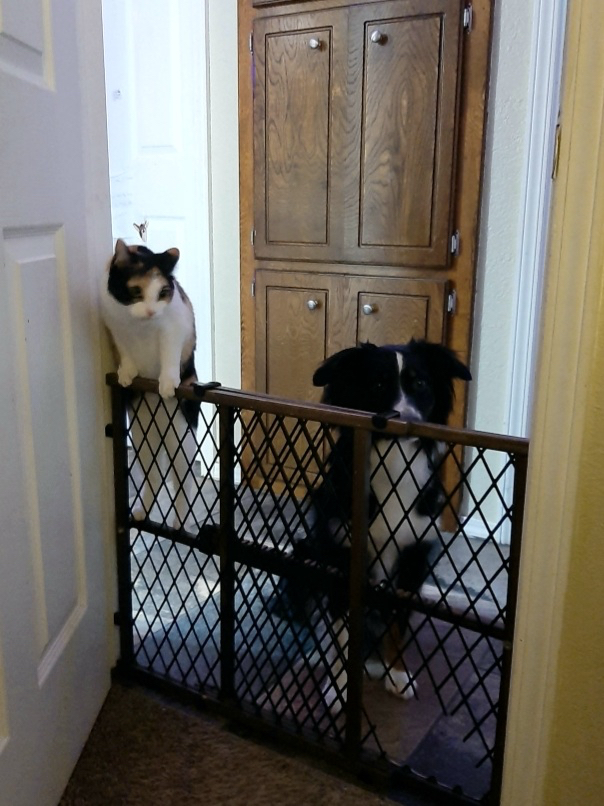
Then take Sophie, our Aussie, who not only is known for her mega energy needs, but is also highly intelligent. Not every family or person out there is like us, I’m aware. Most people are in the great divide: dog people or cat people. Instead we have the benefit of observing several species of animals on our property. And I can tell you that both Sophie and Itty have my morning routine down to a T. While one of them is up my butt, barking to hurry me, the other one is quietly watching and anxiously waiting to see when I’ll be ready to take them outside. Both of them know just before I take them out, I put my shoes on, make my tea, and then I put my sunglasses on. Even though Itty and Sophie are completely different creatures, they share the same expectant look in their eyes.
How Smart are Domestic Cats: Through the Eyes of History

If you Google how smart are domestic cats, your browser will inevitably display a contrast between dog and cat intelligence. Plus, ways dogs have joined humans in the workforce throughout history are usually listed as well. Conversely, the same cannot be said for felines. Alternatively, you just need to go about your search in a different manner. Despite people in the Middle Ages having both bad and very wrong associations about cats, the rest of history casts a favorable light on these cute furballs. Besides being excellent mousers, other jobs cats have held include
- pest control for snakes, rats, mice, etc, and companions in Egypt thousands of years ago. And when cats died, their owners mummified their cats and dressed them in jewels to signify the owners’ status.
- mascots and companions to Roman soldiers in 5th century BCE.
- custodians of precious books and manuscripts in Buddhist temples starting around the mid 6th century CE. Then cats began to symbolize good luck and fortune dating back to the 17th century with the creation of Maneki-neko, “beckoning cat”.
- war heroes, such as Crimean Tom during the Crimean War (1854). Plus, 500,000 cats were deployed during WWI (1914-1918). Also, Simon throughout the Chinese Civil War (1949).
- and lastly therapists. Actually, it’s cat therapy, like pet therapy. So, whether for first responders, soldiers overseas, or patients, cats have proven to comfort those in need.
But How to Test Cat Smarts

If you have one or more cats, and you’re interested in assessing their brainpower, there are some simple tests you can try. However, you may have observed some giftedness in your pets before now. Some of the studies that Vitale and others have done with cats, I’ve observed with Itty. I’ve already mentioned Itty taking cues from my emotions (social referencing), memory, associative learning, pointing and following my gaze. But Itty also has distinct meows for different things she wants. And she makes sure I follow her to help her out with whatever she needs, like going outside or getting past the dog unmolested, which, to me, indicates problem solving. Although, I had no idea any of those things categorically had to do with smarts until researching cat intelligence.
I won’t include any cat intelligence tests on this post, because I feel there are too many factors involved. And the intelligence tests that I’ve seen aren’t really able to capture how intelligent one cat is. For instance, anything that has to do with toys, Itty isn’t interested in. Ever since she was spayed, her energy levels plummeted. So playtime isn’t her thing anymore. Also, she looks like she can’t imagine the toy being prey. She’ll look from the toy to the string up to the wand to my arm and hand. But, if we go outside, she’s a different cat. She’ll chase birds and bugs to her heart’s content. However I will post a link to a test. Don’t worry if your cat doesn’t do so well, especially if you’ve observed your cat being super brainy. Just remember, cats are really quite smart. It’s just tough to test them.
How Smart are Domestic Cats

The intelligence of domestic cats has been compared to dogs and human children countless times. But since intelligence for each species is unique, it isn’t something that really should be compared cross-species. Every species excels at something peculiar to them. Also, cats haven’t been studied as much, because they haven’t been bred for as long as dogs. That means they’ve retained their wild nature. Moreover, there are tests you can use to measure your pet’s intelligence. Though, observing their behavior is much easier, if you have the time. But no matter how their intelligence rates, remember to love your pets.
Do you have a super smart cat? How do you know they’re brainy? I’d love to hear your stories. Thank you for stopping by! Please like, share, and if you don’t already follow, please do so now.

 Chicken Girl
One reply on “How Smart are Domestic Cats”
[…] a previous post, I mentioned that a cat’s brain is 90% genetically similar to our brains. And according to […]
LikeLike