

I use affiliate links to support my content at no extra cost to you.
Watching cats be themselves can be relaxing, comical, and educational for pet parents. And though cats don’t appear as expressive as dogs, since their facial features don’t change much, in truth they really are. You just have to know what to look for. As with dogs, you can learn a lot about what’s going on with a cat just by observing their tail. Therefore, today we’ll look at why cats have a tail.
Reasons Why Cats Have a Tail

Yes, you probably realized already that one of the reasons cats have tails is for communication. One tail movement does not satisfy for all communication or for all cats. Thus, cats communicate with each other and us about how they feel.
But that isn’t the sole reason or even the main reason cats have tails. Tails act as a counterbalance for landing. And for cats, tails increase their agility. Plus, their tails help them jump, climb, and hunt.
Cats also use their tails as a sign for affection or irritation. Though, I suppose that would be a form of communication as well. When cats are feeling affectionate, they wrap their tails around their humans or other pets. But if they’re irritated, sometimes they use their tails to swat at their humans or other pets.
What about cats without tails? Or short-tailed cats?
Different Lengths of Tails
The length of a typical domestic cat tail is about 12 inches long. However, there are some cat breeds that are rumpy, stubby or stumpy. And those words are somewhat similar. While stubby and stumpy mean a cat with a stub for a tail, rumpy means tail-less.
Cats with the Shortest Tails

The Manx cat has a short tail. But it can be tailless as well. Moreover, all breeds of bob tails have the shortest tails. On the other hand, the cat with the longest tail is a Maine Coon from Michigan. Having a long tail doesn’t seem to cause cats any issues. Though having short or no tails can cause health problems. However, the cats don’t seem to have issues with their balance.
So, What is Your Cat’s Tail Saying
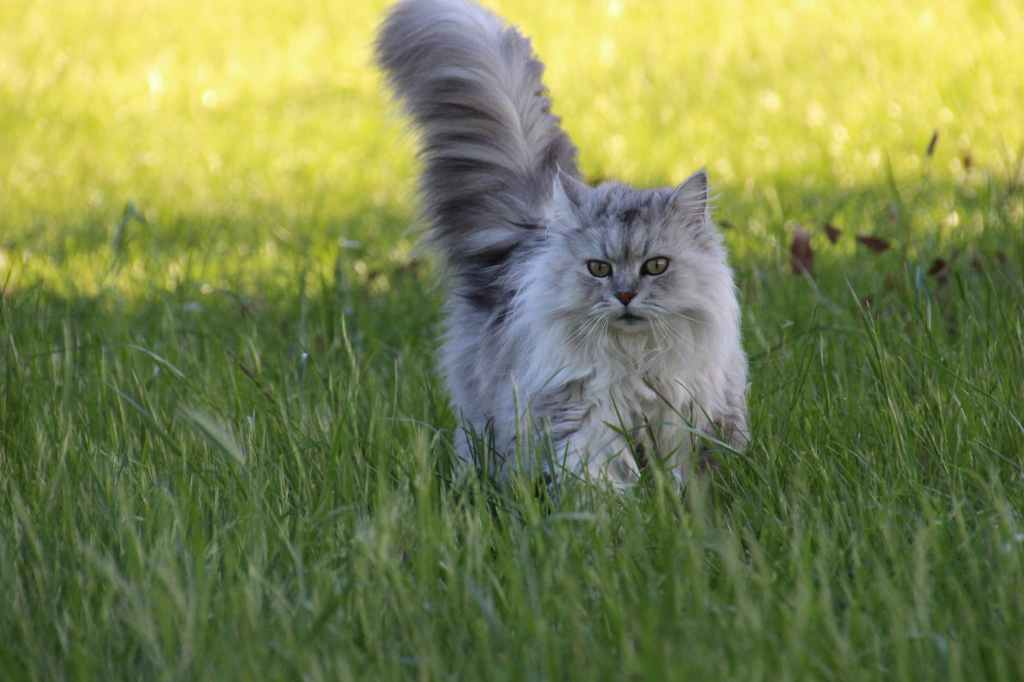
- Straight up tail means your cat is happy and confident
- Straight up with a hook like a question mark means they’re in a playful mood
- Down indicates your cat is anxious
- Bristling tail indicates anger
- Tail between their legs means they’re submissive
- Flicking tail indicates they’re feeling territorial
- Tail curled around their own body could mean they’re either content or they’re stressed
Why Do Big Cats Have Tails

But what about lions, tigers, and the rest? Why do they have tails? Well, unsurprisingly, lions, tigers, and leopards, all have tails for the same reasons as domestic cats: balance and communication.
Conversely, cheetahs and cougars mainly use their tails for balance. I could only find one site that stated cheetahs might use their tails to communicate as well. And then cougars are solitary cats. So, I’m not sure if that means no one really knows or what.
In Summary

Big cats and domestic cats have tails primarily for balance and agility. However, they also use their tails to communicate. But, for domestic cats at least, tails have a wide range of communication. Moreover, even though most cats have a typical 12 inch length tail, there are also tailless, stumpy, and long-tailed cats.
By the descriptions of tail communication above, what does your cat’s tail say about them? Or about what they’re communicating? All of our cats are mostly confident most of the time. However, when we go outside and Itty and Pickles play with each other, they can get bushy tails. But they’re still definitely playing with each other. And sometimes Itty will have her tail down, flicking while walking around and hunting bugs.
Thank you for stopping by! Please share, and if you don’t already follow me, please do so now!
https://chickcozy.com/kristinasmith Chicken Girl