
I use affiliate links to support my content at no extra cost to you.
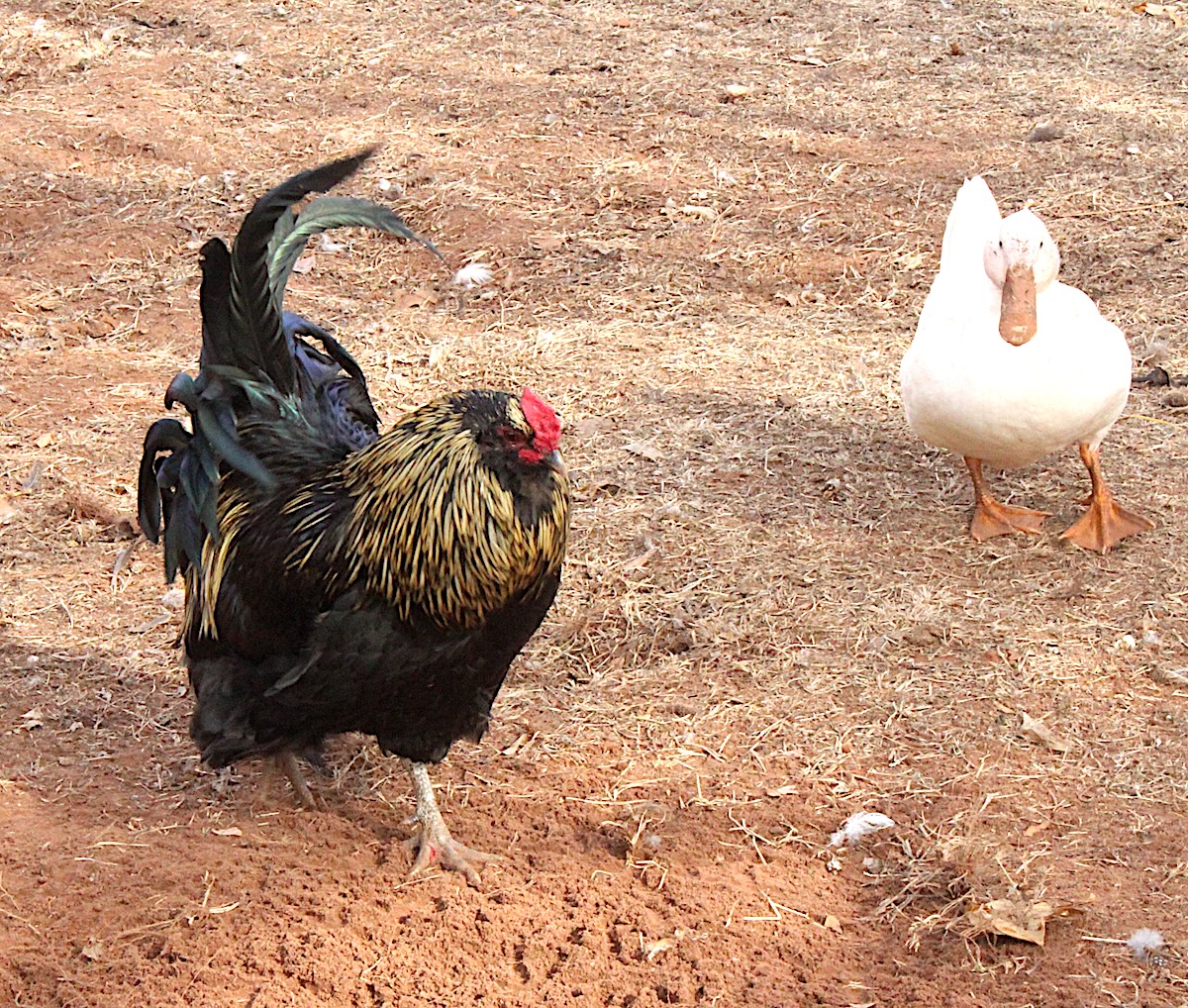
Raising different farm birds in your backyard makes for some funny stories. And keeping roosters and drakes adds even more amusement. Since we’re approaching duck mating season, you might wonder if a duck and chicken can breed. A simple definition for the verb breed is to produce offspring or young, while mating is basically sex. While my own mixed flock mates, or at least tries to mate on occasion, they have not produced any offspring. So the chances of ducks and chickens actually reproducing a hybrid are slim. Even though inter-species mating certainly happens, it isn’t the norm. Thus, certain conditions must be met for it to occur.
Some cites claim chickens and ducks can’t mate. Likely because they’ve never witnessed it or the circumstances weren’t right for it to develop. Nevertheless, I’ve seen chickens and ducks mating. I’ve even seen chickens mating guineas, and guineas mating ducks, and all kinds of backyard shenanigans. Although, it’s not something you should want. Due to completely different sexual anatomies, one species could get injured or even killed during mating. Therefore, continue reading to find out what properties create the perfect opportunity for inter-species mating. Plus, I’ll explain how to prevent it.
Chicken-Duck Hybrids: Fact or Fiction
First, let’s look at whether ducks and chickens can in fact breed. There have been many chicken-duck hybrid stories for the past decade or so, though I couldn’t find any that were DNA confirmed. Some stories also mentioned separate characteristics of each species, trying to prove it was a chuck or a ducken. But later the person making the claim learned it was a duck species they didn’t know about. Or it had a deformity. Both female ducks and female chickens can hold the sperm of multiple lovers, aka drakes or roosters. It’s in those scenarios when sperm from 2 different males wind up fertilizing a single egg that sometimes result in a chick or duckling having a deformity; consequently, looking like a hybrid. In addition, some of the photos I saw looked like juvenile ducks that were molting.
Why Ducks and Chickens Shouldn’t Mate

Even though both ducks and chickens reproduce through internal fertilization, they still have distinct reproductive anatomies. For instance, roosters don’t have outward sex organs, unlike drakes. Rather, hens and roos have cloacas that, once the roo mounts the hen, touch in what is commonly known as the ‘cloacal kiss.’ This lets his sperm enter her reproductive system, and it doesn’t travel far to get to the sperm storage tubules (SSTs). Plus, it happens within minutes of copulating. And once released from the SSTs, the sperm hurries further into the hen’s reproductive organs, primarily the left oviduct. Finally, after entering the oviduct, the sperm waits for the next egg to be released. Then, the moment the egg is released during ovulation, both sperm and egg join to be fertilized.
On the other hand, ducks typically mate in the water. Although, they can also mate on land. Moreover, it’s estimated that as many as 40% of Mallard duck mating encounters alone are forced. Aggression is an understatement for drakes when we’re talking multiples. Whether one or many, drakes can rape a female duck to death. A final distinction between duck and chicken reproductive anatomy is that drakes have corkscrew phalluses; some as long as 18 cm or longer. And female duck vaginas are anti-corkscrew with spirals and blocked pockets. They developed this way to prevent unwanted fertilization due to rape. Drakes might force a female duck to copulate, but she has the last say.
Roosters mating with female ducks most likely will not end in injury. However, it’s a different story if a drake tries mating with a female chicken. Aside from an aggressive sex drive and a long mating season, drakes are also much bigger than female chickens. And since female chickens aren’t designed to be penetrated, drake phalluses can cause internal damage to a chicken. Or if the drake decides to mate in water, the chicken will drown. As a result, always discourage drakes from mating any female chickens you have.
Why a Duck and Chicken Can’t Breed

While there are several definitions for the words ‘breed‘ and ‘mate‘, sometimes they’re used interchangeably as well. Although, for this article, I didn’t do that. Now that I explained that ducks and chickens could copulate, what about breeding? Can they reproduce even if there aren’t any confirmed hybrids? Both ducks and chickens have cloacas. Hence, it’s hypothetically possible, because female ducks decide, just like female chickens, whether they’re going to cooperate with the males. For example, if my rooster, Megatron, decided to mount my Pekin, Bakugo, it might make her day. She seems to like him at least. Yet, she also might or might not go for it. Recall that female ducks have a convoluted vagina due to forced mating. Therefore, would it even work? On the other hand, a drake mating a female chicken would just tear her up. It’s not worth it to try finding out, or letting it happen.
Why Ducks and Chickens Try to Mate
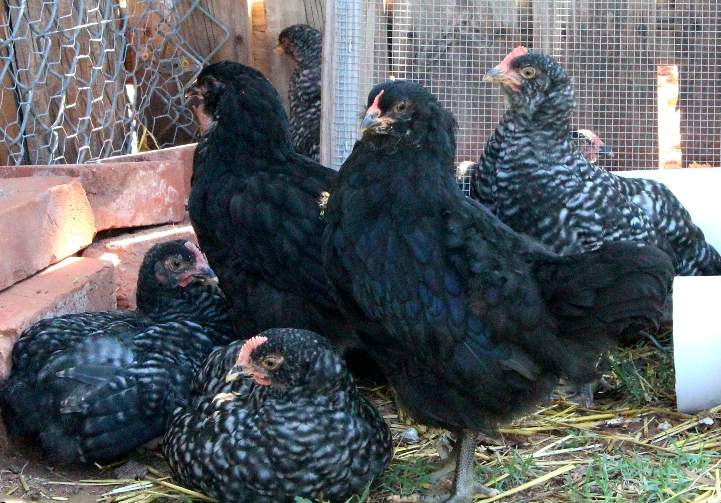
Now it’s time to find out what causes chickens to want to mate with ducks in the first place, and vice versa. These are from my own observations only. Whether you have guineas mating with chickens or roosters mating with ducks, the following are always issues with inter-species mating, such as
- overall space
Not only will overcrowding cause males to breed voraciously, but it can cause inter-species mating. If you have multiple bird species with new hatchlings on limited space, be prepared for inter-species matings and aggression. Moreover, sometimes you might think one of your males is mating, when in fact he’s actually being domineering, or putting another bird in line. Our second-in-command roo, Ravage, did this with our oldest drake a few times before getting his spurs. We had almost 10 roosters we needed to cull last summer, but it was too early to do the job. So, he was showing the drake who was boss of the backyard. Whereas chickens need ~ 3 to 4 square feet each in the coop, they need 10 sq feet each in the run. And ducks need even more space.
- and female to male ratios within the species
Both too many males and not enough females within a species will cause the males to look elsewhere for possible mates. Again, expect to have issues with inter-species mating when having different bird species in your backyard, and later increasing your flock, especially if you end up with more males. We have guineas, ducks, and chickens. Our drakes tried mating with the guineas, while our roos tried mating with the ducks. Thankfully no drakes tried mating with the hens. On the other hand, we had too many boys in all 3 species, so none of the females got injured. Regardless, a good ratio for chickens is 10 to 12 hens per roo, while drakes need at least 4 female ducks each.
Mating Behaviors of Chickens and Ducks
Chicken Mating Behavior
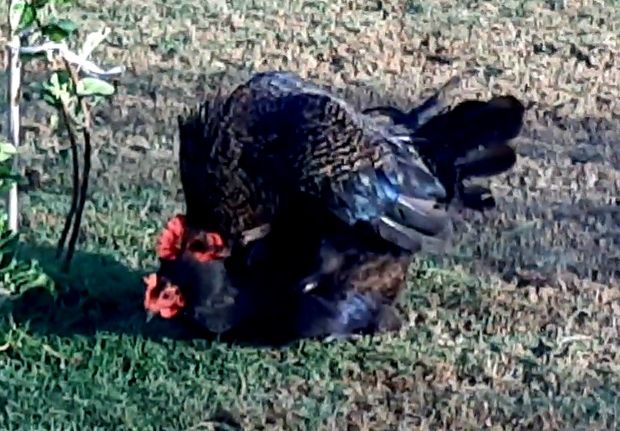
- Once roosters are sexually mature, they’re ready to mate all the time. And depending on the breed, they don’t slow down for years, especially if you add competition.
- Plus, roos woo their potential mate by doing a little dance and spreading their wing feathers downward.
- And if the hen is willing, she lowers herself down so he can mount her. He stands on her while grasping her neck feathers with his beak.
- But, even if she isn’t willing, it doesn’t mean the rooster will let her go. He just might chase her down and take her anyway. It makes for an interesting show, because usually he doesn’t succeed.
Duck Mating Behavior
- Conversely, both male and female ducks bob their heads, as if they were flirting with each other. (And don’t forget Bakugo who always bobs her head at Megatron, my rooster). But in the water it’s signaling more than flirting.
- So, a willing female partner will elongate her neck and flatten her back in preparation for her male partner. Sometimes it can be another female partner as well. (It happens).
- Then the drake will stand on the female before grabbing the back of her neck and doing his business.
- After copulating the male makes a grunt-whistle, which he does above water. And when our drakes are finished having sex, they vacate the sex pool to go clean themselves in a separate pool.
Keeping Ducks and Chickens Together

At this point you may be wondering if you should even try raising ducks and chickens together. But don’t worry. Keeping chickens and ducks is definitely possible. And it isn’t difficult. There are just some pointers about both you need to keep in mind, such as
- have a body of water for your ducks to access. Not only do they need this for mating activities, but they need it to keep their feathers water-proof.
- If your chickens get near this source of water, they will likely drink from it. That’s ok too. Just clean it out a couple of times a day, providing fresh, clean water.
- While your chickens won’t get in the water, chicks might flit around and fall in. So be careful with any chicks you have or might get.
- Whereas chickens roost at night, ducks sleep on the floor. And be sure to have enough space for all the birds.
- Both ducks and chickens can eat the same food.
- Some chicken breeds and duck breeds aren’t as aggressive as others. Therefore, if you have the perfect ratios and space, aggression in drakes and roosters is probably more breed specific. For instance, we have Pekin and hybrid Mallard drakes and Ameraucana roosters, and none of them have come to blows. Except when we had too many males.
So, Can a Duck and Chicken Breed
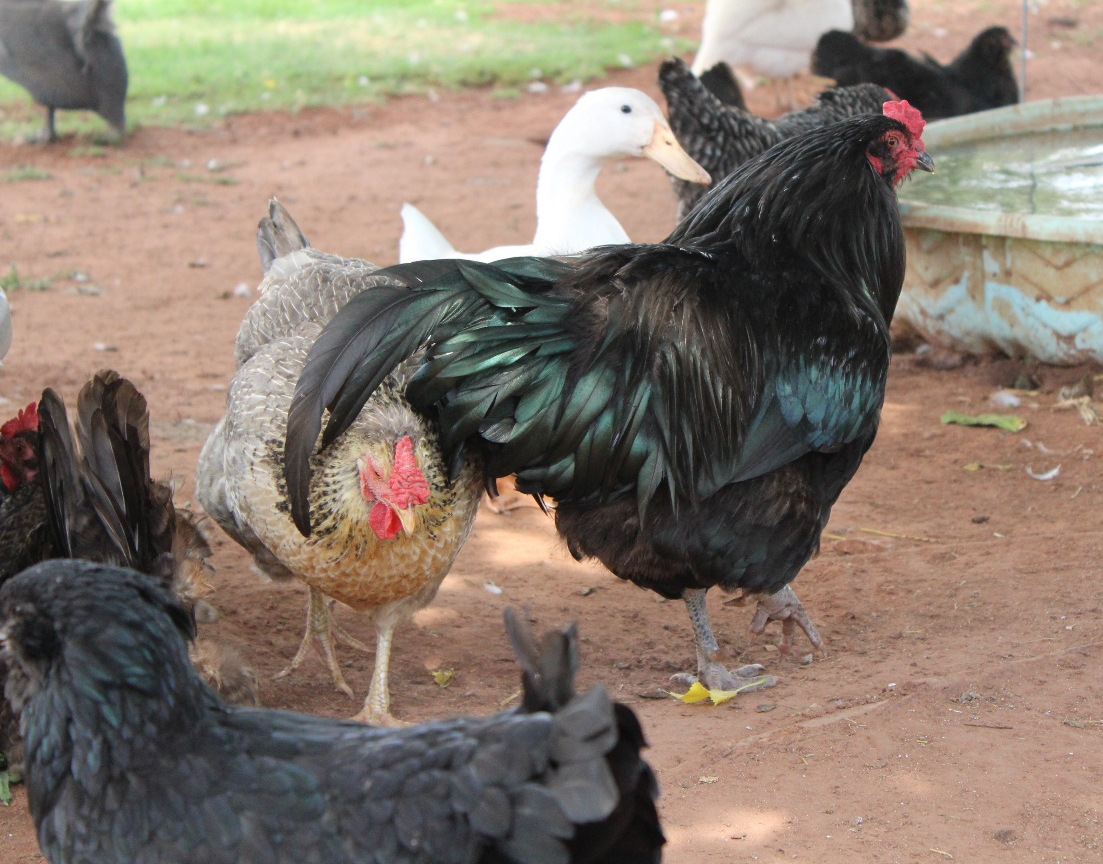
Despite the fact that a duck and chicken can mate, it’s not something that should be allowed. Granted, if a rooster mates with a duck, she’ll be ok. But, if a drake mates with a chicken, it could be deadly. Additionally, the main reasons ducks and chickens try to mate is due to overcrowding and too many males. Alternatively, because producing offspring hasn’t successfully occurred, it’s safe to assume ducks and chickens can’t breed.
We had to cull 4 roosters a few weeks ago, and the 2 extra drakes last weekend. And I have no idea how many male guineas we have. But so far, they haven’t bothered any females, other than their own kind. If you keep males with your birds and incubate eggs or have broody hens, you might find yourself in similar situations: too many males at times. It doesn’t always happen, but it frequently does. Usually I can tell pretty early which will be female and which male. However, we don’t want to cull them too early, because we eat those ones. Thus, we watch the flock dynamics, making sure everyone is getting along. Although in my house, I’ll tell my husband for a few weeks it’s time to cull the boys until he’s finally ready. And typically he’s waiting for the weather. Something about being a hunter, I think. By the time that happens, I get to see a lot of crazy bird behavior before things settle down again.
Do you have ducks and chickens? Have your birds ever tried mating with each other? What caused them to do so? And how did you handle it?
Thanks for stopping by! Please like, share, and if you haven’t already done so, you can follow me now.
https://chickcozy.com/kristinasmith



 Chicken Girl