

Recently my youngest daughter and I started walking mornings. And we typically take the same route each time. But, there are a lot of dogs any way we choose to go. Unfortunately for us, none of the dogs are confined to their yards. In the US, 4.5 million people become victims of dog bites. Of those, half are children. If you live in the city limits, you’re likely in a safer walking environment than where we live. However, if not, do you know how to protect yourself from a dog attack while walking?
City limits require dogs to be on the owner’s property. That’s how it is here in Oklahoma. And I’m sure it’s no different elsewhere. Though, when you get outside city limits, the laws are extremely loose. Or at best, they’re murky. So, when walking, you have to be very cautious. And if you have children with you, be extra vigilant.
First, the Statistics

As I said, there are a ton of dogs just where we live. In fact, a dog we’ve never seen before nearly attacked Sarah on our walk a few days ago. Below you’ll find facts on dog attacks, such as
- ~ 65 million dog owners currently live in the US
- 47.7% of dog owners live in Oklahoma
- 1 out of 5 victims need medical treatment
- 70% of dog bites are from un-neutered or intact male dogs
- 25% of fatal dog bites are from chained dogs
- and US insurance companies paid over $1 billion on dog-related injuries in 2022
Reasons Dogs Attack While You’re Out Walking
The following are the most commonly believed reasons why dogs attack, including
- fear & surprise

Any dog can attack and bite when afraid or surprised. But fear aggression is a behavior that some dogs develop or are predisposed to have. Often it can happen when a dog has experienced trauma, such as abuse, or wasn’t adequately socialized while young.
Also, being surprised has its roots in anxiety, which is linked to fear. In addition, dogs who are startled awake can be bewildered and disoriented. Moreover, this is especially characteristic of older dogs, if eyesight and hearing are failing. So, if you’re out walking and a dog comes out of nowhere, looking like they’re about to attack, your approach might’ve startled them.
- pain & illness
No one likes to be sick or in pain. Not even our canine friends. Plus, being sick and hurt can be very stressful for dogs. Thus, if an ill or injured dog is approached, they’re more likely to attack, because of fear of more pain. This situation is more probable in the home environment, with your own dog. Or it could happen when you visit someone you know.
- possessiveness
This is also called resource guarding. Additionally, it happens when your dog acts aggressively over items they perceive as their own. Food, toys, furniture, your own clothing, and even you are all examples of things dogs guard as their own.
Sophie, our Aussie, has gotten more possessive since having 3 heat cycles. She’s possessive of her food, a hoodie of Paul’s, and most recently, a crate we used while on our trip to South Dakota. When Paul tries to take his hoodie back, she gives all kinds of indications she’ll attack.
- protective
In the wild, dogs live in packs and naturally protect one another. With domestic dogs, the pack might consist of the dog’s owner, other family members, especially helpless family members, and other house pets.
Generally, protective dogs are inherently prone to being protective. Or they’ve been trained to be protective. In addition, they have the socialization to understand an actual threat properly.
- and predatory
Predatory behavior is usually hereditary and not fear based. What is more, it’s commonly related to dogs chasing small animals or other pets like cats or ferrets. For instance, our last dog, Moses, used to chase wild bunnies and birds when we lived in Dallas. However, he never killed anything, and he’d stop chasing when we’d call him. Further, when we moved here, he helped us keep the chickens in their yard.
But, this is why some dogs chase bicyclists, cars, skaters, and even running children as well.
Signs Dogs Will Attack While You’re Out Walking

Now that I’ve covered some statistics and reasons dogs attack, we’ll look at signs to watch for while out walking. Furthermore, quite possibly the first signs to heed will be a running and barking dog. And if you see any of the signs below, be on your guard.
- growling
- snapping
- snarling
- baring teeth
- lunging
- hackles raised
- ears flat against head
- lips compressed together
- yawning
- showing whites of eyes
- pacing
- panting
- tail tucked under
- cowering
- staring at you
- again barking
- and running up to or at you
When I was looking up information to prevent dog attacks, of course everything was the same. Besides that, none of the information seemed proven, like it would actually work if you were about to be attacked by a dog. So, it made me wonder if somebody pulled the ideas out of their hat.
And one of the suggestions meant I could no longer go walking: avoid houses where there are dogs. That’s almost every single house here. Didn’t I tell you practically all of our neighbor’s have dogs, and they’re not confined? Plus, I know that’s the case in similarly rural areas. Therefore, we’ll skip preventative measures, and go straight to the next step.
Protecting Yourself from Dog Attacks While Walking

Again, because a dog attack happens so quickly when you’re out walking. you don’t have the luxury to think about what to look for. Thus, when going out, take the following on your walks:
- a good stout walking stick
- and treats
If you see a dog rushing your way, do the following
- First, stay calm and avoid eye contact with the dog.
It’s been proven that dogs can sense fear and anxiety. And that is more likely to get you attacked if that’s what you’re giving off. Plus, if you’re dealing with an aggressive dog, and you make eye contact, the dog will take your eye contact as a challenge.
- Next, get something between you and the dog, preferably that good stout walking stick.
Most other sites don’t have a preference regarding what you put between you and the dog, just something. However, my partiality to the walking stick is that it has greater reach between you and the dog’s jaws. Thereby, my hopes are that the walking stick will keep any chomping teeth away from you.
But if you’re not going on a walk, except to your car, then by all means, use whatever you have on hand: an umbrella, purse, briefcase, etc.
- Then firmly, command the dog or dogs to go home. Use words like No. Down. Back. Home. etc.
- Don’t yell at it and don’t scream or run away.
Yelling, screaming or running away can get the dog’s arousal further stimulated and escalate the situation. Moreover, if you run away, the dog may very likely see you as prey and try to run you down.
- Now the treats.
Multiple sites and people I know recommend carrying treats for stray dogs while out walking. The idea is to toss any strays some treats, so they don’t find you threatening. Eventually they may find you their personal treat bringer.
Therefore, if the commands don’t work, toss milk bones at the dog’s feet, before they reach you. Thus, you have to act fast. Then move diagonally away from the dog till you are beyond them.
What to do if a Dog Attacks You Anyway

Say you’ve done all of the above, but a dog lunges for you anyway. What do you do then? If the dog lunges at you, be sure to cover your vitals: one knee up to protect your stomach and abdomen. Though, if the dog jumps toward your face, quickly cross your arms over your face and hold them there.
Or you can drop to the ground and curl into a tight fetal position. Also, put your hands behind your neck, with your head down, and your knees up, as close to your face as you can. It’s better to be bitten on the arm than on the face or neck. And be as still as you can until the dog goes away. And don’t pull away if and/or when you get bit. Don’t reach out toward the dog; and don’t stick any fingers out, because you just might lose them.
When the dog leaves, assess your injuries and call for help. Based on the severity of your wounds, either call 911, or immediately go to the ER to get checked out. Not only is rabies a concern with dog bites, but infection is also a serious risk. Next, as soon as you’re able, you need to identify the dog’s owner. Check this site out for more info on what to do in the event a dog bites you.
So, How do You Protect Yourself from a Dog Attack While Walking
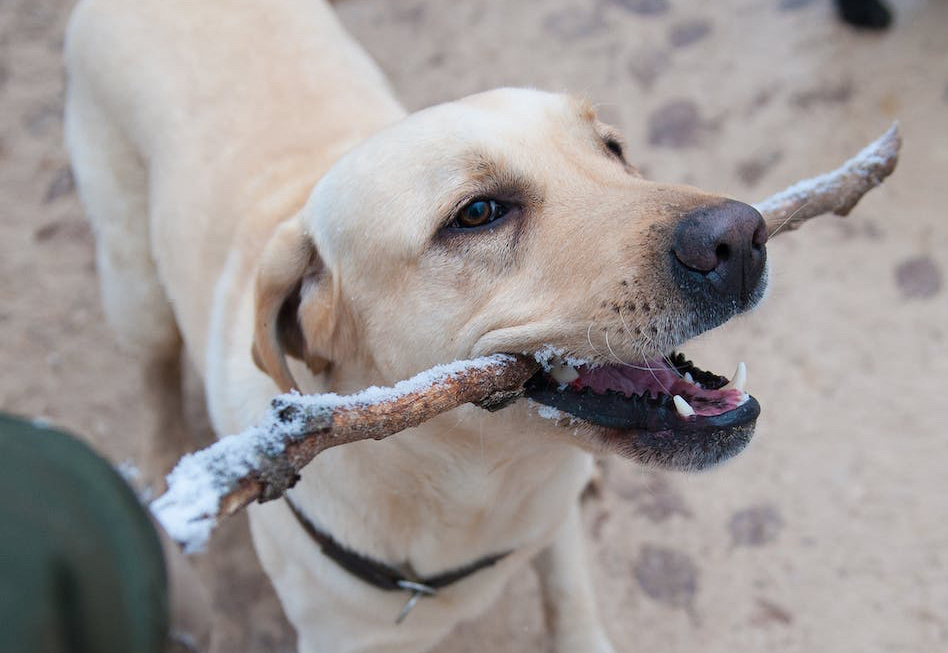
When you’re out walking, don’t forget to bring your trusty walking stick and dog treats. And if you meet an aggressive dog on your walk, be calm, don’t go toward it, and avoid eye contact. Also, put your walking stick between you and the dog. Then if it starts toward you, say, “No, go back,” in your commanding voice. However, if it ignores your commands, toss it a milk bone to distract it. But, if that fails, and the dog attacks anyway, protect your vitals and be still until it leaves.
The dog that almost attacked Sarah was a pug mix. And it came from out of nowhere. Plus, it’s either a new dog the homeowners got or a houseguest. We’ve seen the other dogs there before, because they’ve barked at us many times. But they’ve never attacked. When the dog was on top of us, (our legs) I had the walking stick. Although, it didn’t do much good, since the dog was already at our feet. Regardless, in my commanding voice, I said, “No. Down. Get back.” At which point, the owner came outside and called the dog back.
Most of the dogs that accost us on walks are Maremma sheepdogs. Though, they’re nice. And the only thing I worry about for them is that they’ll get hit by a car. I hope none of you have ever been attacked by a dog. Although, have any of you almost been attacked by dogs while walking? If so, what did you do to protect yourself?
Thank you for taking the time to read this post. I appreciate your comments. Please share, and if you don’t already follow, you can do so now.
Since we’re no longer moving to Dallas, “I’ve finally decided what I wanted to do when I grow up.” I recognized a need based on our own whenever we want to go on vacation, or just need to go out of town. So, if you live in the Oklahoma City Metroplex and have chickens, ducks, and/or farm animals that make it difficult for you to travel, then give me a call. Further, I’ve added the details to my About page for more info, if you’re interested.
 Chicken Girl