
Over a year ago I wrote an article on incubating chicken eggs. And in that post, I explained how to know if an egg is fertilized during incubation. But how do you tell if a chicken egg is fertilized once cracked? And can you tell before the egg is cracked? I’ll answer these questions, and hopefully toss out some tales.
If I had a dollar each time someone asked me if store eggs were fertilized, I’d be rich. The answer is no for many reasons: pasteurization and refrigeration. Also, of course, most store bought eggs come from caged hens, which wouldn’t even have access to roosters. If by some miracle an egg was fertilized, pasteurization and refrigeration would quickly nullify any developing chick.
Eggs don’t have baby chicks in them even if they’re fertilized. Since the conditions are so specific for a chick to develop, a carton of fertilized eggs will never be more than eggs once refrigerated. It is only when the precise conditions for temperature and humidity are met that a chick embryo begins developing.
How do You Tell if a Chicken Egg is Fertilized: 1st Method
Cracking the Egg

So, store bought eggs are NOT fertile. However, if you have a flock with a rooster or multiple roosters, chances are high the eggs are fertilized. Although, sometimes roos can have favorite hens. Therefore, in those cases, some hens might get neglected. We used to have a Rhode Island Red named Jango, and all the boys liked her. She was the lone redhead in a sea of black Ameraucana hens. But now she’s gone. Thus, the young boys are now going after the lighter colored ‘Caunas. In cases where you know the boys play favorites, check for fertility by cracking open some eggs.

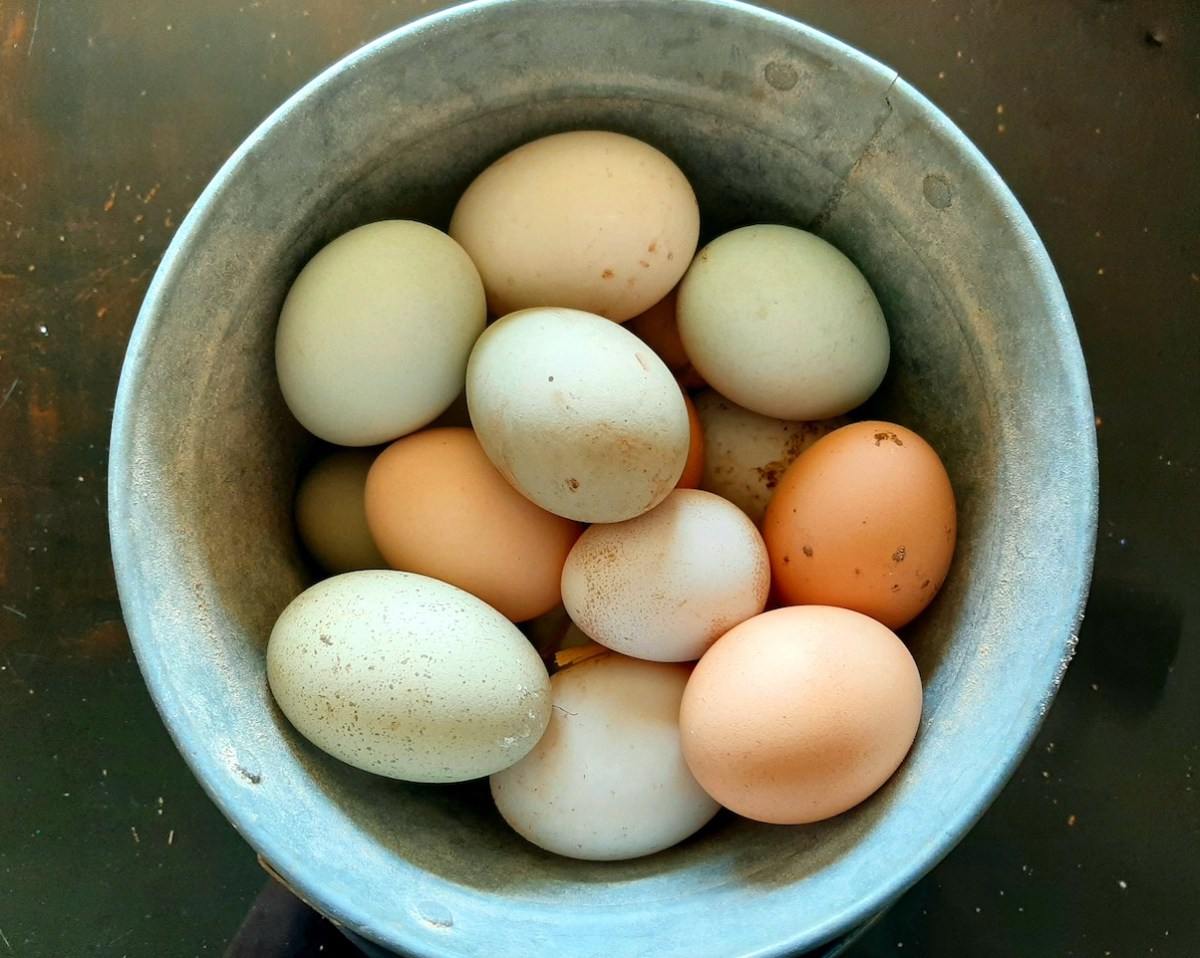
Fertile and non-fertile eggs all look the same on the exterior. Though, on the interior, an unfertilized egg will have a tiny, white dot on the yolk called the germinal disc. If it never gets fertilized, it’s called a blastodisc, while a fertilized one will look like a bull’s eye, called a blastoderm. So, if you crack open some eggs and notice some fertility issues, but want to increase your flock size, you can add another rooster.
Caveats to Adding Another Roo for Fertility

Just because you see evidence of low fertility in your flock doesn’t necessarily mean your rooster is the problem. It is estimated that hens eject ~ 80% of sperm from undesirable roosters. As you’ll recall, this is not unlike what ducks do with drakes. Therefore, getting another roo might help. But it might not. Your hens could very well be finicky creatures. And they might want to stay single the rest of their days. Who knows?
How do You Tell if a Chicken Egg is Fertilized: 2nd Method
Candling Eggs

This method of checking for egg fertilization only works once incubation has already started. Thus, this means, you either have a broody hen with a clutch of eggs under her. Or you have some eggs in an incubator. Though, in order to see anything via candling, it needs to be at least day 4 of incubation. This is the only way to determine fertilization without cracking the egg. Candling will not show you a blastoderm or germinal disc. Consequently, what candling reveals is a developing chick, albeit in a red, spidery blob by day 4. Or it may show you nothing, that indeed the egg is a dud and not fertilized at all. But, if the egg is fertilized, and you see a spidery blob, then, as time goes by, the spidery blob will get more distinct.
You candle an egg by first, having an egg that’s been incubated by a broody hen or incubator for at least 4 days. Next, go to a completely dark room with a very small diameter, but very bright flashlight. Then carefully place the egg over the light. And if it’s fertilized and viable, you’ll see spidery veining from the center of the egg. But, if not, there will be nothing except egg. Although, if you have a blue, green, or dark brown egg, you might not see anything. Those eggshells can be difficult to see through.
Can I Eat Fertilized Eggs

Yes, absolutely, you can eat fertilized eggs. And they are perfectly safe to eat as well, so long as you’ve cooked them properly.
Also, I have had people ask me about blood spots and the white stringy parts of the egg, thinking the eggs were fertilized. But neither indicate fertilization. A red spot is usually just a blood spot, indicating a hen ruptured a blood vessel. And the white stringy stuff are called chalazae. They hold the yolk in place. And the more prominent they are, the fresher the egg. Moreover, both are also entirely safe to eat.
Will the Eggs I Buy Turn into Chicks

The eggs you buy at the store won’t develop into chicks. Even if you purchase eggs from a backyard chicken hobbyist, that isn’t likely, unless you keep your house abnormally warm. However, to allay any concerns, just refrigerate the eggs.
Nevertheless, for a backyard chicken egg to develop into a recognizable chick, or even embryo, would be an extremely rare event. Either you’d have to place the egg under an animal to keep the ideal temperature and humidity. Or you’d need to have an event similar to mine last year. Though, our miracle chick was in the coop with hens for the recommended 3 weeks. And he had 2 broody moms. Even though the dingbats neglected him post-hatch.
Our miracle chick occurred, but we knew there was a fertilized egg in the coop. And we were hoping to get a chick. That he hatched at all was the real miracle based on the mothers he had. If something similar were to happen on your counter, I would question how warm your kitchen was. I would love to find a percentage of how often this sort of thing actually happens, like what happened to us. However, I don’t have that kind of time. Suffice it to say, it’s probably rare. Baby making for any animal is a miracle.
A Note About Living Abroad

This is all good and well when living in the US. Though, if you live in Europe, you might discover something different. There have been a few reports of people trying TikTok trends. And lo and behold, now they have ducks. What about that? I thought you said it wasn’t possible. Well, it isn’t likely here in the US, since factory farms pasteurize the eggs.
But Europe is a different matter entirely. European egg producers don’t wash their eggs, because they want to leave the bloom intact. However, to protect against Salmonella, they directly treat the chickens, whereas US egg producers pasteurize and clean the eggs. Both are treating the same issue, just in different ways. Therefore, for people living in Europe, eggs are not refrigerated. Rather, they are stored at room temperature, like bread. So, it is quite possible for chicks or ducklings to begin developing if the right circumstances are reached. The only stories I have heard about chick or duck development from store eggs originated in Europe, not the US. And the people that the developed birds happened to, wanted and incubated the eggs themselves. Thus, they weren’t some surprising events that occurred when those people decided to eat eggs.
Summary
Now you know grocery store eggs aren’t fertilized, unless you live outside the US. And if you buy farm eggs, it would still take a ton of effort to hatch any chicks. It just wouldn’t happen by chance. I hope this cleared up any misconceptions you might’ve had. Also, in case you want to know how eggs get fertilized, check this out. What was something you always heard about eggs that has been debunked?
As always, thank you for taking the time to read my posts. Please share, and if you don’t already follow, you can do so now.
 Chicken Girl