Categories
All animals Chicks Hens non-fowl Protecting Your Backyard Birds raising happy, healthy chickens Roosters

Bird Flu and Chickens

A couple of weeks ago, I wrote a post on factors, such as bird flu, affecting the cost of eggs. Even as egg prices have decreased slightly where I live, HPAI still abounds. What is it? How is it spread? And are people at risk? These are just some of the questions I’ll answer as we discuss bird flu and chickens.

What is HPAI

person with blue latex gloves on holding Petri dish
Photo by Anna Shvets on Pexels.com

While there are 4 types of influenza viruses (A-D), type A viruses are the main ones identified in causing worldwide flu epidemics. Further, whereas types B, C, and D have been detected in other species, including humans, only type A has been recognized to infect birds. Also, avian influenza, a subtype of type A, is labeled as either high or low pathogenicity in relation to genetic features. Thus, HPAI, or highly pathogenic avian influenza is a severely contagious illness caused by influenza type A virus.

History of Bird Flu

headshot of brown goose on lake water
Photo by Simon Reza on Pexels.com

According to the CDC, bird flu was first documented in 1878 in Northern Italy. Fowl plague, its moniker, was characterized by high mortality. And by 1901, it was concluded that fowl plague was caused by a filterable virus. But it wasn’t until 1955 that fowl plague was revealed to be a type A influenza virus. Moreover, in 1981, the term fowl plague was replaced by highly pathogenic avian influenza (HPAI) at the First International Symposium on Avian Influenza.

Then, in 1996, HPAI H5N1 was first observed in domestic waterfowl in Southern China. Additionally, bird flu was subsequently detected in people in 1997, something previously not thought possible.

More recently, as of 2021-2022, a new H5N1 virus with a wild bird adapted gene popped up. Furthermore, it’s caused the biggest outbreak Europe and the US have seen to date.

How does Bird Flu Spread

black and white digital sketch of a chicken sneezing on another chicken with a sign advising them to stay 6 feet apart if ill
Digital Art, Courtesy of Sarah Smith

Given that avian flu is so infectious, how does it spread? Well, based on the USDA website, bird flu spreads directly from bird to bird. However, it can also spread indirectly by coming into contact with something that’s infected. For instance, suppose someone tracks feces from a contaminated farm back to their own farm, and then their chickens walk and peck the ground where said person tracked contaminated feces, picking up the virus. That’s just one example of how bird flu can spread to birds.

Bird flu has caused over 200 million poultry deaths in a host of countries so far.  Additionally, an unprecedented number of non-poultry birds, including wild birds, have died due to the disease. Plus, because of migration patterns of wild birds, they help the virus circulate. Thus, wild birds, rodents, and people are all possible sources of presenting the disease to domestic birds. But what about other vectors?

What are Vectors

multiple flies hovering around faces of 2 cows
Photo by Maurice Engelen on Pexels.com

vector noun

2 a: an organism (such as an insect) that transmits a pathogen from one organism or source to another

“Vector.” Merriam-Webster.com Dictionary, Merriam-Webster, https://www.merriam-webster.com/dictionary/vector. Accessed 19 Feb. 2023.

Over 2 decades ago my father-in-law was asked to assist veterinarians in Great Britain as they were dealing with foot and mouth disease. While he was there, he remarked on how there were a ton of flies on the dead and diseased cattle. He finally mentioned it to someone in charge, even asking what they were doing about the vectors. Unfortunately his observations were not well received, as he was told to keep his mouth shut.

I found this memory poignant, especially in light of all the affected birds from this latest outbreak of HPAI. What are we doing about other vectors? We’re aware of animal, human, and bird vectors that spread the disease. Though, I could only find a couple of examples online, in the US, that even hinted that flies might be vectors. However, this study done over a decade ago didn’t come right out and say that flies spread bird flu. It advised that the flies carried it in the study, so it was possible. But, more tests would be needed.

Though, in the event you want evidence that flies spread diseases, check this site out. It details HPAI outbreak in Japan during 2003-2004, and was linked to the blow fly, a relative of the common house fly. Also, according to the same study above, flies were listed as mechanical vectors. But what’s the difference between mechanical and biological vectors? And what are wild birds and mammals when they spread avian flu to chickens?

Mechanical and Biological Vectors

close up shot of a mosquito on human skin
Photo by Jimmy Chan on Pexels.com

Mechanical vectors, such as flies, pick up an infectious agent and physically transmit it in a passive way. And a biological vector is one in whose body the pathogen develops and multiplies before passing on to another host. Mosquitos are biological vectors for West Nile virus.

Honestly I couldn’t find what wild birds were, whether biological or mechanical. However, since we’re told that birds spread the disease from bird to bird, it would seem they are also mechanical. Although, we’re told as well that wild aquatic birds are natural reservoirs for the virus. Plus, in the intervening years we don’t see the disease before it resurfaces, and it’s mutated, indicates a biological vector is at work. Interestingly enough, birds are reservoir hosts for West Nile virus.

Wildlife, especially mammals, are reservoirs for an enormous diversity of viruses.

1Faculty of Health Sciences, Curtin University, Perth, Western Australia, Australia
2Burnet Institute, Melbourne, Australia
3CSIRO Australian Animal Health Laboratory, Private Bag 24, Geelong, Victoria 3220, Australia
John S Mackenzie: ua.ude.nitruc@eiznekcaM.J
4Address: 20A Silver Street, Malvern, Vic 3144, Australia.

And according to the CDC, aquatic birds, including shore birds and wild waterfowl like ducks are considered reservoirs, or natural hosts, for bird flu viruses.

Symptoms of H5N1 HPAI in Poultry

dead orange and brown colored chicken on grass

Birds infected with the virus may show one or more of the following:

  • sudden death
  • lack of energy
  • reduction in egg production
  • soft-shelled or misshapen eggs
  • swelling around head, neck, and eyes
  • purple discoloration on head and legs
  • gasping for air (difficulty breathing)
  • nasal discharge, coughing, and sneezing
  • incoordination (stumbling or falling down)
  • twisting of the head or neck
  • and/or diarrhea

What You Can Do

Biosecurity is currently the best policy if you have backyard birds. Read below for recommendations:

person washing hands
Photo by Ron Lach on Pexels.com
  • Disinfect clothes, shoes, egg trays, vehicles, crates, etc.
  • Don’t expose cleaned and disinfected tools and equipment to wild birds.
  • Wash hands and shoes before and after entering chicken yard (area).
  • Buy birds from reputable sources; and isolate for at least 30 days to observe for any signs of illness before mixing with the rest of your flock.
  • Restrict visitors on and off of your property, especially from having contact with your flock.
  • Don’t visit other poultry farms, and avoid visitors that have poultry.
  • Keep wild birds and rodents out of the coop and poultry areas.
  • Don’t let your birds have contact with migratory waterfowl or other wild birds.
  • Secure feed and water to guard against contamination.
  • And have a written biosecurity plan.
  • Finally, if you’re working around sick birds, wear PPE; and visit the CDC site for more info.

In the past, simply culling birds and the heat from summer seemed to keep the virus in check. However, with this latest outbreak, it hung around. And now, some countries are even considering poultry vaccines for H5N1. It’s a measure of desperation. Costs and the need to have a vaccine for all of the strains are just a couple of reasons vaccines haven’t been used before.

Are People at Risk

a person holding pen and paper with graphs
Photo by Karolina Grabowska on Pexels.com

Poultry and wild birds aren’t the only animals being affected by avian flu since 2021. Thus far, several mammals in both Europe and the US have been infected by H5N1. Red fox, opossum, raccoons, a coyote, striped skunks, harbor and grey seals, a bottlenose dolphin, a fisher, 3 types of bears, a mountain lion, a bobcat, an Amur tiger and an Amur leopard all have been found positive for the H5N1 virus in the US.

Likewise, seals in Scotland, sea lions in Peru, and lastly, mink in Spain have also been identified with the virus. Given that mink seemed to pass the virus between themselves gave virologists concern. Furthermore, past studies have revealed mink to be vulnerable to avian and human influenza A viruses.

The high seroprevalence of combined avian and human influenza viruses suggests a strong likelihood of co-infections and thus farmed mink could serve as “mixing vessels”…. 

aKey Laboratory of Animal Epidemiology and Zoonosis, Ministry of Agriculture, College of Veterinary Medicine, China Agricultural University, Beijing, People’s Republic of China
bDepartment of Biostatistics, University of Michigan, Ann Arbor, Michigan, USA
cChinese Academy of Sciences (CAS) Key Laboratory of Pathogenic Microbiology and Immunology, Center for Influenza Research and Early-Warning (CASCIRE), Institute of Microbiology, Beijing, People’s Republic of China
dSchool of Public Health (Shenzhen), Sun Yat-sen University, Guangdong, People’s Republic of China
eSchool of Veterinary Medicine and Science, University of Nottingham, Nottingham, UK
CONTACT Jinhua Liu nc.ude.uac@hjl
*Honglei Sun and Fangtao Li contributed equally to this work.

Nevertheless, the CDC advised that humans lack the type of cell receptor in the upper respiratory tract that H5N1 viruses use to cause the disease. Plus, according to WHO, this current strain of H5N1 has caused less than 10 infections worldwide. And only 1 was in the US. In addition, it mainly affects those who have close contact with sick birds. Moreover, there have been no known human-to-human transmissions of the H5N1 virus that’s presently spreading globally among birds.

In Summary

green rotary telephone
Photo by u5e7bu5f71u591au5a92u4f53 3D on Pexels.com

Bird flu has been around a long time. And each time it returns, it’s changed a little bit more. Further, there are a number of ways bird flu can spread to poultry. Additionally, even though it’s been identified in some mammals, the threat to humans is still considered low.

However, if you see any of the symptoms listed above in your birds, you are encouraged to contact your agricultural extension office/agent, local veterinarian, local animal health diagnostic laboratory, or the State veterinarian; or call USDA toll free at 1-866-536-7593.

Thank you for taking the time to read this. Please comment, share, and follow.

Categories
Protecting Your Backyard Birds raising happy, healthy chickens

Most Common Chicken Diseases

If you have a backyard flock, you might be one of the lucky ones whose birds haven’t experienced any chicken illnesses. Yet. I say yet, because just like people, chickens can and do get ill. In this post I’ll cover the most common chicken diseases. And I’ll go over preventative measures, and if contracted, how to treat the bird.

The Chicken Disease Fowl Pox

The first chicken illness is Fowl Pox. And it’s usually transmitted by biting mosquitoes or new birds who are carriers of the disease. There are also 2 forms of this disease: Wet pox and dry pox. Wet pox is deadlier than dry pox, because wet pox causes throat and respiratory spots that may develop into large growths. These growths may make it difficult to eat, drink, and breathe. With dry pox, there are white spots on the combs, feet, and waddles. It can look like your bird has been pecked mercilessly. At first, you might just think that’s what it is; that your birds were pecked. However, if you have more than a couple of birds like that, and their egg production is down, you just might have birds with fowl pox.

It was a couple of years ago that one of our Black Sex-Link hens died suddenly, out of the blue. Naturally that had us concerned. My husband did a semi-exam on her, but he’s not a vet. We couldn’t say for certain her cause of death. She did, however, have bumps in her mouth, which was strange. Previously we never noticed any odd behavior from her — it was so abrupt. So, we started examining the rest of our flock and discovered some white spots on the combs of a few of our birds.

We separated the 3 hens from the rest of the flock, not knowing at the time what the issue was. Maybe a day or two later, the separated hens started developing sores around their beaks. And in time we realized the hens with the white spots on their combs had fowl pox. Chicken pox for chickens, as I call it; it is not contagious to humans.

Initially we were advised to euthanize our flock. That’s the preferred method most people take with birds, because there aren’t a lot of poultry vets. And illnesses spread so quickly. Plus, if you look at the literature out there, everything says they’ll die. It’s very dismal, but we were very adamant against doing that.

Sketch of Chicken with Fowl Pox Courtesy of Hannah Smith

Perhaps your birds are your pets. Like us. Or maybe they are a small source of income. I’m willing to bet you get some joy out of your backyard flock. Some reward. It’s not easy putting an animal down. Especially if you aren’t sure it’s really necessary.

Treating Fowl Pox

The lesions of fowl pox heal in about 2 weeks, so they need to be separated from the others. Next,

  • Inspect the rest of your birds to look for any spots.
  • Or order the vaccine and administer it to the rest of your flock. Just in case.

In the event that you need the vaccine, you may wonder if the eggs are safe. With de-wormers you’re supposed to go 2 weeks each de-worming, collecting and disposing the eggs.

We kept our three hens separated for the requisite time period. We prayed for the rest of the flock. In the meanwhile, I ordered the vaccine for my remaining birds.

Once a bird has fowl pox, if they live, immunity is supposedly life-long. Further, it’s a slow-spreading disease, which is the main reason why I ordered a vaccine; I didn’t want to wait and see what happened to the rest of my birds. I know now that the Black Sex-link must’ve had the wet pox, while the other three had the dry pox. I’m thankful none of the other birds contracted the illness, because quarantine is a long time away from the flock. And I’m happy to report that the other 3 hens recovered.

The Chicken Illness Coccidiosis

Another common chicken disease is coccidiosis. It’s a parasitic illness caused by coccidian protozoa, primarily affecting birds when they are younger. This is generally why medicated feed is offered, at least here in Oklahoma. Adult chickens can also get coccidiosis. Although, they are more resistant due to earlier exposure to infection, according to Merck Manual. Signs of infection are

  • decreased growth rate
  • severe diarrhea
  • death
  • and if adults, decreased egg production

Treating Coccidiosis

I already mentioned medicated feed for chicks, but if you have an adult bird with coccidiosis, there’s Amprolium. It’s the same treatment in medicated chick starter, which blocks the parasite’s ability to uptake and multiply. However, if your bird has been vaccinated, don’t give them medicated feed, because both taken together will nullify the effects. Other measures to treat coccidiosis include

  • Keeping brooder and coop clean and dry
  • Making sure waterers are clean
  • And don’t overcrowd the coop
  • Also, don’t throw feed and treats on the ground
  • Practice good biosecurity
  • And if you have waterfowl with chickens, make sure the coop is clean and dry. And change the water often.
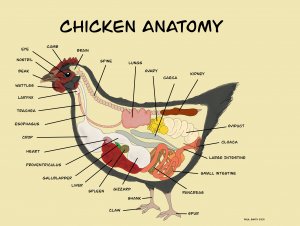
Anatomy of a Chicken on beige background
Anatomy of a Chicken Courtesy of Paul Smith

Egg Binding, a Common Chicken Ailment

Egg binding is another common issue that can affect hens. Symptoms may include

  • Loss of appetite
  • Disinterest in drinking
  • Decreased activity
  • Shaky wings
  • Walking like a penguin
  • Abdominal straining
  • Uncharacteristic sitting
  • Passing wet droppings or none at all
  • Droopy, depressed, or pale comb and wattles
  • And presence of an egg in the oviduct upon an examination.

Being egg-bound simply means a hen has an egg stuck inside of her that she cannot pass. Or the hen is having difficulty laying the egg. There are different reasons this happens:

  • Lack of calcium, which is what puts the shell on the egg and helps the hen’s muscles contract and push the egg out
  • Obesity- a chicken that is obese can have a difficult time laying an egg, because her muscles are weaker and can’t contract as strongly as they should
  • Infection- sometimes a chicken will have an infection in their reproductive tract. They may have no symptoms at all, but it can still cause all kinds of issues, including muscle weakness
  • Malformed eggs- eggs that are very big or misshaped can be problematic for the hen as well
  • Stress- stressors such as a new coop or flock can cause problems for a hen
  • Premature laying- sometimes a hen that starts laying eggs too soon might get egg-bound, because they are too young

Treating an Egg-Bound Hen

How do you treat an egg-bound hen?

  • First, make certain there’s an egg by inserting a gloved finger (coated w/Vaseline) into the suspected hen’s vent to a depth of 2 inches. If you can’t find an egg, there isn’t one.
  • However, if there is one, fill a tub with warm water, and add 1/2 cup of Epsom salt to every 1/2 gallon of water.
  • Then immerse the hen gently into the water till her abdomen and vent area are soaking. You must be careful, because you don’t want the egg to break; that would be another issue entirely.
  • And keep the hen in the tub for 20 minutes at least before removing her and drying her off.

Keep her separated from the other birds to hopefully encourage laying the egg; you can also lubricate her vent with Vaseline to help the egg slip out. If after her first bath she hasn’t laid the egg in a couple of hours, repeat the bath. In the event you still no have no success after 3 or 4 baths, you might need to contact your veterinarian. If you can feel the egg, you might be able to remove it in pieces, although it’s not generally recommended, because it can lead to injury and infection.

You can try to prevent egg binding by managing your flock’s diet, giving them the appropriate feed. A chicken feed with 16% protein should contain all that your flock needs, including calcium. However oyster shell should also be available. Controlling worms is another prevention method, as is making sure you have enough nesting boxes. Reduce stress by eliminating or minimizing changes in coops or flock mates. Decrease premature laying caused by added lights to the chicken coop, by monitoring light exposure until pullets reach maturity around 20 weeks.

There isn’t a whole lot to be done about large and misshapen eggs. Sometimes it’s just a one-time thing. Though, if it becomes habitual that the hen routinely lays large eggs, she needs to be monitored for vent prolapse, which will need to be treated quickly.

headshot of a Rhode Island Red hen on some straw
Rhode Island Red hen we thought had gapeworm

The Bird Parasite Gapeworm

Gapeworm is another problem your birds might come into contact with. It causes respiratory problems in chickens. But what is gapeworm? It’s a parasitic nematode that infects the tracheas of domestic and wild birds worldwide. If your chicken is infected with gapeworm, they will gape. Or they will stretch their necks out to adjust their crops and shake their heads. They also cough, all in an attempt to dislodge the parasites.

Treating Gapeworm

I have read where you could swab your birds throat to know if they have gapeworm. The worms will appear as thin red strings. If your bird is infected with gapeworm, they need a de-wormer like Ivermectin. Although, you can prevent gapeworm by keeping the environment clean and dust-free. You also need to till the soil in the run at the end of the growing season, which is supposed to reduce residual infection. And keep up with the worming schedule.

If your birds are stretching their necks, it doesn’t necessarily mean anything. Chickens will stretch their necks out to adjust their crops; I’ve seen my birds adjust theirs after they’ve been eating a lot of food. Are they coughing and gasping? Has their egg production decreased?

Sketch of a Chicken Mite Courtesy of Paul Smith

Mites, Lice, Ticks and Other Worms

Your birds might get infested with either mites, lice, or worms. Or other critters not specifically mentioned. Anything parasitic is bothersome to chickens and could even be deadly. And the treatments and preventions are different.

If your flock has a problem with mites or lice, generally

  • They won’t lay as many eggs
  • Their combs and wattles will be pale
  • And they can get anemic
  • Additionally, the problem can even cause feather loss, mostly on the back. That’s since the hen will over-preen and possibly pluck her own feathers just to get relief.

Mites and lice can be treated and prevented pretty much the same way, although ticks need a different method. Our birds have had mites, and the natural method is diatomaceous earth, which is supposed to be a cure-all for everything for poultry. But we haven’t had great success with it. I think the first time our chickens were free of mites was when we applied Ivermectin one spring. It is recommended to treat the birds topically for lice and mites. But for ticks, the recommendation is to treat their coop and surrounding area.

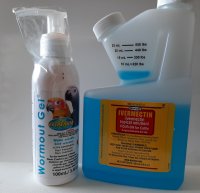
dewormers for chickens

De-wormers as a Treatment for Worms

There are mixed reviews for natural de-wormers out there. A lot of people recommend using apple cider vinegar and garlic. There are probably more natural ingredients than those that could be used. And I’ve used apple cider vinegar and garlic since having chickens. However, one spring our birds all got the yucky anyway (not gapeworm). We had to administer Ivermectin after I ordered Wormout gel from Australia. It was going to take several weeks to arrive, and I was impatient to treat my birds. With Ivermectin you just apply the treatment topically, while Wormout gel is added to their water. (Though I didn’t dose my chickens with the other when it arrived.)

I have read many reviews and spoken to fellow chicken owners who have tried the natural methods as well. Birds, just like any other animal, just like you and me, will still get ill no matter our efforts. Sometimes we have to take the stronger stuff. I continue to put ACV in their water once a month; (1 TBSP per 1 gallon each day for 1 week X once a month. Since we have ducks, I add Brewer’s yeast, which has the garlic in it. So I don’t have to add any extra.

Either Ivermectin applied topically (0.2 – 0.4 mg per kg topically at their shoulders where they can’t reach, and once more in 2 weeks,) or Wormout gel added to their water (2 pumps of the gel per 1 1/3 cup of water) are the best options if there is an infestation; remember you shouldn’t eat or sell any of the eggs from your flock till the treatment is ended. Ivermectin dosing is 2 times in one month, so you can’t eat the eggs for 2 weeks each dosage. And since Wormout gel dosage is just once in their water, you only go 2 weeks refraining from eating and selling the eggs. After that, start a monthly preventative of 1 TBSP ACV per 1 gallon of water daily for 1 week with garlic sprinkled in their food.

Mixed Backyard Flock at Backdoor of House
Our boss hen Fives, the Silver-Laced Wyandotte, close to the front.

Bird Flu, A Common Backyard Menace

Avian flu, or more commonly bird flu, is a chicken illness that is often heard of at least yearly. Symptoms include

  • A general decrease in roaming and activity
  • Cyanosis or blueness in the head area
  • They won’t eat as much
  • In addition, there will be excessive flock huddling and ruffled feathers
  • They might have fluid in their combs and wattles
  • Also, there will also be a decrease in egg production and coughing
  • And their legs may bleed underneath the skin; and they may die suddenly.

How to Treat Bird Flu

You might not completely prevent your birds from getting bird flu. However, there are things you can do to protect them. Don’t encourage wild birds from stopping by your yard by feeding them, and keep your feeders and waterers clean. Bird flu, just like other bird illnesses, can spread by wild birds.

  • Clean out the coop on a regular basis.
  • Have dedicated clothing and footwear you use when handling your birds.
  • Make sure not to wear this when anywhere else but around your own birds, especially when around other chickens. Bird flu can live on clothes that have been contaminated by an unhealthy flock for up to two months.
  • Pick up feed spillages to avoid attracting wild birds.
  • Also, don’t borrow or use equipment from other people who own chickens.
  • And clean your own equipment with which you used to transport your birds or clean out their coops.
  • Monitor your flock’s behavior, appearance, and appetite.

Avian flu is highly contagious and deadly to birds and humans. Although, there are vaccines for people. Failing that, if bird flu is still contracted, antivirals can be administered within 2 days. The only recommendations there are for birds who catch this disease are euthanizing the whole flock, appropriate disposal of the carcasses, and sanitizing the coop.

Sketch of Chickens with Marek's Disease Courtesy of Hannah Smith
This is a sketch of Marek’s Disease.

Marek’s Disease, Another Common Chicken Illness

Another illness in backyard birds is Marek’s disease. Symptoms of this are paralysis of legs, wings, and neck, loss of weight, grey iris or irregular pupil, and vision impairment. It is one of the most common illnesses in small flocks and not treatable once the clinical signs have started. However, it is preventable.

Marek’s is caused by a chicken herpes virus, but it won’t make people sick. Once an animal becomes infected, it will remain infected. Though, not all animals will become sick if infected. Birds become infected by inhaling virus-laden dander. And while the virus is easily killed in its pure form, the virus itself can live for years in the dander. That means that once the disease enters a coop, it can live for a very long time, years, even if the birds are all gone. The only way to prevent this disease is to vaccinate day-old chicks before they’re exposed to the virus.

Unfortunately not all hatcheries will vaccinate their chicks; the vaccine itself is tricky and has to be used within very specified conditions for it to be effective.

Black Ameraucana hen that died with vitamin deficiency
Our trio of Black Ameraucana’s. Shockwave is the one closest to the front.

Vitamin Deficiency

Vitamin deficiency is something to note here, because it can mimic Marek’s disease. A few years ago, we think Megatron, our boss rooster, injured one of his hatchery-mates. He decided he wanted some ‘lovin’, and he was not very coordinated when it came to mating when he first started out. Thus, he injured his hatchery-mate, Shockwave. We noticed she stopped using one of her wings. Eventually she stopped competing for food; I think because she was afraid of getting hurt further by the other birds. She’d hang back until there was less competition.

At the time we didn’t realize what was going on. We knew she was hurt, and we surmised it was due to Megs. But we didn’t realize she was waiting on food, because she was always there when food was being dished out. Over the course of a couple of weeks she started to get weaker, until she was no longer walking.

Sketch of Hen with Vitamin Deficiency Courtesy of Hannah Smith
This is a sketch of our hen Shockwave with vitamin deficiency, but I’ve seen many more photos of birds that look a lot worse.

We thought it was Marek’s due to the paralysis; Hannah, then 18 years old, was convinced. But I’d remind her that Shockwave was injured originally. Marek’s didn’t make sense or fit. Something was missing. So I continued researching the matter until I came across vitamin deficiencies that mimic Marek’s. I purchased Poly-Vi-Sol infant liquid multivitamin and immediately started administering it to Shockwave. Unfortunately it was too little too late; she died the following day.

I felt horrible, because I thought I knew what was going on in my flock, and yet, she died. I felt it was completely preventable. My point in sharing this story with you is that Newcastle Disease and Marek’s Disease mimic vitamin deficiency in the presentation of paralysis. Therefore, it’s vitally important to look at all of the signs. If we had acted sooner we could have saved our hen.

Newcastle disease

Newcastle Disease is another respiratory illness in chickens which causes breathing problems, discharge from nares (nostrils on a chicken). If your bird is infected with Newcastle disease, their eyes will look murky, egg laying will begin to wane, and wings can become paralyzed as well as their necks becoming twisted.

Sketch of Chickens with Newcastle Disease Courtesy of Hannah Smith

This disease is also carried by wild birds. And just like bird flu, it can remain on your clothing and be passed to your flock. Although most older birds will recover, younger birds are at an increased risk from dying from it. Even though there are vaccines available to prevent this disease, there is no treatment for it except antibiotics for secondary infections and supplements. Also, like bird flu, Newcastle disease can be spread to people, though it isn’t deadly. It produces either no symptoms at all, mild flu-like symptoms, or conjunctivitis or pink eye.

All of the sketches in the post courtesy of Hannah Smith.